~sociolingo
Tue, May 2, 2000 (03:09)
#101
I found a Bambara (Mali) creation story in a book of published stories I have. Trouble is the gloss is in French, so i shall have to translate it. If i write it up, I'll get it checked by autumn and then post it. It's very different to the others we've seen.
~MarciaH
Tue, May 2, 2000 (12:31)
#102
Can't wait! The Dogon was the most "far out" one I have heard of so far. Their ancestors came from a planet circling Sirius b...
~sociolingo
Tue, May 2, 2000 (14:30)
#103
From what i can make out so far without a dictionary, this one is a chicken and egg story! I do my best!!!!! *big grin*
~MarciaH
Tue, May 2, 2000 (14:59)
#104
Curious to know which came first, we wait with as much patience as we can muster.
~ommin
Fri, May 5, 2000 (07:13)
#105
I really is an imponderable - either God is or............
~MarciaH
Fri, May 5, 2000 (14:51)
#106
Yes! I am interested in the take on it from this other culture's traditions.
~MarciaH
Fri, May 5, 2000 (14:53)
#107
Anne, God would figure in it in any case. HE could have created either one and let it go from there, is that not so?!
~sociolingo
Thu, May 11, 2000 (14:20)
#108
Ok, here's my translation of the story I promised. It's a fairly literal translation, someone else could probably do better. I've written it out like it appeared in the original. The epithet 'a little tale, a little tale' and the end one 'I have left this small tale where I found it' appear frequently in oral stories (we have something similar in Mandinka stories).
A Bambara creation story from Mali
A little tale. A little tale
The egg and the chick went to pick lemons.
The chick said to the egg, �Climb up the lemon tree and pick the lemons�.
The egg responded that he couldn�t climb.
The chick climbed and shook the lemon tree.
The lemons fell.
They ate them.
The egg in his turn climbed, telling the chick to collect the dust and spread it out under him, so that if he fell he would not break.
The chick collected the dust and spread it under the tree, but a small stone was hidden in the dust.
The egg shook the tree and fell on the small stone, splat! And he broke himself.
And the chick laughed, and laughed and laughed.
But a branch cut off the chick�s head.
And the branch laughed, and laughed and laughed.
The fire burnt the branch.
And the fire laughed, and laughed and laughed.
The water extinguished the fire.
And the water laughed, and laughed and laughed.
The earth absorbed the water.
And the earth laughed, and laughed and laughed.
The earth and God quarrelled.
God picked up the earth and dropped it.
It is since that day that the earth is in her place.
I have left this small tale where I found it.
(Gorog-karady, V. and Meyer, G. 1985, Contes bambara, Mali et Senegal oriental, Conseil International de la langue francaise)
(translated from the French by Maggie Canvin)
~MarciaH
Thu, May 11, 2000 (15:40)
#109
DNA research links genes of Jews, Palestinians
Associated Press
JERUSALEM - Tradition says the biblical patriarch Abraham
fathered both the Jewish and Arab nations.
Now, new DNA-based research reveals a genetic link between
Jews and Palestinians, suggesting the two peoples, locked in a
bitter struggle for more than a century, indeed share a common
ancestry dating back 4,000 years.
The study, published Tuesday in The Proceedings of the National
Academy of Sciences in Washington, D.C., says the Y
chromosome found in Jewish men may go back to a common
pool of Middle Eastern ancestors.
After the first major Jewish exile of 586 B.C., when Jews
dispersed across Europe and North Africa, Jews largely retained
their genetic identity, one that was formed in the Middle East,
according to the study, led by Michael Hammer of the University
of Arizona.
Even after centuries of exile, Diaspora Jews remained closer to
each other and more similar to Palestinians, Syrians and
Lebanese in terms of shared Y chromosome characteristics than
to people in their host countries, the study says.
"Eventually people will realize that they are not that different," said
Batsheva Bonne-Tamir, a geneticist from Tel Aviv University who
participated in the study.
Still, she cautioned that the techniques were new and that until the
human genome is mapped, it will be difficult to be certain about
the conclusions.
The study compared the male, or Y, chromosome, which is
passed from father to son, in 1,371 males from seven groups of
Israeli Jews of various origins and 16 non-Jewish groups in the
Middle East, Africa and Europe.
Mr. Hammer identified 19 variations of the Y chromosome,
including eight lineages found to varying degrees among Jews
and Arabs.
Based on this measure, the study found that despite the many
centuries their ancestors had spent in exile in different parts of the
world, the Israeli Jews in the sample had the closest genetic links.
Next in genetic affinity to Jews were Palestinians and Syrians,
followed by Saudi Arabians, Lebanese and Druse, a Middle
Eastern sect that practices a secret form of Islam.
According to the research, in one of the lineage branches, the
variation in the Y chromosome between Jews and Palestinians
differed by only 1 percent, compared with a difference of 5
percent between Jews and Europeans.
A low rate of intermarriage between Diaspora Jews and gentiles
was a key reason for the continuity, Ms. Bonne-Tamir said. For
example, since Jews first settled in Europe 80 generations ago,
the intermarriage rate was estimated to be only about 0.5 percent
in each generation.
Hebrew University geneticist Howard Cedar said even though Y
chromosomes are considered the best tool for tracing genetic
heritage, researchers still don't know what the history is behind
the variations. As a result, it is difficult to draw conclusions about
genetic affinity.
"The problem is in the interpretation," Mr. Cedar said. "It's very
difficult to reconstruct the histories of these events; it's difficult to
interpret."
Ms. Bonne-Tamir, who heads the National Laboratory for the
Genetics of Israeli Populations, said that until recently, such
research on genetic affinity was limited to classical markers, such
as blood groups and enzymes.
The genetic link between Jews and Arabs suggested by the study
is reflected in the biblical account in Genesis of how Abraham
fathered two sons: Ishmael by his wife's maid Hagar, and then,
when Sarah was able to conceive, Isaac. Although Muslims give
a different version of the story, they revere Abraham and Ishmael
or Ibrahim and Ismail, - just as Jews do Abraham and Isaac.
~ommin
Mon, May 15, 2000 (06:44)
#110
Now as a Christian I never had any doubts about it; but it is most interesting to have it proved! I have visited Israel twice met Arabs and Jews in Jerusalem, Bethlehem and Nazareth, spoke with some length to both Arab and Jew and never had any doubt to their kinship! Yusef our driver and Ahouva our guide in our tour were most interesting. Yusef was a Christian Palestinian and Ahouva a Major in the Israeli army - an interesting combination but it worked when they were prepared to work together. Its politicians as usual that mess everything up. What is your opinion?
~MarciaH
Mon, May 15, 2000 (12:23)
#111
Agree with you entirely - no doubts whatsoever!
~MarciaH
Tue, May 16, 2000 (16:09)
#112
In the beginning, the Cherokee believed that the earth was
covered with water and that beavers came from the sky to drag
the mud from the oceans bottom and bring it to the top. The
beavers attached it to the sky and created the land. The
"great buzzard" then flew to the ground where he flapped his
wings and the valleys and mountains were formed. It was on
one of these flights that the "great buzzard" created the
land on which the Cherokees lived.
~sociolingo
Tue, May 16, 2000 (17:32)
#113
Where did that come from ? (i.e. where did you find it?)
~MarciaH
Tue, May 16, 2000 (17:36)
#114
I got it in "forgotten news" - the rest of that story is posted in
History conference topic 6
~MarciaH
Tue, May 16, 2000 (17:56)
#115
In Honor of John, who is part Cherokee, I present the following:
Yellowstone Valley and the Great Flood
"I have heard it told on the Cheyenne Reservation in Montana and the Seminole camps in the Florida
Everglades, I have heard it from the Eskimos north of the Arctic Circle and the Indians south of the equator.
The legend of the flood is the most universal of all legends. It is told in Asia, Africa, and Europe, in North
America and the South Pacific." Professor Hap Gilliland of Eastern Montana College was the first to record
this legend of the great flood.
This is one of the fifteen legends of the flood that he himself recorded in various parts of the world:
He was an old Indian. his face was weather beaten, but his eyes were still bright. I never knew what tribe he
was from, though I could guess. Yet others from the tribe whom I talked to later had never heard his story.
We had been talking of the visions of the young men. He sat for a long time, looking out across the
Yellowstone Valley through the pouring rain, before he spoke. "They are beginning to come back," he said.
"Who is coming back?" I asked.
"The animals," he said. "It has happened before."
"Tell me about it.'
He thought for a long while before he lifted his hands and his eyes. "The Great Spirit smiled on this land when
he made it. There were mountains and plains, forests and grasslands. There were animals of many
kinds--and men."
The old man's hands moved smoothly, telling the story more clearly than his voice.
The Great Spirit told the people, "These animals are your brothers. Share the land with them. They will give
you food and clothing. Live with them and protect them.
"Protect especially the buffalo, for the buffalo will give you food and shelter. The hide of the buffalo will keep
you from the cold, from the heat, and from the rain. As long as you have the buffalo, you will never need to
suffer."
For many winters the people lived at peace with the animals and with the land. When they killed a buffalo,
they thanked the Great Spirit, and they used every part of the buffalo. It took care of every need.
Then other people came. They did not think of the animals as brothers. They killed, even when they did not
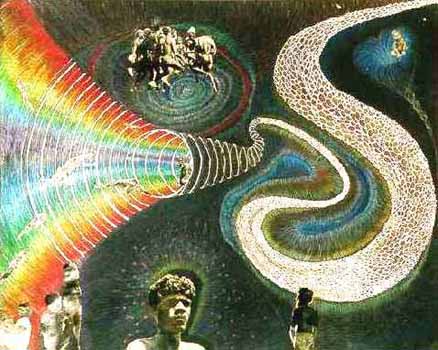
need food. They burned and cut the forests, and the animals died. They shot the buffalo and called it sport.
They killed the fish in the streams.
When the Great Spirit looked down, he was sad. He let the smoke of the fires lie in the valleys. The people
coughed and choked. But still they burned and they killed.
So the Great Spirit sent rains to put out the fires and to destroy the people.
The rains feil, and the waters rose. The people moved from the flooded valleys to the higher land.
Spotted Bear, the medicine man, gathered together his people. He said to them, "The Great Spirit has told
us that as long as we have the buffalo we will be safe from heat and cold and rain. But there are no longer any
buffalo. Unless we can find buffalo and live at peace with nature, we will all die."
Still the rains fell, and the waters rose. The people moved from the flooded plains to the hills.
The young men went out and hunted for the buffalo. As they went they put out the fires. They made friends with
the animals once more. They cleaned out the streams.
Still the rains fell, and the waters rose. The people moved from the flooded hills to the mountains.
Two young men came to Spotted Bear. "We have found the buffalo," they said. "There was a cow, a calf, and
a great white bull. The cow and the calf climbed up to the safety of the mountains. They should be back when
the rain stops. But the bank gave way, and the bull was swept away by the floodwaters. We followed and got
him to shore, but he had drowned. We have brought you his hide."
They unfolded a huge white buffalo skin.
Spotted Bear took the white buffalo hide. "Many people have been drowned," he said. "Our food has been
carried away. But our young people are no longer destroying the world that was created for them. They have
found the white buffalo. It will save those who are left."
Still the rains fell, and the waters rose. The people moved from the flooded mountains to the highest peaks.
Spotted Bear spread the white buffalo skin on the ground. He and the other medicine men scraped it and
stretched it, and scraped it and stretched it.
Still the rains fell. Like all rawhide, the buffalo skin stretched when it was wet. Spotted Bear stretched it out
over the village. All the people who were left crowded under it.
As the rains fell, the medicine men stretched the buffalo skin across the mountains. Each day they stretched it
farther.
Then Spotted Bear tied one corner to the top of the Big Horn Mountains. That side, he fastened to the Pryors.
The next corner he tied to the Bear Tooth Mountains. Crossing the Yellowstone Valley, he tied one corner to
the Crazy Mountains, and the other to Signal Butte in the Bull Mountains.
The whole Yellowstone Valley was covered by the white buffalo skin. Though the rains still fell above, it did not
fall in the Yellowstone Valley.
The waters sank away. Animals from the outside moved into the valley, under the white buffalo skin. The
people shared the valley with them.
Still the rains fell above the buffalo skin. The skin stretched and began to sag.
Spotted Bear stood on the Bridger Mountains and raised the west end of the buffalo skin to catch the West
Wind. The West Wind rushed in and was caught under the buffalo skin. The wind lifted the skin until it formed
a great dome over the valley.
The Great Spirit saw that the people were living at peace with the earth. The rains stopped, and the sun
shone. As the sun shone on the white buffalo skin, it gleamed with colours of red and yellow and blue.
As the sun shone on the rawhide, it began to shrink. The ends of the dome shrank away until all that was left
was one great arch across the valley.
The old man's voice faded away; but his hands said "Look," and his arms moved toward the valley.
The rain had stopped and a rainbow arched across the Yellowstone Valley. A buffalo calf and its mother
grazed beneath it.
~MarciaH
Tue, May 16, 2000 (18:04)
#116
Why the Opussum's Tail Is Bare (Cherokee)
In the beginning all living things - men, animals, plants and trees - spoke the same language and behaved in
much the same way. Animals, like people, were organized into tribes. They had chiefs, lived in houses, held
councils and ceremonies.
Many animals had characteristics which we would not recognize today. The rabbit, for example, was fierce,
bold and cunning, and a great mischief maker. It was through Rabbit's tricks that the deer lost his sharp
wolf-like teeth, the buzzard his handsome topknot of feathers and the opossum his long, bushy tail.
Opossum was very proud of his tail which, in those days, was covered with thick black fur. He spent long
hours cleaning and brushing it and composing songs about its beauty and vigour. Sometimes, when he
walked through the village, he carried his tail erect, like a banner rippling in the breeze. At other times, he
swept it low behind him, like a train. It was useful as well as beautiful, for when Opossum lay down to sleep,
he tucked it under him to make a soft bed, and in cold weather he folded it over his body to keep himself
warm.
Rabbit was very jealous of Opossum's tail. He, too, had once had a long bushy tail but, during the course of a
a fight with Bear, he had lost most of it and now had only a short fluffy tuft. The sight of Opossum strutting
before the other animals and swirling his tail ostentatiously, filled Rabbit with rage and he made up his mind
to play a trick on him at the first opportunity.
At this time, when the animals still lived harmoniously together, each had his appointed station and duty.
Thus, Frog was leader in the council and Rabbit, because of his speed, was employed to carry messages
and announcements to the others.
As was their custom from time to time, the animals decided to hold a great council to discuss important
matters and Rabbit, as usual, was given the task of arranging the gathering and delivering the invitations.
Councils were also occasions for feasting and dancing and Rabbit saw a way of bringing about Opossum's
downfall.
When Rabbit arrived with the news of the meeting, Opossum was sitting by the door of his lodge engaged in
his favourite occupation - grooming his tail.
'I come to call you to the great council tomorrow, brother Opossum,' said Rabbit. 'Will you attend and join in
the dance ?'
'Only if I am given a special seat,' replied the conceited Opossum, carefully smoothing some untidy hairs at
the tip of his tail. 'After all,' he went on, grinning maliciously at Rabbit, 'I have such a beautiful long tail that I
ought to sit where everyone can see and admire it.'
Rabbit was almost beside himself with fury, but he pretended not to notice the jibe and said, 'But of course,
brother Opossum! I will personally see to it that you have the best seat in the council lodge, and I will also
send someone to dress your tail specially for the dance.'
Opossum was delighted by this suggestion and Rabbit left him singing the praises of his tail even more
loudly than usual.
Next, Rabbit called on the cricket, whom Indians call the barber, because of his fame as an expert hair-cutter.
Cricket listened with growing amazement as Rabbit recounted his conversation with Opossum. Like all the
other animals, he found Opossum's vanity and arrogance very tiresome.
He began to protest, but Rabbit held up a paw and said, 'Wait a moment. I have a plan and I need your help.
Listen...', and he dropped his voice as he told Cricket what he wanted him to do.
Early next morning Cricket presented himself at Opossum's door and said that he had been sent by Rabbit to
prepare the famous tail for the council that evening. Opossum made himself comfortable on the floor and
stretched out his tail. Cricket began to comb it gently.
'I will wrap this red cord round your tail as I comb it,' he explained, 'so that it will remain smooth and neat for
the dance tonight.'
Opossum found Cricket's ministrations so soothing that he fell asleep, awakening just as Cricket was tying
the final knot in the red cord which now completely swathed his tail.
'I will keep it bound up until the very last moment,' thought Opossum gleefully. 'How envious the others will be
when I finally reveal it in all its beauty!'
That evening, his tail still tightly wrapped in the red cord, Opossum marched into the council lodge and was
led to his special seat by a strangely obsequious Rabbit.
Soon it was time for the dancing to take place. The drums and rattles began to sound. Opossum stood up,
loosened the cord from his tail and stepped proudly into the centre of the dance floor. He began to sing.
'Look at my beautiful tail!' he sang as he circled the floor. 'See how it sweeps the ground!'
There was a great shout from the audience and some of the animals began to applaud. 'How they admire
me!' though Opossum and he continued dancing and singing loudly. 'See how my tail gleams in the firelight!'
Again everyone shouted and cheered. Opossum began to have just the merest suspicion that all was not
quite as it should be. Was there possibly a hint of mockery in their voices ? He dismissed such an absurd
idea and continued dancing.
'My tail is stronger than the eagle's, more lustrous than the raven's!'
At this the animals shrieked so loudly that Opossum stopped in his tracks and looked at them. To his
astonishment and chagrin they were all convulsed with laughter, some leaning weakly on their neighbour's
shoulders, others rolling on the ground in their mirth. Several were pointing at his tail.
Bewildered, Opossum looked down and saw to his horror that his tail, his beautiful, thick, glossy tail, was now
balk and scaly like that of a lizard. Nothing remained of its former glory. While pretending to comb it, the wily
Cricket had snipped off every single lair.
Opossum was so overcome with shame and confusion that he could not utter a sound. Instead he rolled over
helplessly on his back, grimmacing with embarrasment, just as opossums still do today, when taken by
surprise.
~MarciaH
Tue, May 16, 2000 (18:11)
#117
http://www.nativenashville.com/History/first_woman.htm
The Legend of the First Woman (Cherokee) - As Told by Mary Ulmer Chiltoskey
For a time the man was very happy on earth. He roamed around and ate the fruits and berries
and he visited the animals and he saw all his homeland. There was much to learn and the
earth was beautiful. But before long the man grew discontented and he became very
unhappy. He didn't know what this disease was, bit it was a disease that we still have. He
was bored.
When he got bored, he used his mind and his strength differently. he shot arrows at the deer
without really needing to. He picked the plants and didn't use them. He tore up the animals'
dens just to see if he could do it. And soon the animals became concerned about the new
creature.
The animals called a council meeting to try to determine what to do. They said they thought
this creature was supposed to have respect for other creatures, that he was given a mind. A
little insect said, "Wait, you haven't thought this out. The Great One made him; let's ask him
what to do." This seemed to be a good idea. They called to the Great One to help them with
the new "superior" creature.
The owl said, "You told us the man has a mind and he is to respect us."
The deer said, "I don't want to be disrespectful, but you told us the man would need more of
us deer than any other animal. If he keeps killing us like he is now, very soon he won't have
any deer left."
"Oh," said the Great One, "thank you, thank you. I had not thought about something I left out
in this man."
The bear said, "Look at him right now. He's lying out in the sun with his face up. No animal
will sleep right out in the open. We all know to go into a private, guarded place to rest."
The Great One said, "Yes, there is something missing because I was in such a hurry to make
him. But I know what is missing."
"Stand back," he said. He made a green plant to grow up tall. The plant grew up right over
the man's heart, up toward Galunlati. It was a plant with long, graceful leaves and then an ear
and a golden tassel. Above the tall plant was a woman, a beautiful, tall, brown woman
growing from the stalk of strong corn.
The man woke up and thought he was dreaming. He rubbed his eyes and said, "This is not
true. In a minute I'll wake up and be just as bored as I was before. Oh, I am so lonely."
The Great One sort of kicked him in the behind. "Get up you lazy thing," the Great One said.
"Be a man for your lady" Now no one had any reason to think this man was a mannerly
individual. Recently he had certainly not been acting like a real gentleman. But we don't have
to be taught manners: We need someone to expect the best from us and we use the manners
the Great One has already given us. So the man got up, brushed himself off, and gallantly
offered his hand to the woman who came down from the stalk of corn.
The woman said, "No, wait a minute." The man didn't argue or huff. He just waited as she
asked. She reached up and pulled two good ears of corn to take with her. Then she said, "I'm
ready." Do you know why she wanted the corn? She couldn't have known yet that the corn
would be an important food. She just knew that she had sprung from the corn and she
needed to take something of her heritage with her.
The Great One remembered that although each man will sometimes need to be alone, each
man will also need companionship to be his best.
Over a period of time, the man and the woman built a home where they kept the corn for
planting. The next spring she planted her corn and it grew into a beautiful plant. It was
probably the next year that she noticed a large bird who became sacred to the Cherokee
because they could watch what he ate, and they would then know it was safe to eat.
One morning the woman noticed the turkey eating the tender corn. She knew then the corn
was food and it was time to eat the corn. That evening she set a pottery pot of corn in the
middle of her cook fire. She covered the pot with a curve of chestnut bark. When the man
came in to eat his fish stew, she didn't tell him what she had cooked. She just pulled an ear of
corn from the pot and pealed it back so he could smell it. he thought it was the best aroma he
had ever smelled and he began to eat the first corn of the spring.
Note: Cherokee women now never tell their men when they will serve the first corn of the
season. They believe if they say it, bad luck will happen. One year not long ago, Aunt Mary's
husband overheard her tell a visitor when they would have the first corn of the season.
Before the corn was good and ripe, wild hogs ate nearly all of it!
From Aunt Mary, Tell Me A Story - A Collection of Cherokee Legends and Tales as told by Mary Ulmer
Chiltoskey, edited and compiled by Mary Regina ulmer Galloway. Copyright 1990 Cherokee Communications,
P.O. Box 507, Cherokee North Carolina 28719 (704) 497-5510. ISBN 0-962863009.
~MarciaH
Tue, May 16, 2000 (18:45)
#118
Another version of the Cherokee Creation myth
http://www.cybercomm.net/~grandpa/cretion.html
Long, long ago, a great island floated in a giant ocean. This island hung from four thick ropes from the sky,
which was solid rock. There were no peoples and it was always dark. The animals could not see so they got
the sun and put it in a path that took it across the island from east to west each day. The animals and plants
were told by the Great Spirit to stay awake for seven days and seven nights but most could not and slept.
Those plants that did stay awake, such as the pine and cedar and those few others were rewarded by being
allowed to remain green all year. All the others were made to lose their leaves each winter. Those animals that
did stay awake, such as the owl and the mountain lion and those few others were rewarded with the ability to
go about in the dark. Then the people appeared. That is another story.
~Moon
Tue, May 16, 2000 (18:49)
#119
Interesting tales, Marcia. We have so many opossums here. We even caught one in our small attic. It made so much noise. We often have a trapper come by to set traps around the house. He takes them to the Everglades and releases them there. I do not like opossums at all.
My husband is friendly with the Shaman of the Miccousuki tribe here, who has Chief Oseola's tomahawk, the one which has cracked so many heads. My DH was allowed to hold it, not something the Shaman lets anyone do. My husband loved it.
~MarciaH
Tue, May 16, 2000 (18:56)
#120
Thanks for sharing that. Your DH must be greatly esteemed in the tribe and by the Shaman. How extraordinary to be allowed to hold such a sacred object. I am all chills thinking about it.
Did you see elsewhere that 42 newborn opossum babies would fit into a teaspoon?!
~sociolingo
Fri, Aug 25, 2000 (06:35)
#121
Another Malian creation story for you.
African creation stories are as varied and imaginative as elsewhere in the world. According to nearly all African mythologies, God first agreed to give man eternal life, but his message was perverted through the stupidity or malice of the messenger. Several hundred African variants of the myth of the perverted message are known.
http://africancultures.about.com/culture/africancultures/library/extras/myths/blcreation.htm
Fulani of Mali Creation Myth
http://africancultures.about.com/culture/africancultures/library/extras/myths/blfulani.htm
At the beginning there was a huge drop of milk.
Then Doondari came and created the stone.
Then the stone created iron;
And iron created fire;
And fire created water;
And water created air.
Then Doondari descended the second time.
And he took the five elements
And he shaped them into man.
But man was proud.
Then Doondari created blindness and blindness defeated man.
But when blindness became too proud,
Doondari created sleep, and sleep defeated blindness;
But when sleep became too proud,
Doondari created worry, and worry defeated sleep;
But when worry became too proud,
Doondari created death, and death defeated worry.
But when death became too proud,
Doondari descended for the third time.
And he came as Gueno, the eternal one,
And Gueno defeated death.
(Eng. trans. by Ulli Beier in The Origin of Life and Death, 1966)
~sociolingo
Fri, Sep 22, 2000 (13:18)
#122
More West African Creation myths:
http://www.fandm.edu/departments/Anthropology/Bastian/ANT269/cosmo.html
West African Cosmogony
Origin Myths of Mande, Yoruba, and Cameroon
The creation myths of Africans are as varied as the many cultures which inhabit the continent. Cosmogony mythologies play an important role in West African societies; they set up the framework of the social, political, and even economic structure of society.
I. Mande Creation Myth
The creation myth of Mande-speaking people of southern Mali is an example of what is called a "cosmic egg myth." As reflected in their culture, the creation myth has elements of an imperfect creation as a result of incest. Here, we present one of many versions of the creation myth as told to us by Professor Bastain in our AFS/ANT267 class.
In the beginning, there was only Mangala. Mangala is a singular, powerful being who is perceived to be a round, energetic presence. Within Mangala existed four divisions, which were symbolic of, among many things, the four days of the week (time), the four elements (matter), and the four directions (space). Mangala also contained two sets of dual gendered twins. Mangala was tired of keeping all of this matter inside, so the god removed it and compiled it into a seed. The seed was his creation of the world. The seed however did not hold together well and blew up. Mangala was disappointed with this and destroyed the world he created.
Mangala did not loose hope; the creator began again, this time with two sets of twin seeds. Mangala planted the seeds in an egg shaped womb where they gestated. Mangala continued to put more sets of twin seeds in the womb until he had 8 sets of seeds. In the womb, the gestating seeds transformed themselves into fish. The fish is considered a symbol of fertility in the Mande world. This time, Mangala's creation was successful. This is important, because it illustrates the idea of dual gendered twinship, an idea that permeates Mande culture.
Mangala tried to maintain this perfect creation, but chaos crept in; one of the male twins became ambitious and tried to escape from the egg. This chaotic character is called Pemba. He is a t trickster figure who symbolizes the mischievousness of humans. Pemba's first trick was to steal the a piece of the womb's placenta and throw it down. This action made the the earth. Pemba then tried to refertilize what was left of the womb, committing incest against his mother, the womb.
Mangala decided to sacrifice Pemba's brother Farro to save what was left of his creation. He castrated him and then killed in order to raise him from the dead. Mangala took what was left of the placenta and transformed it into the sun, thus associating Pemba with darkness and the night. Farro was transformed into a human being and was taught the language of creation by Mangala. Farro's knowledge of words is very powerful and the tool he used to defeat Pemba's mischief. Farro and his newly created twins came to Earth and got married (not to each other) and became the horonw. This is the basis for the foundation of exogamy in Mande.
Next, an unknown being named Sourakata arrived from the sky with the first sacred drum, hammer, and the sacrificed skull of Farro. Sourakata began to play on the drum and sung for the first rain to come. Sourakata is a magical being who can
control nature, and he taught Farro and his followers. He is the origin of the nyamakalaw.
As one can see from the origin myth, the horonw are the people of the earth. They were destined to become farmers and well-bred aristocracy. The nyamakalaw, on the other hand, were destined to be primal and mysterious. They understand nature and are able to use it to their benefit. These roles are exactly what we see in the horonw and nyamakalaw relations in Mande society today.
~sociolingo
Fri, Sep 22, 2000 (13:22)
#123
II. Yoruba Creation Myth
http://www.fandm.edu/departments/Anthropology/Bastian/ANT269/cosmo.html
This is just one example of how a cultures origin myths are embedded in the social framework. The Yoruba of what is now Nigeria also conduct their practices in accordance with their cosmogony.
The Yoruba creator is called Olurun or Olodumare and is often assisted by the lesser god, Obatala. In the beginning, there was only water and chaos. The supreme being sent Obatala or Orishanla down from the sky to create some land out of the chaos. He descended on a long chain (umbilical cord) and brought with him a rooster, some iron, and a palm kernel. First, he put the metal on the earth and the rooster on top of that. The rooster scratched the metal and spread it out to create land. Then he planted the palm seed and from it grew the earth's vegetation. Olurun named earth "Ife" and the first city "Ile-Ife." Orshilana created humans out of the earth and got Olurun to blow life into them.
~MarciaH
Sat, Mar 9, 2002 (19:24)
#124
Greek Superstition: The Evil Eye
This is by far the most famous of all Greek superstitions with very old roots in Hellenic culture from the time of
paganism. Paintings of Greek triremes over two thousand years ago have an eye painted at the front of the
trireme in an attempt to ward off the Evil Eye. The Evil Eye is known widely throughout Greece and the Greek
Islands. The Evil Eye is said to be able to strike anywhere without notice and no one can be the wiser.
Think back to a time when someone complemented you on how nice you looked only for you to have a painful
headache immediately after. Happenings such as this are attributed to the Evil Eye.
To ward off the Evil Eye several things can be done. An eye is painted into the middle of a blue charm, this
charm is then worn as a necklace or as a bracelet. Blue beads can also be worn instead of the eye charm in the
form of a necklace or bracelet. The reason the color blue and the painted eye are used is that both are thought
to ward off the evil of the eye. Unfortunately people who have blue eyes are thought to be exceptional givers
of it. In such, believers of the Evil Eye are weary of compliments received from a blue eyed person.
It is also said that a clove of garlic has the ability to ward of the evil eye. Many people keep the clove of garlic
in their clothes or in their pockets.
It is customary for Greeks to spit towards someone if they pay them a compliment. Sometimes they will spit
three times, a symbolism of the using of the Holy Trinity to defend against the eye. This custom of spitting
has its roots in the Evil Eye. The spitting is an attempt to ward of the evil of the eye.
The Greek Orthodox Church also believes in the evil eye, and they refer to it as "Vaskania". There are people
who are said to know how to remove the eye from someone who is affected. The Greek Orthodox church
strictly forbids this. The church sees this as dangerous ground, and only a priest has the power to read a
person in an attempt to remove the eye. However, Greeks openly practice the removing off the eye against the
wishes of the Church. The church fears that attempts to remove the eye can result in possession. Believers of
the evil eye should understand that the person who is attempting to remove the eye should be using the
method that the church uses, and not some custom that has been passed down generation to generation.
Many of the readings that are passed down have their roots in paganism and do not adhere to Orthodoxy, the
church attempts to guard against these readings.
http://www.greekspider.com/superstitions/greek_superstitions9.htm
*You don't have to tell me about Blue Eyes being evil - HM has blue eyes, Wolfie!
~tsatsvol
Sun, Mar 10, 2002 (02:25)
#125
How much old belief is the Evil Eye?
Particular folklore importance presents the Evil Eye in ancient Greece because exist written reports on this.
Sokrates say: �Do not say big word, in order cannot the Evil Eye destroy the future word � (Platon. �Phaedon� 95b). (�� ���� ����, �� ��� �������� ��������� ��� ����� ��� �������� (������: �������� 95»).
Demosthenes, denounces many times and with big insistence the Evil Eye that causes infelicity and failure of efforts.
Stravon (63 - 25 BC.) it reports that according to Artemidoros, the historiographer Timeos the Tauromeneas was ill-wisher person who it can cause Evil Eye.
Ploutarchos, mentioned in his �Symposiaka� a discussion about those that have the faculty to cause Evil Eye. He also reports the case of self-Evil Eye.
Philarhos, Greek historiographer reports that certain populations, that live near the Black Sea, they causes even the death in children but also in men with their look only.
John
~wolf
Sun, Mar 10, 2002 (13:26)
#126
my son has blue eyes (well, blue-hazel)! now the evil eye is different from the eye at the top of the pyramid, right?
~MarciaH
Sun, Mar 10, 2002 (21:02)
#127
Oh Wolfie, I hope the eye at the top of the pyramid is different - it is supposedly the all-seeing eye of GOD.
The Celts and all early societies had some sort of idea of evil eye. That is why we cross our fingers for "goood luck" Thank you, John! I find that the more we diverge from one another on the surface (languages and appearances)the more truly one universal human kind we truly are. I embrace all that is sentive nature in each of us. How wonderful is the continuance of knowledge and lore. I wonder how many other cultures shared this evil eye dread. I suspect many, if not all!
~MarciaH
Sun, Mar 10, 2002 (21:05)
#128
So, I looked it up...
http://www.discovery.com/area/skinnyon/skinnyon970425/skinny1.html
True terror resides in the eye.
It has always been this way, or at least as close
to always as we can tell. The theme of the Evil
Eye runs deep and wide in human history.
Universally it describes a look inspired by
maliciousness or jealousy. Also universally it is
blamed for causing everything from
garden-variety bad luck to toothaches,
headaches, disease and death. An envious Evil
Eye falling on your pigs may presage an
impending sausage shortage. And to this day in
Turkey, many parents keep new babies under
wraps for 40 days, for fear that their defenseless
beauty will inspire a jealous glance.
Many Turks still use blue-glass "eye" brooches
to ward off the gruesome gaze. "Silly them,"
you say, but you may be wearing an Evil Eye
charm, too. Here's a partial list of items whose
roots may be anti-ophthalmological:
Lockets
One old European Evil Eye defense was to
write spells or prayers on a piece of paper, and
stuff it in a little container to wear on your body.
Colonial Americans were partial to heart-shaped
containers.
Battle decorations
Warriors believed that distracting and
flashy decor on helmets and shields would derail
the enemy's perilous peepers.
Eye make-up
Indian women drew black lines around
their eyes not only to shield themselves from the
Evil Eye, but also to ensure that they didn't
accidentally inflict the Evil Eye on their friends.
Harness gew-gaws
Livestock, which incited envy in days of
yore just as surely as do Mercedes and Porsches
today, were equally vulnerable to the Evil Eye.
Baubles and red yarn distracted the green-eyed
gaze. (Jealousy is said to be green-eyed;
likewise, blue and green eyes are often
suspected of being the evil ones.)
Animal brooches and charms
Animals with unusual eyes -- foxes,
grasshoppers, snakes, fish, snails, toads -- were
often accused of wielding the Evil Eye. But,
perversely, their images, worn on the body,
evolved into protections against it.
Why the eye?
.
"Staring is a way of asserting one's dominance
and of expressing interest in another person,"
says Ohio State University psychologist Gerald
Winer. "It can be viewed as an intrusion. And
it's a short step from casting a glance to casting
a spell."
Winer's research has shown that many children
-- and even college students -- believe some
type of emanation from the eye facilitates the
process of seeing, a belief that mirrors ancient
theory. Furthermore he speculates that the act
of looking, which is more obviously focused
than the act of, say, listening, makes it seem
more invasive. These aspects of looking, plus all
that emotional "window of the soul" stuff.
more on the link above
~CherylB
Thu, Mar 14, 2002 (19:14)
#129
Very interesting. One thing I know about eyes is that you shouldn't look directly into a dog's eyes. The dog will percieve it as a challenge and dogs are territorial. If it's your very own pet dog, you probably can look him or her directly in the eyes.
~MarciaH
Thu, Mar 14, 2002 (20:18)
#130
I've also heard about the looking directly into the eyes of a dog not your own. It IS taken as a challenge, I understand. Never worry about that. Eye-level dogs I tend to avoid. I was traumatized as a very small child by a dog licking my face. I don't need that to happen again. He was tasting me to see if I was worth the effort of eating me? I don't even want to think about it. But I can still remember it was a German Shepherd!
~wolf
Fri, Mar 15, 2002 (17:59)
#131
*laugh* poor marcia, i can see how you took it that way!! german shepherds by nature invoke awe and respect.
it is true that upon coming upon a strange dog, avert your eyes (we had this discussion in springark). my dogs are funny when i stare them in the eye--they'll wink at me or think it's play time!!
~MarciaH
Fri, Mar 15, 2002 (18:38)
#132
Is THAT the reason our little furball winks one eye at us? This little dog who has adopted me stares holes in you if you don't look back. If you hold her, she looks up with her head upside down - she is slightly exopthamic anyway. Big liquid brown eyes - how can I NOT look at her?! If she wants to end the stare, she turns around and prances back out of the room, or buries her head on her paws and pretends to sleep.
~tsatsvol
Mon, Mar 18, 2002 (12:21)
#133
The Muses from Greek Mythology
Athena visits Apollo and the Muses
Bartholomeus Spranger (XVI cent.)
The Muses are the Greek goddesses who preside over the arts and sciences and inspire those who excel at these pursuits. Daughters of Zeus, king of the gods, and Mnemosyne ("memory"), they were born at Pieria at the foot of Mount Olympus. Their nurse, Eupheme, raised them along with her son, Crotus the hunter, who was transported into the sky as Sagittarius upon his death. Their name (akin to the Latin mens and English mind) denotes 'memory' or 'a reminder', since in the earliet times poets, having no books to read from, relied on their memories. The Romans identified the Muses with certain obscure Italian water-goddesses, the Camenae.
The original number of muses and their names varies in earlier times as their evolution blossomed in Greek mythology. At first, three muses were worshipped on Mount Helicon in Boeotia: Melete ("meditation"), Mneme ("memory"), and Aoede ("song"). Another three were worshipped at Delphi and their names represented the names of the strings of a lyre: Nete, Mese, and Hypate. Several other versions were worshipped until the Greeks finally established the nine muses in mythology as: Calliope, Clio, Erato, Euterpe, Melpomene, Polyhymnia, Terpsichore, Thalia, and Urania. The Muses had several epithets, which usually referred to places where they had settled.
Ephialtes and Otus, who also founded Ascra, were the first to sacrifice on Helicon to the Muses and to call the mountain sacred to the Muses. Sacrifices to the Muses consisted of libations of water, milk, or honey.
Their companions are the Charities, the Horae, Eros, Dionysus, Apollo, Aphrodite, Harmonia, and Himerus (Desire). Apollo is the leader of the choir of the Muses and consequently he has the surname Musagetes. Athena caught and tamed the winged horse Pegasus and gave him to the Muses. Some of their disciples included the Sphinx who learned her riddle from the Muses, Aristaeus, who learned the arts of healing and prophecy from them, and Echo, who was taught by them to play music.
In Plato's Phaedrus 259c, Socrates says the locusts used to be men before the birth of the Muses. When song appeared when the Muses were born, some men were so overcome with delight that they sang constantly, forgetting to eat and drink until they eventually died. These dead men became locusts with a gift from the Muses allowing them to sing continuously from their birth until death without the need of sustenance. When they die, the locust go to the Muses and report which men on earth honors each, endearing a worshipper to the Muse he follows.
The Muses could be vindictive like in the story of the contest with Thamyris. Thamyris who excelled in minstrelsy challenged the Muses to a musical contest at Dorium in Messenia, the agreement being if he won he would take pleasure from all of them. The Muses won the contest, and bereft Thamyris of his eyes and minstrelsy.
In another story, the king of Emathia (Macedonia) and his wife Euippe had nine daughters and named them after the Muses. The daughters entered a contest with the Muses, were defeated and were metamorphosed by the Muses into birds called Colymbas, Iynx, Cenchris, Cissa, Chloris, Acalanthis, Nessa, Pipo, and Dracontis. These names were taken from actual names of birds such as the wryneck, hawk, jay, duck, goldfinch, and four others with no recognizable modern equivalents.
In yet another myth, it was said Hera, queen of the gods, persuaded the Sirens, who were described in early Greek mythology as having the bodies of birds and heads of beautiful women, to enter a singing contest with the Muses. The Muses won the competition and then plucked out all of the Sirens' feathers and made crowns out of them.
Many places were dedicated to the Muses such as the famous Valley of the Muses - Thespies on the eastern slopes of Mt. Helikon began it's "Mouseai" festivals in the 6th c. B.C. It was organized every 5 years by the Thespians. Poets and musicians from all over Greece also participated in various games (epic, poetry, rapsodia, kithara, aulos, satyric poetry, tragedy and comedy). It was common for ancient schools to have a shrine to the Muses called mouseion, the source of the modern word 'museum.' The famous Museum of Alexandria, founded by Ptolemy I, was a temple dedicated to the Muses. Before poets or storytellers recited their work, it was customary for them to invoke the inspiration and protection of the Muses.
http://www.eliki.com/portals/fantasy/circle/define.html
John
~tsatsvol
Mon, Mar 18, 2002 (12:43)
#134
Find your "MUSA" in the above site. Everything had their face in the ancient Greece.
John
~MarciaH
Mon, Mar 18, 2002 (13:08)
#135
Warmest thoughts to you, and Geo's greatest sympathies on the death of your Uncle. He lived 94 years. May you live even longer and in great health and happiness.
I'll go back through this topic looking for my "MUSA" (Muse in English) I suspect he is far away in the midst of great antiquites and his children this week.
~MarciaH
Mon, Mar 18, 2002 (13:31)
#136
The Painting is beautiful. The mythology surrounding the MUSAE (is that the plural in Greek - I think it is probably Latin) is fascinating and I had forgotten much of it. Athena needs some clothing. I guess when one is born fully grown from the mind of your father, all you need is Helmet and shield. Interesting about the "Halo" depiction which, I am assuming, denotes Athena's place in the Pantheon. And, you thought it was invented for Christian art!
I have at least nine muses, and far more humans who inspire the best in me. The arts at which I do not excel, I appreciate - which is most of them. I figure that someone has to buy the tickets and sit in the audience!
~MarciaH
Mon, Mar 18, 2002 (13:34)
#137
I also find it amusing and entirely appropriate that the mythology of the muses has inspired so much great art in the Western world. My thanks again to the heritage left for us by the great minds of Greece.
~CherylB
Wed, Mar 20, 2002 (16:15)
#138
Marcia, I think that Athena is depicted fully clothed, including her helmet, in the background of the painting. As far as I know, Athena was always depicted as being clothed. The nude figure playing the viol is supposed to be Apollo. He is, however, wearing a cape and shoes, actually they're sandals.
~MarciaH
Thu, Mar 21, 2002 (00:32)
#139
I definitely need to look at that again. I have a Rembrandt painting stuck in my memory of Diana and her company of sylphs.
~terry
Thu, Mar 21, 2002 (05:11)
#140
What's a sylph?
~MarciaH
Thu, Mar 21, 2002 (14:12)
#141
The sylphs were volatile, changeable entities, passing to and fro with
the rapidity of lightning. They work through the gases and ethers of
the earth and are kindly disposed toward human beings. They are
nearly always represented as winged, sometimes as tiny cherubs and
at other times as delicate fairies.
http://www.prs.org/books/book367.htm
Rembrandt seemed to like them and especially mostly naked. Women were not underfed in those paintings!!!
~MarciaH
Thu, Mar 21, 2002 (14:30)
#142
http://www.theartgallery.com.au/ArtEducation/greatartists/Rembrandt/diana/index.html I was previously described as Diana and her sylphs, but this translation call it "Diana and her Nymphs" Enjoy!
~wolf
Thu, Mar 21, 2002 (19:44)
#143
i thought i've seen athena without her helmet before as well, perhaps i'm getting them confused!
~MarciaH
Thu, Mar 21, 2002 (20:34)
#144
From the artwork of John - Athena
I don't know which lady in that psinting John posted is Athena. Apollo is obviously the one with the sun rays. However, I shall look further for the lovely and powerful protectress of Athens. He is guarding him this week.
The statue in the Parthenon had golden *armor* helmet and shield. I have never seen her unclad that I can recall. I'll look further.
~tsatsvol
Sat, Mar 23, 2002 (15:47)
#145
In reality, mythology of muses has created to personalize art and basic human expressions in the ancient world. Ancient humans they had this way to understand or to explain everything that was special. Later, this fact has inspired great art in the Western world. I think that great minds blooming in the garden of the necessity rather than in the society of the abundance.
John
~MarciaH
Sat, Mar 23, 2002 (18:16)
#146
Your point is well taken. Is it not also true of all belief structures? Art imitating life as an allegory.
In a very dangerous and uncertain world, there is a great need to try to put a "face" on the enemy by whom we are threatened. The more limited our science to explain, the more elaborate our art becomes. I wonder if that is not the reason our art and music have become less than memorable. We know much but understand less. Even more is taken for given. I wonder what the new religions which will surely come will worship and hold dear.
~tsatsvol
Sun, Mar 24, 2002 (04:01)
#147
Art is affected by the miracle of life and intellection. Time is a determinative factor that describes the level of knowledge and the distance between the power of technology and humans life for each epoch. Life's rhythm together with human's point of view is directly delineated in our music. Our epoch is the epoch of the contestation for all. Even for the existing religions too. I am not sure that next generations would follow so derogative rhythms of life without beliefs to a supreme force. Except if they become robots.
John
~tsatsvol
Sun, Mar 24, 2002 (06:18)
#148
You are right Cheryl:
Athena was a virgin goddess and is always represented fully clothed, usually in armour and often holding a spear.
Athena's statue was housed in the centre of the Parthenon. It was made of ivory and gold. Her face and arms were made of ivory to symbolize virginity and wealth and the rest of her garments and armour were made of gold. Her statue stood twelve meters tall. Citizens of Athens were not allowed to enter the temple, however. They were to worship and pray to the goddess outside her temple.
Image fromhttp://
www.cadvision.com/calcoin1/reference/myth/myathena.htm
The tetra-drachm coin of Athens (above) shows many of her attributes. On the obverse one sees her head wearing a military helmet symbolizing her warrior aspect as protector of the city. On the reverse are her sacred bird, the owl, and symbolizing wisdom and above, to the left, is an olive sprig symbolizing her agricultural duties. Just behind the owl's back is a small crescent moon, supporting the idea that she may have originated as a lunar goddess.
John
~CherylB
Sun, Mar 24, 2002 (14:30)
#149
Thank you, John, for the information on Athena, the namesake and patron goddess of Athens. Didn't she become the city's protectors as the result of a contest between her and Posiedon? The city's founders were given the gift of the horse by Posiedon; while Athena gave them the olive tree. The future Athenians thought the olive tree to be the more useful gift and honored Athena by naming their city after her.
Historically speaking the olive oil of Attica made Athens rich.
~MarciaH
Sun, Mar 24, 2002 (17:49)
#150
I am so glad John has joined us in Geo! (I also had never heard of Athena being undressed. If it is so in some art, it is NOT correct.)
I have also heard of the olive tree and Posiedon and the contest for the protection of Athens. Beyond that I leave to those not involved in 3 hours of lecture notes taken this morning on the eruption of super-Plinean Thera. I have much work to do to transcribe the notes into usable form. I have all 8 types of eruptions in hand and their examples, but that is for another topic.
~MarciaH
Wed, May 15, 2002 (18:51)
#151
According to a Greek myth, when god created the world he distributed all the available
soil through a sieve and when he had provided every country with enough of it he tossed the remaining stones from the
sieve over his shoulder - and there was Greece.
http://www.nafpaktos.com/map_of_the_world.htm
~MarciaH
Thu, May 16, 2002 (21:30)
#152
According to ancient mythology, the (Easter) bunny was origi-
nally a sacred bird that belonged to the spring goddess, Eostre.
In a fit of anger, she transformed him into a rabbit.
~MarciaH
Thu, May 16, 2002 (21:30)
#153
*sigh*
~tsatsvol
Fri, May 17, 2002 (14:24)
#154
According to mine beliefs, entertainment and strong emotions are absolutely necessary for a human balanced life. So, local morals, mores, beliefs, religion, mythology have created the appropriate ritual attached to life of the local peoples.
Many myths are real stories but they are presented in a way that will make them understandable from people that they cannot easily understand.
John
~MarciaH
Sun, May 19, 2002 (00:22)
#155
Humans need rites of passage and celebrations to mark their year. Far before a calendar was organized into months, the growing year was established by watching the sky for signs. The collapse of order and the rise of chaos begins when respect for the celebrations are abandoned. It is not as important to know the exact reason for the rituals as it is to perform them. From generation to generation, it is the glue that binds the civilizations together.
~tsatsvol
Tue, Jul 9, 2002 (07:46)
#156
Orpheus
The greatest of all musicians was named Orpheus. He sang a wide variety of songs. Sometimes he sang high-pitched songs about the mystical creation of the universe. Other times he played low notes on his lyre as he sang of the battles of Zeus ad the Olympians gods who clashed against the Titans. Orpheus even had songs about people who were changed into flowers or birds.
But whatever he sang, the rich clear words and the silvery notes from his harp were so enchanting that they always had a magical effect on everything around him. His songs could charm even rocks and rivers as well as humans and animals. Once when Orpheus was playing his splendid music in the forest, the oak trees pulled up their roots. They followed him down the mountainside and planted themselves by the seashore where Orpheus ended his song.
When the great adventurer Jason was about to set out on his search for the Golden fleece, Orpheus was invited to go along. Orpheus proved to be of great help on the long journey. When the tempers of the heroes of the ship flared up, Orpheus would sing a peaceful song and calm those who had been arguing. Sometimes when the rowing was long and tedious, Orpheus would begin to stroke his lyre. Then time would seem to float by and the rowers would not feel tired and they listened to the soft rippling music.
The time came when Jason and the Argonauts had to sail past the dangerous isle of the Sirens. The Sirens were beautiful creature who were part human, part bird. Their songs were so wonderful that any person who heard them would become enchanted. All the sailors who heard the Sirens' songs would hurl themselves overboard and swim to the island of the Sirens'. Lured by these strange maidens the men would die upon the jagged rocks around the isle. But as the argonauts came close to the rocky island of the Sirens, Orpheus began a splendid song of his own. Jason and this crew did not listen to the Sirens and were able to sail past the island unharmed.
After the Argonauts returned to Greece, Orpheus fell in love with a beautiful woman names Eurydice. They were married and a great feast was held in their honor. On the day of their wedding, Eurydice strolled through a nearby field and talked joyfully with her friends. But as she walked through the bright green meadow, she stumbled upon a poisonous snake. The huge serpent bit her and she died.
Orpheus was heartbroken over this cruel fate. He had been married and widowed on the same day. After many weeks of mourning, he decided that he would go to Hades,the land of the dead. There he would plead for his wife.
He came to the gates that lead to the underworld, playing on his harp. No living mortals were allowed to cross into the shadowy regions of the underworld. But Orpheus' sweet dad music moved the ferry and of the dead and he gave Orpheus a ride across the dark murky river Styx. Thus Orpheus entered the purple-darkened realm of the dead. Formless ghosts and spirits gathered around him. But Orpheus was unfrightened and continued to play his slow music about his lost wife. The Spirits began to weep and the huge vultures of the underworld listened to his song.The three-headed dog that guarded the Underworld stopped growling and laid down and whimpered at the dad tine. Orpheus passed by the coal-black stallions that pulled the chariot of Pluto. The horses' ears stood straight up when they heard the enchanting song. Finally the musician came before Pluto, King of the Underworld called Hades. All the jewels and precious metals that lie in the ground rightfully belonged to Pluto's domain. Thus he and his wife Perseph
ne, sat on the most magnificent thrones imaginable.Beside Pluto lay a magic helmet that would make anyone who wore it invisible. Here, before the King and Queen of Hades, Orpheus sang his sad, sweet song and pleaded to have his bride back. Even the rulers of the underworld were moved by h is music. Eurydice was called forth and she came still limping from the wound where the serpent had bitten her. The gods of Hades agreed that Orpheus could have his wife back, but only on the condition that he did not look back until he had reached the land of the living.
Orpheus began walking up the long steep path that led to the sunlit world of men. The winding pathway was gloomy and silent. Behind his in the darkness he could hear the soft pad of Eurydice's bare feet upon the rocky steps. At last Orpheus saw sunlight coming through the opening to the overworld. he forgot himself and turned to look at his wife. There stood Eurydice, as lovely as a Spring morning with her dark wavy hair and her snowy cheeks. But as he looked Orpheus saw his lovely wife begin to fade. He desperately tried to embrace her but she only had time to whisper "Farewell" before she vanished.
Orpheus once again tried to cross the River Styx in hopes of regaining his wife. But the ferryman would not listen to Orpheus' enchanting music this time and he soul not cross the river. He sadly returned to the land of Thrace. Oh a hill in Thrace, Orpheus remained the rest of his life, singing songs that enchanted the beast and the trees of the forest.
It is said that when Orpheus finally met his death, the birds wept on the hillside.The trees shed their leaves and the nearby streams were swollen with their own tears. Orpheus' spirit went down to the Underworld and he soon found Eurydice. Although it is a shadowy existence the two walk together for eternity without fear of another separation.
http://www.hipark.austin.isd.tenet.edu/mythology/orpheus.html
John
~wolf
Tue, Jul 9, 2002 (11:48)
#157
so they're residing in hades forever? at least they're together (or not?)
~MarciaH
Tue, Jul 9, 2002 (14:53)
#158
*sigh* This is such a sad tale. I have read it since childhood and felt the pangs of unfulfilled anguish each time.
Now you know why some of our theaters are named Orpheum. Remember RKO? That is what the O stood for. Music of all sorts, not just dirges.
Now is when I wish I had IM. Wolfie, I need to talk to you!
~wolf
Tue, Jul 9, 2002 (17:33)
#159
email me sweetheart!!!
~MarciaH
Wed, Jul 10, 2002 (10:57)
#160
Wolfie, laptop arrives today (I can't remember your email address - it went with the hard drive when it died.) I'll get online as soon as possible when it arrives!
David was kind enough to install Yahoo for me so it would be up and running when I got it hooked into the system here. MSN I will load ASAP.
~wolf
Wed, Jul 10, 2002 (11:37)
#161
~MarciaH
Wed, Jul 10, 2002 (11:54)
#162
Thanks! will email you now!
~tsatsvol
Fri, Jul 12, 2002 (06:12)
#163
Apollo
The Greek god who personified youthful masculinity. Also was a god of many roles, including prophecy, music, medicine and hunting.
Source: Dr. Vollmer's W�rterbuch der Mythologie aller V�lker.
Stuttgart: Hoffmann'sche Verlagsbuchhandlung, 1874.
http://www.pantheon.org/areas/gallery/mythology/europe/greek/
John
~sociolingo
Sun, Jul 14, 2002 (08:04)
#164
Marcia .. email me sometime please!
sociolingo@hotmail.com
~MarciaH
Tue, Jul 16, 2002 (20:21)
#165
I will do so right away, Maggie, but I did respond to one of your letters earlier in the day when I finally got everything working again.
Apollo was a wondrously endowed god... Not unlike other Greeks I could mention... Thank you for keeping the t\opic awake and functioning. *HUGS* forever for your heroic efforts!
~wolf
Tue, Jul 16, 2002 (20:40)
#166
hi maggie!
apollo and david *sigh*
~tsatsvol
Wed, Jul 17, 2002 (06:03)
#167
Has someone any idea for the number TWELVE in human history?
There are twelve hours in a day and twelve hours in a night.
There are twelve months in a year.
There are twelve apostles;
Twelve astrological signs;
Twelve gates in the city of Jerusalem;
Twelve lost tribes of Israel;
Gods of Olympus were 12:
I heard for 12 ancient plates in Tibet with unknown alphabetise;
Constellations are 12;
Feats of Hercules were 12;
Etc
Is this number magic?
John
~aa9il
Wed, Jul 17, 2002 (15:06)
#168
Greetings
12 is considered to be a 'perfect' number. This could lead to the reason
why 13 is considered unlucky as this is a disturbance to perfection. A similar
analogy would be the use of 40 days/nights in the Old Testament. 40 days
implies a very long time. I personally find 13 to be very lucky for me and
have no problems when it turns up.
Mike
r-c-i
~MarciaH
Wed, Jul 17, 2002 (16:31)
#169
Thirteen considered unlucky - I have heard two different reasons. One is that the Celts held it sacred and they were thebiggest obstacle to the promotion of Christianity in Europe.Thus anything concerned with their practices were declared anathema to The Church.(However, we still celebrate their holidays in disguis!)
The second reason I heard was that the Pope and King of France had Jaques Demolay burnt at the stake on Friday the 13th. That was surely unlucky!
~aa9il
Wed, Jul 17, 2002 (17:28)
#170
Hi all
Yep, 13 has special 'good' significance to the old world religions.
Mike
~MarciaH
Wed, Jul 17, 2002 (18:51)
#171
That's why I LIKE IT!!! Thirteen can be lucky if you want it to be. What is luck anyway other than casual happenstance or work well-planned? Soemtimes you make your own luck! But old religion stuff is not all bad, depite the propaganda to the contrary.
~wolf
Wed, Jul 17, 2002 (19:19)
#172
you got it marcia!! 7 is also a perfect number (7 days, 7 seals, etc)
~MarciaH
Wed, Jul 17, 2002 (20:05)
#173
so is 3. John can attest to the meaning of 7 in regards to his unhappy new year accident.
~tsatsvol
Fri, Jul 19, 2002 (22:59)
#174
Hi all,
I am back to my base. I have a very bad experience that is strongly connected (by luck?) with number seven. I can�t explain it. But I can�t believe (without prove) any theory. I am like doubting Tomas.
John
~MarciaH
Sat, Jul 20, 2002 (00:29)
#175
HUGS John, we all are seekers of truth. It is our minds which make us work extra to learn the mysteries we do not know. You have company onyour quest!
~TheMaharaja
Sat, Jul 20, 2002 (10:00)
#176
Nice to hear from you John. I have always thought number 7 to be
connected with good luck.
~tsatsvol
Tue, Jul 23, 2002 (07:19)
#177
Hi friend Sikander
I had a strongly bad experience with a long sequence of the number 7 in the first days of my accident in the last January. For example, even if 7th of January is my name day I ware in the operating theatre of the local hospital.
John
~MarciaH
Tue, Jul 23, 2002 (14:24)
#178
John, I am assuming that the fates have had their time playing with your mind and determination. I truly hope you have a much better life from now on. Occasionally we seem to need reminding how mortal we really are. No, thank you. I can remember all too well. May the fates go elsewhere for their caprices from now on!
~BeardedOne
Sun, Aug 18, 2002 (14:11)
#179
In reference to this partial statement from Topic 28 of 80 [Geo]: Geo Mythology
Response 46 of 178: anne hale (ommin) * Wed, Mar 15, 2000 (00:36) * 1 lines
"You were asking about Australian Aboriginal myths - the dreaming time it is called - it is often tied up with the serpent the Woggle..."
A woggle is a boy scouts folded handkerchief
http://www.google.com/search?hl=en&q=Woggle
however,
A Warrigal is a Dingo, or Wild Dog of Australia.
http://www.google.com/search?q=Aboriginal+legend+Warrigal&btnG=Google+Search&hl=en&lr=&ie=ISO-8859-1
The Serpent was the Rainbow Serpent
http://www.google.com/search?q=Aboriginal+rainbow+serpent&hl=en&lr=&ie=ISO-8859-1
more Aboriginal legends
http://www.crystalinks.com/dreamtime.html
http://www.astronomy.pomona.edu/archeo/Other%20student%20web%20sites/Alex%20N%20Smith/aborigines/baiameandman.htm
The Aborigine was here long ago and the dreamtime stories have been handed down since before the beginning , or so it almost seems.. and we are constantly pushing back the time envelope . Many now believe that there is scientific evidence for the Aborigine to have existed in Australia at least 175,000 years and more, ago.
~MarciaH
Sun, Aug 18, 2002 (16:58)
#180
Aloha, BeardedOne and welcome to Geo. Thanks for your imput. I had no idea what a woggle was. Now I know. I'm sure they are called something exotic in Hawaii, also, but off hand I cannot remember what it is. I'll check!
~BeardedOne
Sun, Aug 18, 2002 (21:44)
#181
:) Yes well, I was searching for an accurate account of a legend I was told as a child. I found this page, read it and felt I had to make a comment..
I must say that the internet gets stuck on things that are sometimes not totally correct. The only accurate way of learning about the dreamtime is to be with Aborigines and even that has become difficult due to the overpowering erasure of indigenous belief systems by the various Church Missions and the degradation of indigenous peoples by the invasion of modern cultural habits.
However I still remember a version of the First Man and Woman story that includes the first man and woman being let out of a tree which Baiame had landed. It to my knowkledge was the beginning of the account which ends in the Yowee story, where a tree took off again and flew into being the Southern Cross.
A version which adds a strong offworld/or parallel universe theme to the description of the beginning. I do not however, have a written account or verification by other parties to add, at present.
~BeardedOne
Sun, Aug 18, 2002 (21:45)
#182
~MarciaH
Sun, Aug 18, 2002 (22:50)
#183
I think we have not yet had the Australian Aboriginal creation stories. I missed not having them and doubted my ability to tell what was real and what was just patronizing on the internet.
I am delighted you have returned. I like having an Aussie onboard even though I have to remain neutral between you and the kiwis during cricket matches.
~MarciaH
Sun, Aug 18, 2002 (23:06)
#184
How is this site as to reliability of text? I need The Bearded One's expertise on this
http://www.cs.williams.edu/~lindsey/myths/myths_13.html
~BeardedOne
Mon, Aug 19, 2002 (00:27)
#185
Interesting as it may seem, the Aborigine had Women's business and Men's business. This aspect of two secret societies each apart from the other.. along with the scurge of the White man's changes and translations, both may heve led to the destructuring and rearrangement of some of these dreamtime stories.
I do believe that this is fairly accurate but I will have to check local sources, as I can see possible embellishment here.
By the way, I come from Murrumbidgee.
~BeardedOne
Mon, Aug 19, 2002 (00:33)
#186
so I lean towards this story.
[img]
http://www.crystalinks.com/dreamtime.jpg[/img]
How The Sun Was Made
For a long time there was no sun, only a moon and stars.�That was before there were men on the earth, only birds and beasts, all of which were many sizes larger than they are now.
One day Dinewan the emu and Brolga the native companion were on a large plain near the Murrumbidgee. There they were, quarrelling and fighting.�Brolga, in her rage, rushed to the nest of Dinewan and seized from it one of the huge eggs, which she threw with all her force up to the sky. There it broke on a heap of firewood, which burst into flame as the yellow yolk spilled all over it, and lit up the world below to the astonishment of every creature on it. They had been used to the semi-darkness and were dazzled by such brightness.
A good spirit who lived in the sky saw how bright and beautiful the earth looked when lit up by this blaze. He thought it would be a good thing to make a fire every day, and from that time he has done so. All night he and his attendant spirits collect wood and heap it up.�When the heap is nearly big enough they send out the morning star to warn those on earth that the fire will soon be lit.
The spirits, however, found this warning was not sufficient, for those who slept saw it not. Then the spirits thought someone should make some noise at dawn to herald the coming of the sun and waken the sleepers. But for a long time they could not decide to whom should be given this office.
At last one evening they heard the laughter of Goo-goor-gaga, the laughing jackass, ringing through the air. "That is the noise we want," they said.
Then they told Goo-goor-gaga that, as the morning star faded and the day dawned, he was every morning to laugh his loudest, that his laughter might awaken all sleepers before sunrise. If he would not agree to do this, then no more would they light the sun-fire, but let the earth be ever in twilight again.
But Goo-goor-gaga saved the light for the world.
He agreed to laugh his loudest at every dawn of every day, and so he has done ever since, making the air ring with his loud cackling, "Goo goor gaga, goo goor gaga, goo goor gaga."
When the spirits first light the fire it does not throw out much heat.�But by the middle of the day, when the whole heap of firewood is in a blaze, the heat is fierce.�After that it begins to die gradually away until, at sunset, only red embers are left.�They quickly die out, except a few the spirits cover up with clouds and save to light the heap of wood they get ready for the next day.
Children are not allowed to imitate the laughter of Goo-goor-gaga, lest he should hear them and cease his morning cry.
If children do laugh as he does, an extra tooth grows above their eye-tooth, so that they carry the mark of their mockery in punishment for it.�Well the good spirits know that if ever a time comes when the Goo-goor-gagas cease laughing to herald the sun, then no more dawns will be seen in the land, and darkness will reign once more.
~MarciaH
Mon, Aug 19, 2002 (01:50)
#187
The
http://www.crystalinks.com/dreamtime.jpg image you posted is amazingly cosmic and New Age in appearance. Lovely graphic! Might I assume there is some aboriginal blood in your background? If so, all the better! I particularly cherish authenticity and we can use your input to everyone's better understanding. Thank you again for being so willing to share fascinating posts affording a glimpse the rest of us will not have any other way.
I would post the image here in a bit of a borrow with credits, but I hesitate to do so. Crystal is both talented and lovely. Again, thanks!
~wolf
Mon, Aug 19, 2002 (10:43)
#188
i believe i saw something on dreamtime and the aborigines on Discovery. i think the story you posted was told there as well. thanks!
~tsatsvol
Mon, Aug 19, 2002 (17:57)
#189
Welcome in Geo BeardedOne.
Best regards from Greece.
John
~CherylB
Tue, Aug 20, 2002 (19:11)
#190
Welcome and thank you for the recounting the creation stories, BeardedOne.
I remember reading that Australia might be considered the Land of the Snake, in that according to Aboriginal belief Australia was created by the Rainbow Serpent. Also, there are believed to be atleast 190 different species of snake native to Australia; about 130 of them are venomous.
~terry
Sun, Jun 13, 2004 (14:08)
#191
~MarciaH
Fri, Jun 25, 2004 (20:59)
#192
There are two rocks on Molokai that are not only erotic, they are downright exhibitionistic (is that a word?) I'll watch for shoulder surfers while I hunt for your url. Thanks!
![http://www.crystalinks.com/dreamtime.jpg[/img]](http://www.crystalinks.com/dreamtime.jpg[/img])