~MarciaH
Thu, Feb 3, 2000 (15:15)
seed
For those obscure and esoteric hard-to-get outposts of civilization, here are the ones on the air currently
~MarciaH
Thu, Feb 3, 2000 (15:16)
#1
DX news...February 3, 2000
This week's bulletin was made possible with information provided by
Tedd, KB8NW, the OPDX Bulletin, The 599Rpt, QRZ DX, The Daily DX,
425 DX News and Contest Corral from QST. Thanks to all.
GUINEA, 3X. Robert, 3XY1B0, has been QRV around 14009 kHz at 0630z.
QSL via F5XX.
SENEGAL, 6W. Phil, F5PHW, is QRV from Dakar during the month of
February as 6W1/F5PHW. He is active using CW, SSB and perhaps RTTY.
QSL via F6KPQ.
UNITED ARAB EMIRATES, A6. Salem, A61AS, has been QRV on 10 meters
just before 1400z.
ETHIOPIA, ET. ET3AA is QRV using RTTY around 14092 kHz just after
1600z.
ANGOLA, D2. Jesus, EA1BF, has been QRV as D2BF on 20, 17, 15 and 10
meters using CW and SSB. QSL via EA8EE.
ISLE OF MAN, GD. Rupert, G4XRV, is QRV on all bands as GD4XRV from
IOTA EU-116 until February 8. QSL to home call.
TEMOTU ISLANDS, H40. Bernhard is QRV as H40MS, and may be found on
20 meters SSB around 0600z. QSL via DL2GAC.
SVALBARD, JW. Rag, LA5HE, is QRV as JW5HE until February 8. He
emphasizes activity on the low and newer bands. QSL to home call.
LEBANON, OD. Pavel, is QRV as OD5/OK1MU, and is usually active on
160 meters just after 0400z. QSL via OK1TN.
LORD HOWE ISLAND, VK9L. Yuji, JA3IG, will be QRV as VK9LY from
February 8 to 15. He will be active on the HF bands, and possibly 6
meters. QSL to home call.
ANTARCTICA. Lance is QRV as VK0ERZ on Davis Base and is often
active on 14255 kHz just after 1200z. QSL via VK2FUN.
TURKS AND CAICOS ISLANDS, VP5. Tak, JA1MZL, will be QRV as VP5DX
from February 4 to 7. QSL to home call.
CHATHAM ISLANDS, ZL7. Lothar, DJ4ZB, is active as ZM7ZB from the
Chatham Hotel until March 2. QSL to home call.
PRINCE EDWARD AND MARION ISLANDS, ZS8. Derek is QRV as ZS8D, and is
usually active on 14260 kHz. He is here until May, 2000.
THIS WEEKEND ON THE RADIO. The North American Phone Sprint,
Minnesota QSO, Delaware QSO, Vermont QSO, and New Hampshire QSO
Parties, FYBO Winter QRP Field Day, Ten Ten International Net Winter
Phone QSO Party, YL-OM CW Contest, Spring Classic Radio Exchange and
the Mexico RTTY International Contest will fill up your contest
weekend. Please see February QST, page 96 for details.
~MarciaH
Thu, Feb 3, 2000 (15:44)
#2
SFI=154 up from 144 | A=7 up from 6 | K=2 down from 3 at 2100 on 3 February. SAF: low, GMF: quiet to unsettled Aurora Level: 5
~MarciaH
Fri, Feb 4, 2000 (20:23)
#3
Propagation Report
Average solar flux and sunspot numbers were down over the past week,
and geomagnetic indices were about the same as the week before.
Average solar flux was down over 10 points to 138, and average
sunspot numbers were off over 36 points to 99.
As projected in last week's Propagation Forecast Bulletin ARLP004,
geomagnetic indices were active last weekend, with planetary A index
for Friday through Sunday of 29, 25 and 11, compared to the
predicted values of 25, 25 and 18. Planetary K index values were as
high as 5 on Friday and Saturday, and the College K index, based in
Alaska, was as high as 7, which indicates a severe geomagnetic
storm.
For this weekend, expect moderate planetary A indices of 7, 7 and 10
for Friday through Sunday, rising to 15 on Monday. Geomagnetic
indices should stay moderate until February 23-26, when the
planetary A index could reach 20.
Predicted solar flux for Friday through Sunday is 155, 170 and 180,
rising to 190 on Monday, 195 on Tuesday, and peaking around 205 on
February 11-12. Solar flux is expected to drop below 150 again
after February 18, and bottom out around 130 from February 23-25.
There should be another solar flux peak around March 9-10, based on
the rotation of the sun, which happens about every 27 days relative
to earth.
Where are we now in the current cycle? A year ago this bulletin
reported an average solar flux of 123.9 and 153.9 for the week
previous. The average solar flux for the month of January was 159,
for December was 169.8 and November was 191.5. The latest
prediction from NOAA shows the peak flux value of the current solar
cycle coming up in August of this year, but the value is only about
17 points higher than the monthly average forecast for this month.
W0NXS sent an interesting article from the Jet Propulsion Laboratory
at the California Institute of Technology concerning repeatability
in periods of solar magnetic fields. The article spoke of research
which observed data over 38 years, and concluded that variations in
solar magnetic fields repeat every 27 days and 43 minutes. The
findings were published in the February 1 issue of the Journal of
Geophysical Research. Additional information is at
http://spacephysics.jpl.nasa.gov/pr/longitude.htm.
Another interesting article appears at the NASA Space Science News
site at
http://spacescience.com/headlines/y2000/ast03feb_1.htm.
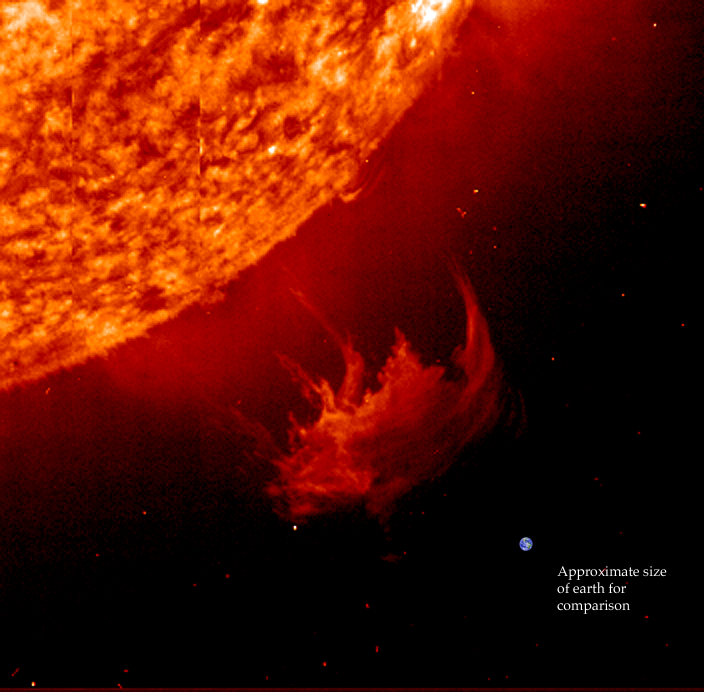
This shows some dramatic pictures from the Solar and Heliospheric
Observatory detailing huge coronal mass ejections from the sun over
the past week.
Sunspot numbers for January 27 through February 2 were 110, 96, 81,
90, 82, 107 and 127 with a mean of 99. 10.7 cm flux was 132.4, 152,
127.7, 132.7, 138.6, 138.1 and 144.4, with a mean of 138, and
estimated planetary A indices were 12, 29, 25, 11, 6, 8 and 7, with
a mean of 14.
This week's path projection will be from the center of the
contiguous 48 U.S. states for Saturday, February 5.
To Western Europe, 80 meters 2230-0930z (best 0230-0630z), 40 meters
2130-1100z (best 0030-0730z), 30 meters 2000-1230z (best
0000-0730z), 20 meters 1400-0030z, 17 meters 1400-2130z, 15 meters
1430-2030z, 12 meters 1500-1900z, 10 meters 1600-1830z.
To Eastern Europe, 80 meters 2330-0700z, 40 meters 2230-0800z, 30
meters 2130-0930z, 20 meters 1400-1530z and 1900-2100z, 17 meters
1430-1830z, 15 meters 1500-1730z, 12 meters 1600-1630z.
To Southern Africa, 80 meters 2330-0430z, 40 and 30 meters 2230-
0500z, 20 meters 2200-0300z, 17 meters 1930-0030z, 15 meters
1830-2330z, 12 meters 1800-2200z, 10 meters 1830-2130z.
To South America, 80 meters 0000-1000z (best 0230-0900z), 40 meters
2330-1000z (best 0030-0900z), 30 meters 2330-1100z (best
0030-0930z), 20 meters 2200-0930z, 17 meters 1300-1400z and
2100-0200z, 15 meters 1400-0100z (strongest later in the period), 12
meters 1430-0030z, 10 meters 1500-2230z.
To the Caribbean, 80 meters 2330-1200z (best 0130-1030z), 40 meters
2200-1330z (best 0030-1030z), 30 meters all hours, best 0030-1030z,
weakest 1530-1930z, 20 meters 1330-0100z, 17 meters 1400-0000z, 15
meters 1430-2300z, 12 meters 1530- 2130z, 10 meters 1630-2030z.
To Australia, 80 meters 0930-1400z, 40 meters 0930-1500z, 30 meters
0900-1500z, 20 meters 0830-1200z and 1400-1600z, 17 meters
1500-1700z, 15 meters 1530-1700z.
To Japan, 80 meters 0730-1400z, 40 meters 0700-1500z, 30 meters
0630-1600z, 20 meters 1430-1730z, 17 meters 2100-0300z, 15 meters
2130-0200z, 12 meters 2200-0030z, 10 meters 2200-2330z.
~MarciaH
Thu, Feb 10, 2000 (17:18)
#4
DX news
This week's bulletin was made possible with information provided by
Tedd, KB8NW, the OPDX Bulletin, Trey, N5KO, The 599Rpt, The Daily
DX, 425 DX News and Contest Corral from QST. Thanks to all.
FIJI, 3D2. Paul, A35RK, and Bob, W7TSQ, are QRV from the QTH of
Craig, 3D2TC. Paul is QRV as 3D2RK, and Bob as 3D2SQ. QSL both
calls via W7TSQ.
VIETNAM, 3W. Mal, VK6LC, is now licensed as 3W2LC. He will be QRV
from February 12 to 13, and again from February 19 and 20 during his
mornings and evenings. QSL to home call.
GHANA, 9G. Zdeno, 9G5ZW, is active on the HF and newer bands. QSL
via OM3LZ.
BAHAMAS, C6. Dick, N4RP, will be QRV on all HF bands as C6AKP from
Bimini, IOTA NA-048, February 11 to 23. He will use mostly CW, and
some SSB. QSL to home call.
ISLE OF MAN, GD. Look for DL3OI, DL4LQM, DL5AXX, DL5LYM and DL7URH
to be active as MD/homecalls from February 15 to 21. Activity will
be on 160 to 10 meters using mostly CW, but also some RTTY. QSL to
home calls.
GALAPAGOS ISLANDS, HC8. Look for HC8N to be QRV during February and
March. Activity includes entries in the World Wide RTTY Contest and
the ARRL International DX Phone. QSL via AA5BT.
GUANTANAMO BAY, KG4. Karl, K1KO, is QRV until February 14 as KG4KO.
Activity is centered on the low bands. QSL to home call.
SURINAME, PZ. Ramon, PZ5RA, is QRV using RTTY, and can usually be
found on 20 meters around 0300z. He is also active on 10 meters
from 1130 to 1300z.
PALAU, T8. Hide, JM1LJS, will be active again as T88LJ from
February 11 to 14 on all HF bands using CW and SSB. QSL via JH8DEH.
UZBEKISTAN, UJ. Shams, UK8CK, is often QRV on 80 meter CW around 0130z.
COCOS ISLAND, VK9C. Richard, DJ4OI, Bernd, DJ3OS, and Joachim,
DF6IC, are QRV as VK9CN, VK9CO and VK9CP, respectively, until
February 16. QSL to home calls.
CHRISTMAS ISLAND, VK9X. After their Cocos Island operation, look
for DJ4OI, DJ3OS and DF6IC, to be QRV as VK9XS, VK9XT and VK9XU,
respectively, from February 16 to 26. QSL to home calls.
THIS WEEKEND ON THE RADIO. The North American CW Sprint, YL-OM
Phone Contest, Winter Fireside SSB Sprint, World Wide RTTY WPX
Contest, PACC Contest and the Novice Round-Up are all scheduled for
this weekend. The 14th Annual School Club Roundup is scheduled for
February 14 to 19. Please see February QST, pages 96 and 97,
respectively, for details.
~MarciaH
Fri, Feb 11, 2000 (14:25)
#5
Propagation Forecast Bulletin 6
Sunspot numbers and solar flux rose over the past week, with average
solar flux up over 36 points and average sunspot numbers rising
nearly 70 points compared to the previous week. Peak activity
probably already occurred, with solar flux on Wednesday at 199 and
sunspot numbers peaking on Tuesday at 198. Solar flux should decline
for the near term, with the values for this Friday through Sunday at
176, 176 and 174.
The next low is forecast around February 22-25 with a solar flux
value around 130. The next peak is predicted for March 8-9, with
solar flux near 195. Based on the 27.5 day solar rotation, the
following near term solar flux minimum would be around March 20-23
at 130.
There were a couple of active geomagnetic days on February 6 and 7,
when the planetary A index was 24 and 25 and the maximum K index was
5. The College A index from Fairbanks was 43 and 38 on those days,
with a peak K index of 7, because of the high latitude. KL7AK sent
an email message asking about the College index. These readings,
along with the planetary A index can be seen with your web browser
at
gopher://sec.noaa.gov/00/indices/DGD.
The predicted planetary A index for this Friday through Sunday is
15, 10 and 20. Conditions should be quiet for February 15-22, but
active again around February 24 with predicted A index of 30. March
4 and 5 may also be active, and so may March 22 and 23.
Sunspot numbers for February 3 through 9 were 149, 136, 153, 173,
169, 198 and 189 with a mean of 166.7. 10.7 cm flux was 154.1 167.4,
167.8, 177.7, 181.9, 173.6 and 199, with a mean of 174.5, and
estimated planetary A indices were 8, 4, 9, 24, 25, 12 and 11, with
a mean of 13.3.
Path projections for this week are from San Francisco, California.
To Western Europe, 80 meters 0100-0830z, 40 meters 0030-1000z (best
0130-0700z) 30 meters 2330-1100z (best 0200-0730z), 20 meters
1500-1700z and 2130-2300z, 17 meters 1530-2030z, 15 meters
1600-1900z, 12 meters 1700-1800z, 10 meters around 1730z.
To Eastern Europe, 80 meters 0130-0630z, best around 0230z, 40
meters 0030-0800z, best 0230-0500z, 30 meters 0000-0930z, best
0200-0530z, 20 meters 1500-1730z and 0400-0600z, 17 meters
1530-1830z, 15 meters 1630-1730z.
To Southern Africa, 80 meters 0130-0430z (best 0200-0330z), 40
meters 0030-0500z (best 0200-0330z), 30 meters 0000-0530z (best
0200-0330z), 20 meters 0000-0530z (best 0100-0400z), 17 meters
2300-0300z (stronger toward the end of the period), 15 meters
2330-0300z, 12 meters 2200-2330z, 10 meters 2000-2200z.
To South America, 80 meters 0130-1000z (best 0430-0900z), 40 meters
0100-1030z (best 0230-0930z), 30 meters 0030-1100z (best
0200-0930z), 20 meters 0030-1100z 17 meters 2230-1000z, 15 meters
1430-1600z and 2200-0330z, 12 meters 1500-0300z, 10 meters
1530-0200z.
To the Caribbean, 80 meters 0130-1130z (best 0400-1000z), 40 meters
0000-1230z (best 0230-1030z), 30 meters 2300-1300z (best
0230-1000z), 20 meters open most hours, strongest 0200- 1030z,
weakest 1300-1400z and 1630-2000z, 17 meters 1430- 0330z, 15 meters
1500-0100z, 12 meters 1530-0330z, 10 meters 1530-2330z.
To New Zealand, 80 meters 0700-1500z (best 1000-1400z), 40 meters
0630-1530z (best 0800-1430z), 30 meters 0600-1600z (best
0730-1430z), 20 meters 0530-1600z (best 0800-1430z), 17 meters
0430-1200z, 15 meters 0230-1030z, 12 meters 2000- 0400z, 10 meters
1830-0430z.
To Australia, 80 meters 0930-1530z (best 1100-1200z), 40 meters
0900-1600z (best 1000-1500z), 30 meters 0830-1630z (best
1000-1500z), 20 meters 0800-1700z, 17 meters 0700-1200 and
1600-1800z.
To Japan, 80 meters 0800-1600z (best 0930-1030z), 40 meters
0730-1630z, 30 meters 0630-1700z, 20 meters 0500-1200z and
1500-1830z, 17 meters 2100-0530z, 15 meters 2130-0430z, 12 meters
2200-0300z, 10 meters 2200-0130z.
~MarciaH
Thu, Feb 17, 2000 (14:46)
#6
DX Bulletin 7
From ARRL Headquarters
Newington CT February 17, 2000
To all radio amateurs
This week's bulletin was made possible with information provided by
Tedd, KB8NW, the OPDX Bulletin, Jim, WT9U, QRZ DX, The 599Rpt, The
Daily DX, 425 DX News and Contest Corral from QST. Thanks to all.
BARBADOS, 8P. Will, AA4NC, and Jim, K4MA, are QRV as 8P9JB and
8P9JA, respectively, until February 22. They are active on all
bands and plan to be in the ARRL DX CW contest signing 8P9JA as a
Multi/Single entry. QSL to home calls.
BAHAMAS, C6. Look for AC8W/C6A and K8DD/C6A to be active from
Treasure Cay, Abaco Island, IOTA NA-080, until February 25. This
includes an entry in the ARRL DX CW contest as a Multi Operator
entry. QSL to home calls.
JUAN FERNANDEZ ISLAND, CE0Z. DL2OAP, DL3DXX, DL7UFN, DK1BT and
DK7YY are QRV as CE0ZY with 2 stations on 160 to 10 meters until
February 29 using CW, RTTY and some SSB and PSK31. They have
special permission to operate on 30 meters. QSL via DK7YY.
MADEIRA ISLANDS, CT3. Ricardo, CT3KN, will participate in both ARRL
International DX Contests, from Madeira, IOTA AF-014. QSL via
CS3MAD.
GALAPAGOS ISLANDS, HC8. Dave, W6NL, will participate in the ARRL DX
CW contest as HC8L as a Single Op/All Band entry, from San Cristobal
Island, IOTA SA-004. QSL via N2AU.
PANAMA, HP. Don, W4OC, and Ken, N4UK, are QRV on 160 to 10 meters
as 3E1AA from Contadora Island, IOTA, NA-072, until February 22.
They will be a Multi/Single entry in the ARRL DX CW contest. QSL
via operator's instructions.
ITALY, I. IK1LWL, I1NVU, IK1CLP and IK1QBT will be QRV as II1R as a
Multi/Single entry in the ARRL DX CW contest. QSL via I1NVU.
ALAND ISLANDS, OH0. Pertti, OH2PM, will be QRV as OH0B during the
ARRL DX CW contest. QSL via OH2BH.
ST. MAARTEN, PJ7. ND5S, KF5LG, W8EB and W8DVC, will be QRV as
PJ8/homecalls from February 19 to March 12. They will also be
active in the ARRL DX CW contest as PJ8A. QSL PJ8A via W9NIP. QSL
all others to home calls.
ST. KITTS AND NEVIS, V4. Jim, WT9U, will be QRV from V44NK's QTH as
V47X during the ARRL DX CW contest. QSL to home call.
CANADA, VE. Special Event call VB7GGQ will be used February 19 to
20 for the Girl Guides on the Air Event, GOTA, in Quesnel, British
Columbia. QSL via operator instructions.
TURKS AND CAICOS ISLANDS, VP5. Kenny, K2KW, is active as VP5/K2KW
from North Caicio Island, IOTA NA-002, until February 22. Activity
will be on all bands using CW and SSB and includes an entry in the
ARRL DX CW contest as VP5TT. QSL both call via WA4WTG.
THIS WEEKEND ON THE RADIO. The ARRL International DX CW Contest
will certainly keep contesters busy this weekend. Please see
December QST, page 99 for details.
~MarciaH
Fri, Feb 18, 2000 (14:54)
#7
Propagation de K7VVV
Solar flux and sunspot counts increased the week before last, fell
last week, and the averages for both weeks were about the same.
Average solar flux was down about 11 points last week, and average
sunspot numbers were off by a little over one point. Last weekend
had a surprising burst of geomagnetic activity, when Saturday's
planetary A index was 52. The planetary K index was as high as 7,
and Alaska's College A index, which is frequently higher because of
its proximity to the pole, was 71. During a six hour period, from
0600-1200z, the planetary A index was 7 and 6 while the College A
index was 8 and 7. These all indicate severe geomagnetic storm
levels.
What should we see over the next week? For the next five days,
Friday through Tuesday, solar flux is predicted to be 155, 150, 150,
145 and 145. Planetary A index for those same days is forecast to
be 5, 5, 12, 8 and 8. For best HF conditions, we want a low A index
in the single digits, and rising solar flux. So Sunday, February 20
with a planetary A index of 12 could be somewhat unsettled.
Solar flux for the short term is expected to bottom out near 130
around February 25, then rise to about 150 by March 1, but peak
broadly and fairly low near 175 around March 4-8. The next
predicted short term minimum is forecast for March 23-24. Of course
these are all guesses based upon activity over previous solar
rotations, which occur about every 27.5 days. Since the predicted
high levels of 175 are much lower than previous rotations where
solar flux was above 200, this means that the prediction is based
upon sunspot regions which are currently fading. Any new sunspot
areas will probably result in increased solar flux and better HF
conditions. With spring coming, it would be nice to see extended
worldwide openings on 10 and 12 meters again, which would accompany
the high flux levels normally expected in a peak year of a solar
cycle.
Sunspot numbers for February 10 through 16 were 172, 184, 157, 147,
158, 158 and 182 with a mean of 165.4. 10.7 cm flux was 175.7
170.2, 163.2, 159.9, 158.7, 156 and 160.2, with a mean of 163.4, and
estimated planetary A indices were 7, 13, 52, 14, 29, 11 and 5, with
a mean of 18.7.
Path projections for this weekend are from a place in Arizona
between Tucson and Phoenix, near Eloy.
To Western Europe, 80 meters 0100-0830z, 40 meters 0000-0930z, 30
meters 2330-1030z, 20 meters 1400-1600z and 2200-0000z, 17 meters
1430-2100z, 15 meters 1500-2000z, 12 meters 1600-1830z, 10 meters
around 1700z.
To Eastern Europe, 80 meters 0030-0630z, 40 meters 0000-0800z, 30
meters 2330-0830z, 20 meters 1330-1530z, 17 meters 1430-1830z, 15
meters 1530-1800z, 12 meters 1600-1630z.
To Southern Africa, 80 meters 0030-0430z, 40 meters 0030-0500z, 30
meters and 20 meters 2330-0530z, 17 meters 2300-0100z, 15 meters
2300-0000z, 12 meters 2130-2230z, 10 meters 2000-2130z.
To South America, 80 meters 0100-1000z, 40 meters 0030-1030z, 30
meters 0000-1100z, 20 meters 2330-1200z, 17 meters 1330-1400z and
2230-0500z, 15 meters 1400-1500z and 2130-0230z, 12 meters
1430-1600z and 2030-0200z, 10 meters 1500-0100z.
To the Caribbean, 80 meters 0000-1130z, 40 meters 2330-1230z, 30
meters 2200-1400z, 20 meters 1300-0830z, 17 meters 1400-0100z, 15
meters 1430-0000z, 12 meters 1500-2300z, 10 meters 1530-2200z.
To Australia, 80 and 40 meters 0930-1500z, 30 meters 0900-1500z, 20
meters 0830-1530z, 17 meters 0700-1100z and 1500-1630z, 15 meters
around 1500z and around 0430z.
To Japan, 80 meters 0800-1500z, 40 meters 0700-1500z, 30 meters
0630-1600z, 20 meters 0530-1700z, 17 meters 2100-0430z, 15 meters
2100-0400z, 12 meters 2130-0230z, 10 meters 2200-0130z.
~MarciaH
Thu, Feb 24, 2000 (14:23)
#8
DX news
This week's bulletin was made possible with information provided by
Tedd, KB8NW, the OPDX Bulletin, QRZ DX, Walt, W0CP, Bill, N2BT, The
Daily DX, 425 DX News and Contest Corral from QST. Thanks to all.
NEPAL, 9N. Nab, 9N1AC, is usually QRV on 40 meters CW around 2300z.
QSL via KC3AJ.
EASTER ISLAND, CE0Y. Vladislav, G0KBO, and his brother Victor,
UA6AF, are active as CE0Y/G0KBO and CE0Y/UA6AF, respectively, until
March 2. QSL both calls via G0KBO.
MAYOTTE, FH. Christian, 6W1QV, is QRV as FH/TU5DX for the next 6
months from Mamoudzou. QSL via F5OGL.
SCOTLAND, GM. Leo, W3LEO, will be QRV as MM/W3LEO from Portpatrick
in southwest Scotland from February 29 to March 17. Activity will
mainly be on 20, 17, 15, 12 and 10 meters SSB. QSL to home call.
SOUTH KOREA, HL. Special event station 6K2000WFK is active until
May 7 for the World Flower Exhibition in Koyang. QSL via bureau.
SVALBARD, JW. Ken, LA6WEA, and LA7FD, are QRV as JW6WEA and JW7FD,
respectively, until February 27. They are mainly active on the low
bands, and will participate in the CQ WW 160 Meter Contest. QSL via
home calls.
US VIRGIN ISLANDS, KP2. Fred, K4FMD, and Wicky, W4WWT, will be QRV
as K4UP/KP2 from February 28 to March 5. This includes an entry in
the ARRL DX SSB Contest. Activity will be on all bands. QSL via
K4UP.
MOUNT ATHOS, SV/A. Monk Apollo has received special callsign SY2A
to celebrate his 10th anniversary of activity from Mount Athos. He
will use this call until December 31, 2000.
EASTERN KIRIBATI, T32. Walt, W0CP, and Jim, KK0T, will be QRV as
T32B from February 29 to March 6. This includes an entry in the
ARRL DX SSB Contest. Activity will be on 160 to 6 meters, using CW,
SSB, RTTY and PSK31. QSL via KK0T.
COTE D'IVOIRE, TU. Martin, TU5IJ, is active using RTTY. QSL via
I2AOX.
LAOS, XW. Hiroo, JA2EZD, is QRV as XW2A until May 5. Activity is
on all bands using CW and SSB. QSL to home call.
IRAQ, YI. Peter, OM6TY, is a member of the Slovak Embassy for
another 2 years and is licensed as YI9OM. QSL via OM6TX.
THIS WEEKEND ON THE RADIO. The CQ World Wide 160-Meter SSB Contest,
REF French Phone Contest, UBA CW Contest, YL International Phone QSO
Party, RSGB 7 MHz Contest, CQC Winter QRP QSO Party and the North
Carolina QSO Party are all scheduled for this weekend. Please see
January QST, page 100, and February QST, page 97 for details on
these operating events.
~MarciaH
Fri, Feb 25, 2000 (13:12)
#9
Propagation Forecast Bulletin 8
Solar flux and sunspot activity were down last week, but heading
back up. Average solar flux for last week compared to the previous
week was down almost 4 points, and sunspot numbers were off about 28
points. The low point was Friday, February 18, when the three solar
flux measurements for the day were 139.6, 141.1 and 140.4. The noon
measurement of 141.1 is the official reading for the day. Solar
flux is expected to rise, with the projection for Friday through
Tuesday of 197, 197, 200, 200 and 204. Solar flux for the near term
is expected to peak around 205 on Wednesday or Thursday, March 1 and
2, then decline to below 170 by March 9, and bottom out near 130
around March 23 or 24.
Planetary A index has been rising, due to a well-placed coronal hole
streaming charged particles toward the earth. NASA has an
interesting article about this as well as a dramatic photo online at
http://www.spacescience.com/headlines/y2000/ast23feb_2.htm. Also
check
http://www.spaceweather.com, which on Thursday had an article
about a gust of solar wind at 1430z on February 24.
The projected planetary A index for Friday through Tuesday is 20,
18, 15, 13 and 10. Conditions may be disturbed again around March 4
and 5, and fairly quiet between March 13-20. Based on the current
solar rotation, disturbed conditions may recur around March 22-23,
and possibly quiet conditions again around March 26-29, although
predictions that far in the future are more of a guess. These
projections are based upon sunspots and coronal holes moving across
the visible solar surface, as the sun rotates relative to earth
every 27.5 days. Various features grow and fade with time, and new
areas appear. Some are oriented toward earth and have a large
effect, while others do not.
The coronal hole that is causing the current geomagnetic disturbance
has been visible for the last seven solar rotations.
Doug Brandon, N6RT wrote to ask about the URL for Cary Oler's Solar
Terrestrial Dispatch web site, which seemed to disappear some time
back. Doug did some detective work, and found that it had moved.
The new site is at
http://solar.spacew.com/.
George Jacobs, W3ASK has an interesting item in his propagation
column in the March issue of CQ Magazine concerning equinoctial
propagation. This is about the effect that occurs in spring and
fall seasons when the daylight distributed between the northern and
southern hemisphere is roughly equal, dependent on how close the
date is to the equinox. He says that during March intercontinental
openings on 160-30 meters should peak just before local sunrise and
again at local sunset. 20 meter openings should peak an hour or two
after sunrise and again for an hour or so after sunset. 17-6 meter
intercontinental openings should peak during daylight hours.
Signals on these upper bands are stronger toward the west around and
after sunset, while toward the east they are stronger before noon.
He notes that signals to the south are stronger after sunrise and
again late in the afternoon. W3ASK has a web site at
http://www.gjainc.com/.
Sunspot numbers for February 17 through 23 were 152, 146, 126, 131,
122, 129 and 155 with a mean of 137.3. 10.7 cm flux was 168.4
141.1, 144.8, 153.3, 152.1, 172.3 and 185.1, with a mean of 159.6,
and estimated planetary A indices were 6, 2, 4, 5, 15, 5 and 9, with
a mean of 6.6.
Path projections this week are from Boston, MA, and are based on
Sunday, February 27 with a solar flux of 200.
To Western Europe, 80 meters 2200-0800z, peaking 2300-0000z and
again at 0630z, 40 meters 2030-0900z, 30 meters 1830-1100z, 20
meters 1030-0400z, 17 meters 1130-2230z, 15 meters 1230-2130z, 12
meters 1330-2030z, 10 meters 1430-1930z.
To Eastern Europe, 80 meters 2130-0530z, 40 meters 2130-0630z, 30
meters 2030-0730z, 20 meters 1730-0630z, 17 meters 1100-2300z, 15
meters 1200-2030z, 12 meters 1230-1930z, 10 meters 1300-1830z.
To Southern Africa, 80 meters 2200-0430z, 40 meters 2200-0500z, 30
meters 2100-0500z, 20 meters 2030-0600z, 17 meters 2000-0030z, 15
meters 2000-0000z, 12 meters 1830-2230z, 10 meters 1900-2130z.
To South America, 80 meters 2300-0930z, 40 meters 2300-1000z, 30
meters 2200-1030z, 20 meters 2200-1100z, 17 meters open all hours,
strongest 2300-0500z, weakest 1300-2000z, 15 meters 1100-1300z and
1930-0300z, 12 meters 1200-0030z, 10 meters 1200-0000z.
To the Caribbean, 80 meters 2200-1100z, best 0100-1000z, 40 meters
2030-1300z, best 2330-1000z, 30 meters open all hours, best
2330-1000z, weakest 1530-1800z, 20 meters open all hours, best
2300-1030z, weakest 1500-1830z, 17 meters 1130-0130z, 15 meters
1200-0030z, 12 meters 1230-2300z, 10 meters 1300-2200z.
To Australia, 80 meters 0930-1130z, 40 30 meters 0900-1300z, 20
meters 1200-1330z and 0800-0830z, 17 meters 1330-1530z, 15 meters
1400-1600z, 12 meters 1500-1530z.
To Japan, 80 meters 0830-1200z, 40 meters 0800-1230z, 30 meters
0700-1330z, 20 meters 0600-1430z and 2130-2230z, 17 meters
2000-0000z, 0530-0830z and 1300-1600z, 15 meters 2100-0200z, 12
meters 2130-0030z, 10 meters 2200-2230z.
NNNN
~sprin5
Sun, Feb 27, 2000 (22:57)
#10
Cut loose of the FT-100 at a swapfest, but I still have the reliable old Atlas hf rig.
~MarciaH
Sun, Feb 27, 2000 (23:09)
#11
Now that propagation is way up you should fire it up and listen around!
~sprin5
Sun, Feb 27, 2000 (23:22)
#12
Yeah, I just work strong signals anyway.
~MarciaH
Sun, Feb 27, 2000 (23:33)
#13
Yup! It gets to be an old thing trying to figure out why the guy sounds like he is talking chinese - only to have him get stronger and find he REALLY is speaking in Chinese!!! Been there - done that!
~MarciaH
Wed, Mar 1, 2000 (21:47)
#14
The numbers for today are the highest I have seen in ages
SFI=233 | A=18 | K=4 up from 3 at 0300 on 2 March. SAF: low to moderate,
GMF: unsettled to active Aurora Level: 8
There is a guy QRZeding from "North Pecos" and he is shouting at me. The 14 MHz band is booming in at it is 5:30pm Hawaiian time. Terry where are you??!!
~MarciaH
Wed, Mar 1, 2000 (21:54)
#15
(Yes, I know he is QSL-ing...and he has quite a pileup. there is also a FO0AAA hitting 10 over 10. Incredible background silence, too. Fire up the rigs!
~MarciaH
Thu, Mar 2, 2000 (15:53)
#16
DX Bulletin 9
This week's bulletin was made possible with information provided by
Tedd, KB8NW, the OPDX Bulletin, The Daily DX, 425 DX News and
Contest Corral from QST. Thanks to all.
EASTER ISLANDS, CE0. Dan, XQ3IDY and CE3WDH will be QRV as 3G0Y
from March 4 to 13. Activity will be on 160, 80, 40, 30, 17 and 12
meters. QSL per operator instructions.
VIETNAM, 3W. Nag, JA7GAX, will be active from Saigon as XV2GAX
until the end of March. While here he plans to operate from
Phu-Quoc Island, IOTA AS-128, as XV2GAX/p. QSL to home call.
EASTERN MALAYSIA, 9M6. Jani, YB0US, will be QRV in the ARRL DX
Phone contest as 9M6US. He plans to be a Single Op/All Band entry.
QSL via N2OO.
URUGUAY, CX. Al, CX4SS and George, CX1SI are often QRV on 1833 kHz
CW around 0000 to 0400z.
CLIPPERTON ISLAND, FO. FO0AAA is now QRV from here. Activity can
be found on 160 to 6 meters, including the newer bands, using CW,
SSB and RTTY. QSL via N7CQQ.
MARQUESAS ISLANDS, FO. Alain, F2HE, is signing FO0CLA. He is here
until March 20. He will then operate from Tuamotu. QSL via F6CLT.
U.S. VIRGIN ISLANDS, KP2. Fred, K4FMD, and Wicky, W4WWT, are QRV as
K4UP/KP2 from St. Johns, IOTA NA-106, until March 5. This includes
an entry in the ARRL DX Phone contest. QSL via K4UP.
LUXEMBOURG, LX. Kazik, DL2SBY, is QRV as LX/DL2SBY on 160 to 10
meters using CW, SSB and RTTY. He plans to be QRV in the ARRL DX
Phone contest. QSL to home call.
ALAND ISLANDS, OH0. Martti, OH2BH, will be signing OH0B in the ARRL
DX Phone contest. QSL to home call.
GREECE, SV. SV1DNW, SV1DKL, SV1DKR and SV1DZB will participate in
the ARRL DX Phone contest as SY1D. QSL via SV1DNW.
GUATEMALA, TG. Luca, TG9/IK2NCJ, will be QRV in the ARRL DX Phone
contest as TG0AA.
REVILLA GIGEDO, XF4. Jose, XE1ZJV, Luis, XE1YJL, and Enrique,
XE1LWY, will sign XF4LWY using CW and SSB on all bands from Socorro
Island, IOTA NA-030, until March 8. QSL via XE1LWY.
EL SALVADOR, YS. Hrane, YT1AD, will be QRV from the YS1RR QTH for
the ARRL DX Phone contest. He will sign HU1A during the contest,
and YS/YT1AD before and after the contest. QSL to home call.
CAYMAN ISLANDS, ZF. John, KK9A, will be QRV as ZF2JB in the ARRL DX
Phone contest as a Single Band entry. QSL to home call.
THIS WEEKEND ON THE RADIO. The ARRL International DX Phone Contest
will keep contesters busy this weekend. Please see December 1999
QST, page 99 for details.
NNNN
~MarciaH
Fri, Mar 3, 2000 (12:54)
#17
Propagation Forecast Bulletin 9
RLP009 Propagation de K7VVV
Solar activity really took a big jump over the past week. Average
solar flux was up almost 57 points from the previous week, and
average sunspot numbers were up nearly 66 points. Solar flux peaked
on Wednesday, March 1, with a reading of 232.8. Geomagnetic indices
were also higher. The peak day for the planetary A index was
Thursday, February 24 when it was 26. Planetary K indices were
mostly 4 for the day, but reached 5 at one point.
Last week's bulletin spoke of a predicted near term peak in solar
flux around Wednesday, but about 25 points lower.
The short term forecast for this week shows a declining solar flux
for Friday, March 3 through Tuesday, March 7 of 210, 210, 205, 195
and 190. Solar flux is expected to bottom-out near 145 around March
16 or 17, then rise above 200 again after March 23.
Unfortunately, the outlook for the ARRL International DX Phone
Contest this weekend is not positive, at least in terms of
geomagnetic indices. The predicted planetary A index for Friday
through Tuesday is 12, 28, 25, 20 and 15. It is a shame that the
predicted A index for Saturday and Sunday is 28 and 25, but it
sometimes comes with increased solar activity. Beyond the weekend
geomagnetic conditions should stay quiet until March 22 and 23, then
quiet down again until March 31 and April 1.
Contesters this weekend can always hope, and monitor WWV for updated
K indices. If the K index, which is updated every three hours, is
three or lower, that is a good sign. If you want the last solar
bulletin broadcast on WWV and want to use a telephone instead, dial
303-497-3235.
News from
http://www.spaceweather.com/ this week spoke of two
intense solar flares erupting on March 2, and another piece at
http://science.nasa.gov/headlines/y2000/ast02mar_1m.htm was a story
about a polar substorm caused by solar wind, which it described as a
''gale of energetic particles from the sun.'' The cause of some of
the recent activity is described in an article at
http://spacescience.com/headlines/y2000/ast29feb_1.htm from NASA
Space Science News.
Sunspot numbers for February 24 through March 1 were 181, 202, 193,
201, 186, 211 and 247 with a mean of 203. 10.7 cm flux was 192.2
210.4, 214.8, 227.3, 218.8, 219 and 232.8, with a mean of 216.5, and
estimated planetary A indices were 26, 18, 12, 10, 12, 6 and 19,
with a mean of 14.7.
Are you in Texas, and planning on participating in this weekend's
contest? Then this path projection is for you. This is for Saturday,
March 4, from Dallas.
To Western Europe, 80 meters 2330-0730z (best 0300-0600z), 40 meters
2300-0830z (best 0130-0630z), 20 meters 2100-0600z, 15 meters
1330-2200z, 10 meters 1500-1930z.
To Eastern Europe, 80 meters 0030-0530z (best 0200-0400z), 40 meters
2330-0700z (best 0030-0400z), 20 meters 2130-0530z, 15 meters
1400-1900z, 10 meters 1600-1700z.
To European Russia, 80 meters 0030-0500z, 40 meters 0000-0700z, 20
meters 2130-0530z, 15 meters 1400-1800z, 10 meters possibly
1530-1630z.
To Southern Africa, 80 meters 0000-0430z, 40 meters 0000-0500z, 20
meters 2300-0530z, 15 meters 2100-0230z, 10 meters 2030-2300z.
To South America, 80 meters 0000-1030z (best 0330-0900z), 40 meters
0000-1100z, 20 meters 2300-1200z, 15 meters 2030-0930z, 10 meters
1300-0300z.
To the Caribbean, 80 meters 2330-1130z (best 0300-1000z), 40 meters
2230-1300z (best 0100-1030z), 20 meters open all hours, best
0030-1100z, weakest 1600-1900z, 15 meters 1230- 0300z, 10 meters
1300-0100z.
To Australia, 80 meters 0930-1300z, 40 meters 0900-1330z, 20 meters
0830-1430z, 15 meters 0630-1100z, 10 meters possibly 2200-0300z.
To Japan, 80 meters 0830-1330z, 40 meters 0830-1400z, 20 meters
1300-1500z and 0630-0900z, 15 meters 2100-0300z, 10 meters
2130-0130z.
NNNN
~MarciaH
Thu, Mar 9, 2000 (17:48)
#18
DX Bulletin 10
This week's bulletin was made possible with information provided by
Tedd, KB8NW, the OPDX Bulletin, The 599Rpt, QRZ DX, The Daily DX,
425 DX News and Contest Corral from QST. Thanks to all.
CHESTERFIELD ISLAND, FK. Members of Association des Radio Amateurs
de Nouvelle Caledonie, ARANC, will be QRV as TX8CI from March 15 to
April 1 from this new DXCC entity. Beginning March 23, they will
use the call TX0DX. Activity will be on all HF bands and 6 meters,
using CW, SSB and possibly RTTY. QSL all HF QSOs via OH2BN, and all
6 meter QSOs via JA1BK.
VIETNAM, 3W. Nag, JA7GAX, is QRV until the end of March as 3W2GAX.
QSL to home call. Meanwhile, Scott, AC3A, hopes to be QRV as 3W2SO
on 40, 20 and 15 meters near the QRP frequencies. QSL to home call.
SENEGAL, 6W. Marie, 6W1RB, is usually active on 20 meters. Her
activity is centered between 14175 and 14190 khz after 0230z and as
late as 0500z.
NAURU, C2. Jack, VK2GJH, and Nev, VK2QF, intend to operate C21JH
and C21/VK2QF, respectively, from IOTA OC-031 during March and
April. Activity is planned on the HF bands and especially on 6
meters. QSL via home calls.
BALEARIC ISLANDS, EA6. Babs, DL7AFS, and Lot, DJ7ZG are active as
EA6/DL7AFS and EA6/DJ7ZG, respectively, until March 11. Activities
are on all bands using SSB and RTTY. QSL both calls via DL7AFS.
NEW CALEDONIA, FK. Rene, FK8CP, is QRV on 80 meters CW after 1000z.
He can also be found on 160 meters at times.
GUERNSEY, GU. John, G0NEB, and Ron, G4DIY, of the St. Helens Radio
Club are QRV until March 13 as GP0STH and GU4DIY/p, respectively,
using CW and SSB on 40 to 10 meters. QSL both calls via G4DIY.
LUXEMBOURG, LX. Kazik, LX/DL2SBY, is active using CW, SSB and RTTY
on 160 to 6 meters until March 11. QSL to home call.
PAPUA NEW GUINEA, P2. Bernhard, DL2GAC, is QRV as P29VMS until
March 29. QSL to home call.
SEYCHELLES, S7. Kurt, HB9MX, is active from Mahe as S79MX until
April 1. Activity is on 40 to 10 meters with a special emphasis on
6 meters. QSL to home call.
REVILLA GIGEDO, XF4. XF4LWY is QRV on 28040 kHz from 1700z until
0000z each day. QSL via XE1LWY.
U.K. SOVERIEGN BASE AREA ON CYPRUS, ZC4. ZC4RAF is generally QRV on
20 meters around 1930z. QSL via 5B4YX.
THIS WEEKEND ON THE RADIO. The QCWA QSO Party, Wisconsin QSO Party,
World Wide Locator Contest are on tap for this weekend. The CLARA
and Family HF Contest is scheduled for March 14 to 15. Please see
March QST, page 100 for details.
NNNN
~MarciaH
Fri, Mar 10, 2000 (13:53)
#19
Propagation Forecast Bulletin 10
There was a nice surprise for participants in last weekend's DX
contest. ARLB009 predicted stormy geomagnetic conditions, but it
turned out that the energy from solar eruptions did not affect the
earth's geomagnetic field. Instead of the predicted planetary A
indices of 12, 28 and 25 for Friday through Sunday, the A index for
those days was 5, 5 and 7, which is very quiet. Solar flux was 189,
167 and 181.
Average solar flux was about the same last week as the week before,
and average sunspot numbers were slightly lower. Average A indices
have also been lower.
Solar flux is expected to dip below 200 this weekend. Predicted
flux values for Friday through Tuesday are 200, 195, 190, 185 and
180. Solar flux is expected to bottom out around 150 on March 17 or
18, then rise above 200 by March 23 and stay around 220 from March
25 to April 4.
Geomagnetic indices are expected to remain quiet until March 22-23,
then settle down again until March 31 and April 1.
We are moving toward the spring equinox, which always means better
HF conditions, especially with the rising solar flux. Look for more
frequent worldwide openings on 10, 12 and 15 meters.
Cable News Network has an email service which delivers weekly space
news, and some of it concerns solar activity of interest to hams.
The email service sends URL links to articles, such as the one at
http://CNN.com/2000/TECH/space/03/01/sunspots/index.html. You can
subscribe at
http://cnn.com/EMAIL.
In the mail this week was an interesting tip from a ham in Vermont,
who wrote, ''This is Zach Manganello, K1ZK, I am a freshman at
Middlebury College, and I just attended a lecture that I thought was
absolutely fascinating, pertinent to HF propagation, and worthy of
sharing with you at the ARRL. The lecture was about the Super Dual
Auroral Radar Network (SuperDARN), and these scientists have giant
radar arrays at several locations near the Earth's poles which they
use to study interaction of solar radiation with the Earth's
geosphere and ionosphere. Check out their web site at
http://superdarn.jhuapl.edu ''.
NASA Space Science News has an item this week about predicting
disturbances by seeing what is happening on the other side of the
sun that faces away from earth. This uses the Michelson Doppler
Imager on the Solar and Heliospheric Observatory, on the web at
http://science.nasa.gov/headlines/y2000/ast09mar_1.htm .
This is important because solar forecasts for the short term are
based on calculating when known active regions will rotate back into
view. If activity can be observed on the far side of the sun, then
more accurate forecasts can be made which are not dependent on the
last glimpse of the active region before it rotated out of view.
Finally, check out
http://www.solarmax2000.com/, a site devoted to
this year's peak in solar activity.
Sunspot numbers for March 2 through 8 were 209, 189, 167, 181, 172,
164 and 212 with a mean of 184.9. 10.7 cm flux was 213.2 203.8,
200.2, 220.3, 222.4, 221.8 and 214.9, with a mean of 213.8, and
estimated planetary A indices were 8, 5, 5, 7, 11, 16 and 13, with a
mean of 9.3.
The path projection for this week is from Middlebury, Vermont.
To Europe, 80 meters 2200-0730 UTC, 40 meters 2100-0830 UTC, 30
meters open all hours, best 2300-0600 UTC, weakest 1330-1630 UTC, 20
meters open all hours, except 0630-0930 UTC, 17 meters 1130-2300
UTC, 15 meters 1200-2230 UTC, 12 meters 1330-2130 UTC, 10 meters
1330-2100 UTC.
To Southern Africa, 80 meters 2230-0430 UTC, 40 meters 2200-0500
UTC, 30 meters 2100-0530 UTC, 20 meters 2030-0600 UTC, 17 meters
2000-0130 UTC, 15 meters 2000-0030 UTC, 12 meters and 10 meters
1900-2330 UTC.
To South America, 80 meters 2330-0930 UTC, 40 meters 2300-1000 UTC,
30 meters 2230-1000 UTC, 20 meters 2200-1100 UTC, 17 meters 1100-
0400 UTC, 15 meters 2130-0130 UTC, 12 meters 1230-0030 UTC, 10
meters 1300-2330 UTC.
To the Caribbean, 80 meters 2230-1100 UTC, 40 meters 2100-1230 UTC,
30 meters open all hours, strongest 2330-1000 UTC, weakest 1500-
1830 UTC, 20 meters open all hours, strongest 2300-1030 UTC, weakest
1430-1900 UTC, 17 meters 1100-0600 UTC, 15 meters 1130-0200 UTC, 12
meters 1200-0100 UTC, 10 meters 1200-0030 UTC.
To Australia, 80 meters 0930-1200 UTC, 40 meters 0930-1200 UTC, 30
meters 0830-1300 UTC, 20 meters 0830-1300 UTC, 17 meters 1300-1500
UTC, 15 meters 1400-1530 UTC, 12 meters 1430-1600 UTC, 10 meters
1500-1530 UTC.
To Japan, 80 meters 0900-1130 UTC, 40 meters 0800-1230 UTC, 30
meters 0800-1300 UTC, 20 meters 0730-1300 UTC, 17 meters 0630-1300
UTC, 15 meters 2100-0600 UTC, 10 meters 2130-0130 UTC.
~MarciaH
Thu, Mar 16, 2000 (16:10)
#20
DX news
This week's bulletin was made possible with information provided by
Tedd, KB8NW, the OPDX Bulletin, The 599Rpt, QRZ DX, The Daily DX,
425 DX News and Contest Corral from QST. Thanks to all.
EAST TIMOR, 4W. Ross, VK8UN, has been authorized to use 4W6UN from
this new DXCC entity. His activity of late has been on 20 and 10
meters. Thor, TF1MM, is now licensed as 4W6MM. QSL 4W6UN via
VK3OT. 4W6MM QSL route to be announced.
MONACO, 3A. Look for 3A/W8MV and 3A/WZ8A to be QRV from March 20 to
25 using CW on 80 to 10 meters. QSL to home calls.
VIETNAM, 3W. 3W50K has been QRV on 10 meters using CW and SSB
around 0000z. QSL via OKDXF.
ALGERIA, 7X. Angel, 7X0AD, will occasionally show up on 20 meters
using RTTY between 1600 and 2000z. QSL via EA4URE.
MALDIVES, 8Q. Peter, HA2SX, is active as 8Q7KK until March 25 while
on holiday. Operations are on 80 to 10 meters, including the newer
bands, using CW, SSB, RTTY, SSTV, PSK31, Hellschreiber and MT63.
QSL to home call.
JUAN FERNANDEZ ISLANDS, CE0Z. OH2MXS, OH2NSM and OH3JF will be
active as homecalls/CE0Z from March 17 to April 8. They will
operate with three stations on all bands with an emphasis on CW and
RTTY and some SSB. QSL to home calls.
ETHIOPIA, ET. ET3AA is usually QRV on 15 meters around 0930z.
THAILAND, HS. Kurt, HS0ZBS, is usually QRV around 28010 kHz daily
starting around 0000z.
SVALBARD, JW. Jan, LA5QFA will be active mainly on 160 and 80 meters
using SSB as JW5QFA on March 17 to 20. QSL to home call.
ANTARCTICA. Operator Dave is QRV as KC4AAA from Amundsen-Scott
South Pole Station until November, 2000. Look for him on 14243 kHz
around 0500z. QSL via K1IED.
WAKE ISLAND, KH4. Randy will be QRV as KH9/KH7EH March 22 to 24.
He will be active in his spare time, and may be found on 20, 10 and
6 meters. QSL to home call.
MARKET REEF, OJ0. Seppo is QRV as OJ0VR and has been found on 80
and 40 meters using CW between 1930 and 2100z. QSL via OH1VR.
SURINAME, PZ. Ramon, PZ5RA, is active on 20 meters using RTTY after
0400z.
BRITISH VIRGIN ISLANDS, VP2V. Bill, AA7X, will be QRV from Virgin
Gordo, March 25 to April 1 as VP2V/AA7X. Activity is centered
around 40 to 10 meters using CW and SSB. QSL to home call.
THIS WEEKEND ON THE RADIO. The Alaska, Virginia and Ohio Winter QSO
Parties, and the Bermuda Contest will be contesters busy this
weekend. Please see March QST, page 100 for details.
~MarciaH
Thu, Mar 23, 2000 (16:51)
#21
DX Bulletin 12 *** March 23, 2000
This week's bulletin was made possible with information provided by
Tedd, KB8NW, the OPDX Bulletin, The 599Rpt, QRZ DX, The Daily DX,
425 DX News and Contest Corral from QST. Thanks to all.
CHESTERFIELD ISLANDS, FK. TX0DX is QRV, and has been found on 17
and 15 meters using CW and SSB. QSL via operator instruction.
VIETNAM, 3W. Scott, AC3A, has received the callsign 3W2SO. He
hopes to operate on 20 and 15 meters as a QRP station. QSL to home
call.
UNITED ARAB EMIRATES, A6. Look for an entry in the CQ WPX contest
from A61AJ. QSL via W3UR.
MOLDOVA, ER. Slawa, ER1LW, will be QRV as ER6A in the CQ WPX
contest. QSL to home call.
ETHIOPIA, ET. Look for 9E1C to be QRV during the CQ WPX contest.
QSL via IV3OWC.
JERSEY, GJ. Craig, K3PLV, and Pete, K8PT, are QRV as MJ/homecalls,
using CW, SSB and RTTY on 80 to 10 meters, including the newer
bands. Their activity includes an entry in the CQ WPX contest. QSL
to home calls.
SVALBARD, JW. LA2RY, LA9IY and LA9GY are QRV as JW2RY, JW9IY and
JW9GY, respectively, until March 27. They will be QRV as JW8G
during the CQ WPX contest. Outside of the contest they will use CW,
SSTV, PSK31 and Feld-Held modes. QSL via operator's instructions.
BRAZIL, PY. Mario, PP5MQ, will participate in the CQ WPX contest as
PV5M on 10 meters. QSL to home call.
GREECE, SV. Panos, SV1APA, will be QRV as SY1A during the CQ WPX
contest. QSL to home call.
TURKEY, TA. YM3LZ will be a Multi/Single entry in the CQ WPX
contest. QSL via TA3YJ.
COSTA RICA, TI. Uwe, TI2/DL8UD, is QRV on 80 to 10 meters using CW
and SSB until March 28. This includes an entry in the CQ WPX
contest. QSL to home call.
INDONESIA, YB. A group of YB ops will be QRV as 7A0A as a
Multi/Single entry in the CQ WPX contest. QSL via YB0FMT.
MACEDONIA, Z3. Mike, NN6C, will be guest operating as Z38/NN6C
until April 4. He is active on all bands using CW, SSB and RTTY. He
and a large group of Z3 operators will participate in the CQ WPX
contest as Z30M as a Multi/Multi entry. QSL to home call.
THIS WEEKEND ON THE RADIO. The CQ WW WPX Phone Contest will
certainly keep contesters busy this weekend. Please see March QST,
page 100 for details.
~MarciaH
Fri, Mar 24, 2000 (15:08)
#22
Propagation Forecast Bulletin 12
Spring is here, and 10 and 12 meters are the place to be. A high
solar flux and shifting seasons are again producing conditions where
low power mobiles can work the world on the highest HF bands.
Last year at this time, the average solar flux for the week was
147.5. This week it was 207.8, much higher, and almost 13 points
higher than last week's average. A steady upward recent trend can be
seen in the graph at
http://www.dxlc.com/solar/.
Geomagnetic indices have been quite low, but this should change.
Active conditions are predicted for the next few days due to
recurring coronal holes and some recent flare activity. A large
coronal hole that has been returning for several months has split
into three groups, and one of them crosses the sun's equator and is
well positioned for disturbing radio conditions here on earth.
Weekend conditions for the CQ Worldwide WPX Phone Contest could be
stormy. The predicted planetary A index for the next five days,
Friday through Tuesday, is 25, 30, 20, 10 and 10, so it looks like
the best contest conditions may be on Sunday. On March 31 and April
1 conditions may be unsettled or active again, but should be quiet
until April 18. Solar flux predicted for the next five days is 230,
240, 245, 245 and 235. Flux values are expected to bottom out around
185 on April 12 or 13, then peak near 250 around April 22 or 23.
The High-Energy Solar Spectrograph Imager mission was set back at
least six months when the satellite was mistakenly vibrated too hard
in a test on a shake table at the Jet Propulsion Lab. The deployment
of the satellite, which is designed to observe solar flares in their
most energetic wavelengths, was expected to coincide with the solar
maximum this year. You can read about the accident at
http://www.msnbc.com/news/386019.asp?0a=23232C5 and about the HESSI
mission itself at the NASA web site
http://hesperia.gsfc.nasa.gov/hessi/index.html and at a University
of California site,
http://hessi.ssl.berkeley.edu/.
Sunspot numbers for March 16 through 22 were 138, 152, 142, 208,
240, 191 and 212 with a mean of 183.3. 10.7 cm flux was 184.4,
192.4, 194.8, 208.2, 210.3, 230.5 and 233.8, with a mean of 207.8,
and estimated planetary A indices were 4, 6, 7, 8, 8, 6 and 11, with
a mean of 7.1.
The path projections for this contest weekend are from Charlotte,
North Carolina.
To Western Europe, 80 meters 2330-0700z, 40 meters 2230-0800z, 20
meters 2030-0530z, 15 meters 1200-2300z, 10 meters 1530-2100z.
To Southern Africa, 80 meters 2300-0430z, 40 meters 2300-0500z, 20
meters 2130-0600z, 15 meters 2100-0230z, 10 meters 2000-0000z.
To South America, 80 meters 2330-1000z, 40 meters 2300-1030z, 20
meters 2200-1100z, 15 meters 1030-1330z and 2000-0700z, 10 meters
1200-0300z.
To the Caribbean, 80 meters 2300-1100z, 40 meters 2000-1330z, 20
meters open all hours, best 2330-0900z, weakest 1500-1900z, 15
meters 1200-0230z, 10 meters 1400-2300z.
To Australia, 80 meters 0900-1200z, 40 meters 0830-1230z, 20 meters
0800-1300z, 15 meters 1300-1500z, 10 meters possibly 1400-1500z or
0200-0300z.
To Japan, 80 meters 0900-1100z, 40 meters 0830-1200z, 20 meters
0800-1300z, 15 meters 2000-0130z, 10 meters 2130-0030z.
~MarciaH
Thu, Mar 30, 2000 (15:44)
#23
DX Bulletin 13 - March 30, 2000
This week's bulletin was made possible with information provided by
Tedd, KB8NW, the OPDX Bulletin, The 599Rpt, DXNL, 425 DX News and
Contest Corral from QST. Thanks to all.
SRI LANKA, 4S. John, NZ9Z, expects to be QRV as 4S7NZG from April 1
to 23 on 80 to 10 meters using CW and SSB. QSL via W9DXA.
EAST TIMOR, 4W. Bernie, W3UR, is QRV as 4W/W3UR. QSL via OH2BN.
Other stations include Antonio, 4W6GH, QSL via CT1EGH, and 4W6EB,
QSL via CT1EEB.
TOGO, 5V. Michael, DF8AN, will be QRV as 5V7MN from April 6 to 12.
QSL to home call.
GHANA, 9G. Zdeno, OK2ZW, is active as 9G5ZW, but will go QRT in
early April. QSL via OM3LZ.
PRATAS ISLAND, BV9P. Randy, W9ZR, will be joining the team of 13
DXers from Taiwan, Japan and the USA to return to Tung-Sha Dao for
BQ9P operation, from April 5 to 12. He hopes to concentrate on the
low bands, propagation permitting. QSL via KU9C.
PHILIPPINES, DU. Roland, DU1KGJ/DU4, is planning activity from
Calagua, IOTA OC-202, during the first week of April. QSL to home
call.
NEW CALEDONIA, FK. Dany, FK8VHY, and FK8HA, may be active as
FK8KAB/p from D'Entrecasteaux Reefs, IOTA OC-058, for 48 hours
beginning April 2. Activity will be on 40 to 10 meters, including
the newer bands using CW and SSB. QSL via FK8KAB.
AUSTRAL ISLANDS, FO0. Denise, F6HWU, is now active as FO0HWU from
Tubuai Island, IOTA OC-152. She will be here until April 12. She
is mostly active on CW and RTTY. QSL to home call.
SCOTLAND, GM. Look for GM3POI, GM4DZX, GM0HTH and GM0HTT to be
active as GB5RO from Copinsay Island on April 1 and 2. If bad
weather makes the sea trip impossible on April 1, they will
automatically reschedule for the following weekend. QSL via GM4DZX.
SOLOMON ISLANDS, H4. Peter, G8BCG, is QRV until April 9, mainly on
10 and 6 meters as H44PT. His beacon will be on 50105 kHz. He may
be QRV from Temotu Province as H40PT soon after. QSL to home call.
TURKEY, TA. Hans, TA4/DL7CM, is active using CW and RTTY until
April 4. QSL to home call.
PITCAIRN ISLAND, VP6. Jukka is QRV as VP6BR. He now puts the
emphasis of his activity on 160 to 30 meters. QSL via OH2BR.
MARION ISLAND, ZS8. Deryck, ZS6DE, is QRV as ZS8D, and will be here
for just a few more weeks and will operate as his schedule permits.
QSL via ZS6EZ.
THIS WEEKEND ON THE RADIO. The EA RTTY Contest, SP DX Contest and
the 500th Anniversary of Brazil Discovery contest are all scheduled
for this weekend. Please see April QST, page 100 for details.
~MarciaH
Fri, Mar 31, 2000 (16:58)
#24
Propagation Forecast Bulletin 13 March 31, 2000
Last week's conditions for the CQ Worldwide WPX Phone contest turned
out to be quite good. The predicted geomagnetic upset did not
arrive. This is the second time recently that bad conditions were
forecast for a contest weekend, and then the energy from the coronal
hole or flare that was expected to disrupt propagation did not
affect the earth.
Geomagnetic indices did rise last Friday, the day before the
contest, but even then the planetary K index rose only briefly to 4.
On Saturday and Sunday the planetary K index was mostly 1 or 2, and
during one period was even 0. What is really interesting is that the
College K index, measured in Alaska where the geomagnetic activity
is higher due to proximity to the polar region, was actually 0 over
six 3 hour periods on Saturday and Sunday.
Solar flux and sunspot numbers were higher this week than last, with
average sunspot numbers up 54 points and average solar flux rising
several points. Solar flux actually peaked for the short term during
the previous week on March 22, when the noon reading at Penticton
was 233.8 and the reading two hours later was 235.6. The low for
week was Tuesday, when solar flux was 200.9. It may go lower this
weekend, if solar flux this Sunday goes below 200.
The predicted solar flux for the next five days, Friday through
Tuesday, is 205, 200, 195, 205 and 210. Flux values may again dip
below 200 around April 10-16, then peak near 250 around April 22 or
23. Possible days of geomagnetic upset, based on the solar rotation
are April 18 and 19 and April 28.
MSNBC ran another story this week on the so-called solar heartbeat.
You can see the article at
http://www.msnbc.com/news/389042.asp,
which explains a theory concerning how layers of gas rotating at
different speeds may affect the formation of sunspots and solar
flares. MSNBC also ran a story about a new solar satellite that was
launched last Saturday. Called IMAGE, or Imager for
Magnetosphere-to-Aural Global Exploration, it will be used to study
the relationship between solar wind and the earth's magnetosphere.
It will deploy four wire antennas that are each 820 feet long,
making it the longest artificial object in space. Read about it at
http://www.msnbc.com/news/386647.asp?0a=235A162. NASA also ran a
story on the IMAGE at
http://science.msfc.nasa.gov/headlines/y2000/ast27mar_1m.htm.
Sunspot numbers for March 23 through 29 were 236, 230, 243, 255,
227, 232 and 238 with a mean of 237.3. 10.7 cm flux was 224.1,
218.9, 205.1, 211.3, 204.9, 200.9 and 208.8, with a mean of 210.6,
and estimated planetary A indices were 11, 10, 8, 5, 5, 5 and 9,
with a mean of 7.6.
The author joined in on the 10 and 12 meter mobile fun this week,
and here are some path projections based just on those bands.
The first group of path projections is from Southern California.
To Cleveland, Ohio, 12 meters 1330-0430z, 10 meters 1430-0230z (both
bands stronger later in the day), to Atlanta, Georgia, 12 meters
1330-0430z, 10 meters 1430-0300z, to the Caribbean, 12 meters
1400-0300z, 10 meters 1430-0130z, to Japan, 10 meters 2030-0630z, 12
meters 2100-0630z.
The second group is from Dallas, Texas.
To Seattle, Washington, 12 meters 1500-0400z, 10 meters 1630-0130z,
to Europe, 12 meters 1330-2330z, 10 meters 1530-2200z, to the
Caribbean, 12 meters 1200-0400z, 10 meters 1230-0230z, to Japan 12
meters 2000-0500z, 10 meters 2030-0330z.
The third group is from Atlanta, Georgia.
To Seattle, Washington, 12 meters 1400-0400z, 10 meters 1500- 0300z,
to Europe, 12 meters 1300-2300z, 10 meters 1530-2200z, to Brazil, 12
meters 1130-0400z, 10 meters 1230-0200z.
~MarciaH
Thu, Apr 6, 2000 (16:43)
#25
DX Bulletin 14 ARLD014
From ARRL Headquarters
This week's bulletin was made possible with information provided by
Tedd, KB8NW, the OPDX Bulletin, The 599Rpt, DXNL, QRZ DX, 425 DX
News and Contest Corral from QST. Thanks to all.
WESTERN MALAYSIA, 9M2. Richard, PA0RRS, is active until April 27 as
9M2/PA0RRS. QSL to home call.
CHINA, BY. Look for BX5AA on 24923 kHz around 1550z and also BX4AF
on 21089 kHz using RTTY at 1500z.
CHILE, CE. Luis, CA8VOW, will operate from Cullen Tierra del Fuego,
IOTA SA-008, until April 13. His license is for ten meters only and
he will be on 28438 kHz from 1300 to 1500z. QSL to home call.
THAILAND, HS. An IOTA DXpedition to Koh Nu in the Malay Peninsula
will use callsign E29DX until April 16. Activity will be on 160 to
10 meters, using CW, SSB and RTTY, but no newer bands. QSL via
HS0GBI.
JAPAN, JA. Masa, JA6GXK, will be active at various times generally
in his spare time from Danjo Archipelago, IOTA AS-056, until July
11. QSL to home call.
JAN MAYEN, JW. Per, LA7DFA, is QRV for 6 to 12 months as JX7DFA.
Activity will be on 160 to 2 meters, using CW, SSB, SSTV and digital
modes, including PSK31. QSL to home call.
DENMARK, OZ. Look for special event station OZ5HCA to be active
until April 8 to celebrate the birthday of Hans Christian Andersen.
QSL via OZ3FYN.
NETHERLANDS ANTILLES, PJ. Albert, HB9BCK, will be QRV as PJ4/HB9BCK
from April 9 to 22 from Bonaire Island. Activity will be on 80 to 6
meters using CW, SSB and RTTY. QSL to home call.
BRAZIL, PY. Ari, PT2BW, to celebrate the 500th anniversary of
Brazil's discovery by Portuguese navigators, will be active on all
bands and modes as PW500A until April 30. QSL to home call.
MICRONESIA, V6. Bruce, KD6WW, will be active as V63VL from Chuuk,
IOTA OC-011, from April 7 to 10, and then from Pohnpei, IOTA OC-010,
from April 10 to 14. He will use CW primarily and possibly some
FSK. QSL to home call.
LAOS, XW. Hiroo, JA2EZD, is QRV as XW2A until early May on all
bands and modes. QSL to home call.
SOUTH AFRICA, ZS. The ZS31ER operation from Elephant Rock continues
until April 9. Activity is on 80 to 10 meters, including the newer
bands, using CW and SSB. QSL via ZS1FJ.
THIS WEEKEND ON THE RADIO. The Japan International DX CW Contest,
QRP ARCI Spring CW QSO Party, and His Majesty the King of Spain
Contest are scheduled or this weekend. On April 10, look for
activity in the VHF/UHF Spring Sprints. Please see April QST, page
100 for details.
~MarciaH
Fri, Apr 7, 2000 (22:30)
#26
Date: Fri, 07 Apr 2000 16:25:44 EDT
From: "ARRL Members Only Web site"
Propagation Forecast Bulletin 14
The sunspot number took a big leap this week, rising to 301 on
Sunday. It has not been this high since November 12 of last year,
when it was 324. Two days prior on November 10 meters the solar flux
was 343, which is still the record for this cycle. The average
sunspot count for the week was only up about 8 points though, and
average solar flux was about the same as last week.
Solar flux is a measurement of 2.8 GHz energy from the sun, measured
at the Dominion Radio Astrophysical Observatory operated by the
National Research Council Canada in Penticton, British Columbia. You
can visit the observatory web site at
http://www.drao.nrc.ca/.
Sunspot numbers are calculated by multiplying the number of visible
sunspot groups by 10, and adding the number of individual spots in
all the groups. A multiplication factor is also used, and it differs
for each observatory. You can see a complete explanation for sunspot
numbers and their derivation at
http://spacescience.com/headlines/y2000/ast05apr_1m.htm.
Geomagnetic indices have been high this week, with the average
planetary A index almost double last week's number. The A index was
in double-digits every day, with April 4 being the most disturbed.
The planetary A index was 21, with planetary K indices as high as 5,
and the mid-latitude index at 6 during the same period.
Coming up on Saturday and Sunday is the HF CW weekend for the Japan
International DX Contest. Unfortunately, as this bulletin is being
written on Thursday night, a major geomagnetic storm is raging. An
interplanetary shock wave passed earth at 1730z on April 6, and
Aurora have been spotted in North America as far south as North
Carolina. The planetary K index for the end of thez day on Thursday
was 8, and the A index was 56. The Boulder K index at 0300z on
Friday is also 8. A severe geomagnetic storm began at 0100z on April 7.
For the next five days, Friday through Tuesday, the expected
planetary A index is 30, 20, 15, 10 and 7. The predicted solar flux
for the same five days is 175, 180, 180, 175 and 170. Solar flux is
expected to rise above 200 again around April 14 and stay there well
into the month of May.
Sunspot numbers for March 30 through April 5 were 225, 248, 287,
301, 252, 184 and 221 with a mean of 245.4. 10.7 cm flux was 205.5,
225.4, 222.9, 219.3, 215.4, 206.7 and 194.4, with a mean of 212.8,
and estimated planetary A indices were 10 meters, 19, 14, 16, 12, 21
and 12, with a mean of 14.9.
Path projections for this week are for the Japan International DX CW
Contest. Because the contest is for 10, 15 and 20 meters only, and
for international stations to work Japan, the path projections will
all be toward Japan and for 10, 15 and 20 meters only.
From Boston, Massachusetts, 20 meters 0930-1300z, 15 meters
2000-0000z, 10 meters possibly 2100-0100z.
From New York City, 20 meters 0900-1230z, 15 meters possibly
1100-1500z (best around 1400z), 10 meters possibly 2000-0100z.
From Atlanta, Georgia, 20 meters 1130-1330z, 15 meters 1930-0330z,
10 meters possibly 2030-0000z.
From Nashville, Tennessee, 20 meters 1130-1400z, 15 meters 1930-
0330z, 10 meters 2100-2330z.
From Louisiana, 20 meters 1130-1400z and 0630-0730z, 15 meters
2000-0500z, 10 meters 2100-0000z.
From Houston, Texas, 20 meters 0700-0830z and 1130-1430z, 15 meters
2000-0600z (stronger toward the end of the period) and again around
1330z, 10 meters 2100-0030z.
From the center of the contiguous 48 United States, 20 meters 1300-
1530z, 0600-0700z and again around 0800z, 15 meters 2000-0400z
(weaker toward the middle of the period), 10 meters possibly around
2230-0000z.
From Chicago, 20 meters 1100-1400z, 15 meters 2000-0100z.
From Salt Lake City, 20 meters 0630-0830z and 1330-1630z, 15 meters
2000-0500z, 10 meters possibly around 2300-0030z.
From Billings, Montana, 20 meters 1400-1630z and 0630-0830z, 15
meters 2000-0330z.
From Arizona, 20 meters 0700-1030z and 1230-1530z, 15 meters
1930-0730z, 10 meters 2130-0030z.
From Los Angeles, 20 meters 0630-1030z and 1300-1630z, 15 meters
2000-0730z, 10 meters 2130-0100z.
From San Francisco, 20 meters 0630-1000z and 1330-1700z, 15 meters
2000-0730z, 10 meters 2200-0000z.
From Portland, Oregon, 20 meters 0630-0900z and 1500-1730z, 15
meters 2030-0430z.
From Hawaii, 20 meters 0530-1930z, 15 meters 1930-1200z, 10 meters
2100-1000
~MarciaH
Thu, Apr 20, 2000 (14:42)
#27
DX Bulletin 17
From ARRL Headquarters
Newington CT April 20, 2000
This week's bulletin was made possible with information provided by
Tedd, KB8NW, the OPDX Bulletin, QRZ DX, The Daily DX, DXNL,
425DXnews and Contest Corral from QST. Thanks to all.
MONACO, 3A. Henryk, SP3FYM, and Woytek, SP6PT, will be QRV as
3A2/homecall from April 26 to May 1. Look for them on 40 to 10
meters using CW, SSB and RTTY. QSL both calls via SP6PT.
YEMEN, 7O. DJ7MG, DK1II, DK9KX and DL5EBE are QRV from Sanaa, the
capital of Yemen using callsigns 7O1II and 7O1YGF. Activity is on
all HF bands using CW and SSB. Activity on 6 meters depends on
local conditions, and the team will monitor 50.204 MHz. QSL 7O1II
via DJ3XD and 7O1YGF via DK9KX.
SAN FELIX ISLANDS, CE0. XR0ZY is QRV from San Ambrosio Island, IOTA
SA-013, on all bands, using mainly CW. QSL via OM2SA.
GALAPAGOS ISLANDS, HC8. Ted, HC5K, is QRV using the callsign HC8K.
His activity includes using all modes, especially data modes,
including MT63 and Feld-Hell. His activity is restricted around his
work hours. QSL to home call.
THAILAND, HS. Kurt, HS0ZBS, is active using CW especially around
0000z on 28010 kHz looking for North American stations. QSL via the
bureau.
VATICAN CITY, HV. HV5PUL will be active on all HF bands, including
6 and 2 meters, from April 26 to 28. QSL via operator's
instruction.
ITALY, I. Claudio, IV3/IN3DEI and Antonello, IV3/IN3YGW, are active
from Grado Island, IOTA EU-130, until April 25. QSL to home calls.
JAPAN, JA. Kouji, JQ1HBT, will be QRV as JH1HUK/6 from
Kita-Daito-Jima, IOTA AS-047, from April 22 to May 7. QSL to home
call.
BRAZIL, PY. Special event station PQ500BA is active until the end
of April in celebration of the 500th anniversary of the discovery of
Brazil. QSL via PS7ZZ.
DODECANESE, SV5. John, SM0DJZ, is QRV as SV5/SM0DJZ during his 14
day vacation. He is active on 80 to 10 meters, using CW, SSB and
RTTY mainly during his mornings and evenings. QSL to home call.
Meanwhile, Richard, G3CWI, is active as SV5/G3CWI until May 4. He
is running low power on 20 meters CW, usually around 1900z. QSL to
home call.
CORSICA, TK. Look for TK5PB/p to be active from Maestro Maria, IOTA
EU-100, from April 22 to 24.
THIS WEEKEND ON THE RADIO. The Six Meter Sprint, DXYL-NAYL Phone
Contest, Low Power Spring Sprint and QRP in the Field are all
scheduled for this weekend. The 432 MHz Spring Sprint is on tap for
April 26. Please see April QST, page 100 for details.
~MarciaH
Thu, Apr 20, 2000 (14:44)
#28
I post this information as soon as it reaches me. It has been highly irregular lately...sorry!
~MarciaH
Thu, Apr 27, 2000 (16:05)
#29
DX Bulletin 18 ARLD018
April 27, 2000
DX news
BHUTAN, A5. A number of operators are scheduled to be QRV from here
starting May 3. The callsign to be used has not as yet been
announced. They will be active until May 12. Operations will be on
160 to 6 meters using CW, SSB and RTTY. QSL via W0GJ.
CHINA, BY. Members of the Jiangsu DX Club will be QRV as BI4L from
Changdao Island from May 1to 3. Activity will be on 160 to 6 meters
using CW, SSB and RTTY. QSL via BY4RSA.
ISLE OF MAN, GD. Ian, G0KRL, will be QRV as GD0KRL/p from April 30
to May 1 while on vacation. Activity will be on all HF bands using
mostly SSB with some RTTY. QSL to home call.
ITALY, I. Special Millennium and Jubilee Year station IU0PAW is
active until December 31. QSL via IK0SHF. Meanwhile, look for
participation on International Marconi Day from IY4IMD on April 29.
QSL via IW4EEG.
NETHERLANDS, PA. Club station ON4LAR is active until April 30 as
PA6TXL from Texel Island on the IOTA frequencies. QSL to ON4CAO.
PALAU, T8. Look for JJ1DWB, 7N1KAE and JH8DEH, and one other
operator, to be QRV as T88MT, T88YH, T88LJ, respectively, on 80 to 6
meters using CW and SSB from April 38 to May 3. QSL to home calls.
UZBEKISTAN, UJ. Fedor, UK9AA, has been QRV around 18074 kHz
starting around 0100Z.
UKRAINE, UR. Special event call EMORSE is QRV until April 30 to
celebrate the 209th anniversary of the birth of Samuel F.B. Morse.
QSL via DJ0MAQ.
MICRONESIA, V6. JA3DAU and JA3HRV will be QRV as V63BJ and V63BD,
respectively, from Yap Island from April 30 to May 3. Activity will
be on 40 to 6 meters using CW and SSB. QSL to home calls.
LORD HOWE ISLAND, VK9L. Ed, VK2INI, is QRV as VK9LEH from IOTA
OC-004 on 40, 20, 15 and 10 meters using mostly CW until May 1. QSL
to home call.
NORFOLK ISLAND, VK9N. Kirsti, VK9NL, is usually QRV around 18072
kHz at 0430Z.
VIETNAM, XV. A group of operators will be QRV from Cat Ba, IOTA
AS-132. Look for XV5JY, XV5TK, and XV5VE from May 1 to 5 on 40 to
10 meters. QSL via JA1KJW, JA3MCA and JA8VE, respectively.
THIS WEEKEND ON THE RADIO. The Florida, Nebraska and Ontario QSO
Parties, County Hunters Phone Contest, the North American High Speed
Meteor Scatter Contest, and QRP to the Field, are all scheduled for
this weekend. Please see April QST, page 100, and May QST, page 91,for details.
~MarciaH
Fri, Apr 28, 2000 (19:29)
#30
Propagation Forecast Bulletin 17 - April 28, 2000
Sunspots and solar flux were up this week. The average sunspot
number was up over 40 points and average solar flux rose over 30
points over the past week. Geomagnetic indices have been mostly
quiet, with April 24 the most active day.
Last week's bulletin ARLP016 said that the solar flux should be up
around 220 this weekend, but conditions are not cooperating.
Although activity has been higher this week than last, it is not as
high as expected.
Solar flux is expected to hover around 175 to 185 until April 8,
then dip below 170, and rise to around 200 from May 19 through 28.
The planetary A index prediction indicates unsettled conditions for
Friday. The A index should stay quiet from this weekend until May 6
and 7, when it may rise to 15.
Predicted solar flux for the next five days, Friday through Tuesday
is 180, 175, 175, 180 and 180.
Sunspot numbers for April 20 through 26 were 179, 211, 226, 252,
222, 229 and 197 with a mean of 216.6. 10.7 cm flux was 180.6,
187.3, 201.8, 206.1, 205.6, 202.5 and 189.9, with a mean of 196.3,
and estimated planetary A indices were 14, 10, 7, 8, 21, 6 and 4,
with a mean of 10.
Path projections for this weekend are from Wisconsin.
To Europe, 80 meters 0100-0530 UTC, 40 meters 2330-0630 UTC, 30
meters 2230-0730 UTC, 20 meters 2100-0700 UTC, 17 meters 2000-0300
UTC, 15 meters 1330-0100 UTC, 12 meters and 10 meters possibly
1700-2000 UTC.
To Southern Africa, 80 meters 0030-0430 UTC, 40 and 30 meters 0000-
0430 UTC, 20 meters 2300-0530 UTC, 17 meters 2130-0200 UTC, 15
meters 2100-0130 UTC.
To South America, 80 meters 0030-1000 UTC, 40 meters 0000-1000 UTC,
30 meters 2330-1030 UTC, 20 meters 2230-1130 UTC, 17 meters 0930-
1200 UTC and 2200-0630 UTC, 15 meters 1130-1230 UTC and 2100-0500
UTC, 12 meters 1400-2300 UTC.
To the Caribbean, 80 meters 0000-1030 UTC, 40 meters 2230-1130 UTC,
30 meters 2000-1330 UTC, 20 meters open all hours, best 0100-0930
UTC, weakest 1500-1900 UTC, 17 meters open all hours, weakest 0730-
0800 UTC and 1300-1530 UTC, 15 meters 1000-1600 UTC and 1730-0530
UTC, 12 meters 1200-0330 UTC, 10 meters 1530-2130 UTC.
To Australia, 80 meters 0900-1130 UTC, 40 meters 0830-1200 UTC, 30
meters 0730-1230 UTC, 20 meters 0730-1300 UTC, 17 meters 0700-0830
UTC and 1130-1300 UTC, 15 meters 0600-0700 UTC and 1300-1500 UTC.
To Japan, 80 meters 1000-1030 UTC, 40 meters 0930-1130 UTC, 30
meters 0830-1200 UTC, 20 meters 0800-1230 UTC, 17 meters 0600-0800
UTC and 1130-1500 UTC, 15 meters 1430-1500 UTC and 1830-2000 UTC and
0330-0500 UTC, 12 meters 2030-2200 UTC, 10 meters possibly 2000-0400
UTC.
~MarciaH
Mon, May 1, 2000 (18:22)
#31
Keplerian Bulletin 32 - April 28, 2000
Decode 2-line elsets with the following key:
1 AAAAAU 00 0 0 BBBBB.BBBBBBBB .CCCCCCCC 00000-0 00000-0 0 DDDZ
2 AAAAA EEE.EEEE FFF.FFFF GGGGGGG HHH.HHHH III.IIII JJ.JJJJJJJJKKKKKZ
KEY: A-CATALOGNUM B-EPOCHTIME C-DECAY D-ELSETNUM E-INCLINATION F-RAAN
G-ECCENTRICITY H-ARGPERIGEE I-MNANOM J-MNMOTION K-ORBITNUM Z-CHECKSUM
AO-10
1 14129U 83058B 00111.71281053 -.00000031 00000-0 10000-3 0 6414
2 14129 26.9588 335.1191 6024509 45.1315 350.4214 2.05869894 98776
UO-11
1 14781U 84021B 00118.95033058 +.00003160 +00000-0 +51180-3 0 02811
2 14781 097.9769 082.9709 0009829 265.1701 094.8348 14.71923916864912
Mir
1 16609U 86017A 00119.69985792 .00074998 00000-0 38902-3 0 5842
2 16609 51.6483 150.7329 0002827 167.5951 192.5140 15.80331741811376
UO-14
1 20437U 90005B 00119.14248262 +.00000464 +00000-0 +19451-3 0 05296
2 20437 098.4153 187.8108 0011296 008.0329 352.1032 14.30411197535710
AO-16
1 20439U 90005D 00119.19576296 +.00000464 +00000-0 +19439-3 0 03467
2 20439 098.4477 194.0709 0011922 010.2904 349.8521 14.30474708535744
LO-19
1 20442U 90005G 00119.18769235 +.00000592 +00000-0 +24232-3 0 03444
2 20442 098.4613 197.1814 0012723 008.9832 351.1567 14.30711917535826
FO-20
1 20480U 90013C 00118.93851536 +.00000047 +00000-0 +17362-3 0 02555
2 20480 099.0448 258.7686 0540749 168.9772 192.3750 12.83271561478834
RS-12/13
1 21089U 91007A 00118.76711583 +.00000163 +00000-0 +15696-3 0 02763
2 21089 082.9257 223.1583 0027822 267.7352 092.0623 13.74191486462752
UO-22
1 21575U 91050B 00119.10933846 +.00000710 +00000-0 +24993-3 0 00304
2 21575 098.1606 149.1487 0007984 359.0088 001.1082 14.37663245460729
AO-27
1 22825U 93061C 00119.14898544 +.00000362 +00000-0 +16226-3 0 08105
2 22825 098.4148 178.0324 0009580 052.1525 308.0535 14.28119069343333
IO-26
1 22826U 93061D 00119.17052927 +.00000480 +00000-0 +20927-3 0 08076
2 22826 098.4183 178.6574 0010240 048.8942 311.3112 14.28262312343367
KO-25
1 22828U 93061F 00119.15116529 +.00000533 +00000-0 +22856-3 0 07908
2 22828 098.4133 178.8013 0011141 032.7308 327.4558 14.28656793311528
RS-15
1 23439U 94085A 00118.85535893 -.00000034 +00000-0 +25115-3 0 04612
2 23439 064.8149 261.8898 0166479 297.9387 060.4775 11.27536006219838
FO-29
1 24278U 96046B 00118.74977891 +.00000140 +00000-0 +18034-3 0 03538
2 24278 098.5887 033.2238 0351498 357.6339 002.3121 13.52718102182478
TO-31
1 25396U 98043C 00119.24280847 -.00000044 00000-0 00000+0 0 3111
2 25396 98.7235 195.2331 0003277 189.4771 170.6350 14.22631203 93559
GO-32
1 25397U 98043D 00119.16578267 -.00000044 +00000-0 +00000-0 0 03053
2 25397 098.7213 194.9629 0000866 039.5403 320.5839 14.22388614093553
SO-35
1 25636U 99008C 00119.10357134 +.00000671 +00000-0 +18932-3 0 02165
2 25636 096.4566 335.5530 0152656 339.3884 020.1193 14.41258582061875
UO-36
1 25693U 99021A 00119.44260343 -.00000126 00000-0 20177-5 0 2156
2 25693 64.5581 261.5849 0041325 304.0010 55.7204 14.73542091 54978
Keplerian bulletins are transmitted twice weekly from W1AW.
The next scheduled transmission of these data will be Tuesday,
May 2, 2000, at 2230z on Baudot and AMTOR.
~MarciaH
Tue, May 2, 2000 (15:57)
#32
Keplerian Bulletin 33 - May 2, 2000
Decode 2-line elsets with the following key:
1 AAAAAU 00 0 0 BBBBB.BBBBBBBB .CCCCCCCC 00000-0 00000-0 0 DDDZ
2 AAAAA EEE.EEEE FFF.FFFF GGGGGGG HHH.HHHH III.IIII JJ.JJJJJJJJKKKKKZ
KEY: A-CATALOGNUM B-EPOCHTIME C-DECAY D-ELSETNUM E-INCLINATION F-RAAN
G-ECCENTRICITY H-ARGPERIGEE I-MNANOM J-MNMOTION K-ORBITNUM Z-CHECKSUM
AO-10
1 14129U 83058B 00121.91236578 -.00000320 +00000-0 +10000-3 0 06443
2 14129 026.9399 333.4784 6024641 047.9155 349.7122 02.05874034098988
UO-11
1 14781U 84021B 00122.96108021 +.00002995 +00000-0 +48520-3 0 02820
2 14781 097.9773 086.9047 0009729 249.2913 110.7252 14.71947684865509
Mir
1 16609U 86017A 00123.44591544 .00067054 00000-0 64765-3 0 6086
2 16609 51.6497 131.5025 0019184 265.5724 94.3077 15.65593192811968
UO-14
1 20437U 90005B 00123.19958049 +.00000418 +00000-0 +17688-3 0 05263
2 20437 098.4145 191.7332 0010987 356.7631 003.3476 14.30414507536298
AO-16
1 20439U 90005D 00123.18272729 +.00000509 +00000-0 +21167-3 0 03422
2 20439 098.4481 197.9440 0011631 359.8307 000.2870 14.30479332536316
LO-19
1 20442U 90005G 00123.17399935 +.00000522 +00000-0 +21562-3 0 03462
2 20442 098.4617 201.0615 0012327 357.9754 002.1377 14.30715655536392
FO-20
1 20480U 90013C 00122.91489047 +.00000068 +00000-0 +22042-3 0 02444
2 20480 099.0461 261.9989 0540949 159.9752 202.3490 12.83272327479342
RS-12/13
1 21089U 91007A 00123.20859043 +.00000165 +00000-0 +15892-3 0 02762
2 21089 082.9247 219.8637 0027664 254.6466 105.1632 13.74192716463369
UO-22
1 21575U 91050B 00123.07640184 .00000697 00000-0 24567-3 0 294
2 21575 98.1601 152.9138 0007835 347.1009 12.9974 14.37669101461295
AO-27
1 22825U 93061C 00123.21258732 +.00000402 +00000-0 +17849-3 0 08115
2 22825 098.4140 181.9471 0009311 043.2629 316.9283 14.28123095343915
IO-26
1 22826U 93061D 00123.16367116 +.00000446 +00000-0 +19571-3 0 08052
2 22826 098.4177 182.5062 0010204 038.4404 321.7487 14.28266085343938
KO-25
1 22828U 93061F 00123.14320377 +.00000522 +00000-0 +22447-3 0 07869
2 22828 098.4126 182.6489 0011240 021.3621 338.8022 14.28661307312094
RS-15
1 23439U 94085A 00122.84653902 -.00000027 +00000-0 +43205-3 0 04665
2 23439 064.8149 255.4348 0166747 297.3374 061.0667 11.27536123220283
FO-29
1 24278U 96046B 00123.18748990 +.00000113 +00000-0 +15272-3 0 03551
2 24278 098.5887 037.0789 0351480 346.1618 013.0077 13.52719255183071
TO-31
1 25396U 98043C 00123.25170355 -.00000044 00000-0 00000+0 0 3131
2 25396 98.7203 199.1937 0003557 194.0708 166.0379 14.22637687 94128
GO-32
1 25397U 98043D 00123.17537005 -.00000044 +00000-0 +00000-0 0 03010
2 25397 098.7217 198.9241 0000396 191.1028 169.0143 14.22392386094126
SO-35
1 25636U 99008C 00123.54675607 .00000646 00000-0 18287-3 0 1834
2 25636 96.4589 338.9202 0151885 325.3580 33.7794 14.41264305 62513
UO-36
1 25693U 99021A 00123.44677589 .00008115 00000-0 12452-2 0 2255
2 25693 64.5622 249.3902 0042553 304.5633 55.1445 14.73549831 55564
Keplerian bulletins are transmitted twice weekly from W1AW.
The next scheduled transmission of these data will be Friday,
May 5, 2000, at 2230z on Baudot and AMTOR.
~MarciaH
Thu, May 4, 2000 (15:12)
#33
DX Bulletin 19 ARLD019 - May 4, 2000
TUNISIA, 3V. Giovanni, I5JHW, will be QRV from club station 3V8BB
during the ARI International Contest.
BHUTAN, A5. A52A is now QRV. The operators are active until May
12. Operations are on 160 to 6 meters using CW, SSB and RTTY. QSL
via W0GJ.
JUAN FERNANDEZ ISLANDS, CE0. Eliazar, CE0ZIS, has been QRV on 17
meters around 2000z.
URUGUAY, CX. During the ARI International Contest, look for CV7V,
operated by CX4ACQ, CX4ACR and CX8CT using CW and SSB on 80 to 10
meters. QSL via CX4ACR.
FRENCH POLYNESIA, FO. Alain, F2HE, is QRV as FO0CLA from Tatakoto
Island, IOTA OC-066. He has been active on 40 to 10 meters,
including 17 meters using CW and SSB. QSL via F6CTL.
MARIANA ISLANDS, KH0. Hiro, JK1FNN, and YL operator Mie, 7L1MKM,
will be active on 40 to 15 meters as KH0/JK1FNN and KH0/7L1MKM,
respectively, until May 5. They will participate in the ''Children
Day'' Contest organized by the Japan UNICEF Amateur Radio Club. QSL
both calls via JK1FNN.
ITALY, I. Multi operator station IO0A will be QRV during the ARI
International contest. QSL via I0TIC.
SWEDEN, SM. Ben, OZ5AAH, will operate as 8S7IPA from Markaryd,
Sweden, from May 5 to 8. He will also participate in the US IPA
contest. QSL to home call.
GREECE, SV. J43O will be QRV from May 5 to 30 to celebrate the
lighting of the Olympic flame in ancient Olympia, Greece. Activity
will be on 160 to 10 meters using SSB. QSL via SV3AQR.
EUROPEAN RUSSIA, UA. Members of the Michurinsk Contest Group will
activate special event stations RP3RST, RP3RTG, RP3RTK and RP3RZK
between May 5 to 9, and again from May 13 to 14 to celebrate the
55th anniversary of the Russian Victory in Great Patriotic War.
This includes entries in contests. QSL all stations via RN3RQ.
MACAO, XX9. Ed, K8EP, will be QRV as XX9TEP from May 4 to 8, using
CW and SSB on 40 to 10 meters. QSL to home call.
UK SOVEREIGN BASE AREAS ON CYPRUS, ZC4. Colin, GM0RLZ, is active as
GM0RLZ/ZC4 for the next 4 weeks. QSL to home call.
THIS WEEKEND ON THE RADIO. The MARAC County Hunters CW contest, ARI
International DX contest, Danish SSTV Contest, US IPA contest,
VHF/UHF Spring Sprint for 902/1296 and 2304 MHz, and the Indiana,
Connecticut and Massachusetts QSO Parties will certainly keep
contesters busy this weekend. Please see May QST, page 91, for
details.
~MarciaH
Fri, May 5, 2000 (14:24)
#34
Propagation Forecast Bulletin 18 - May 5, 2000
It seems odd to view the solar disk at the peak of the solar cycle
and see few sunspots, but that was the case this week. Solar flux, a
measure of 2.8 GHz energy from the sun which correlates roughly with
sunspots and the ionization of the particles which reflect HF radio
waves, were down sharply this week. On Thursday, when this bulletin
was written, the thrice daily solar flux numbers were 133, 134.5 and
134.7. Solar flux has not been this low since January. Average
solar flux for this week dropped over thirty points, and average
sunspot numbers were down over seventy points, when compared to the
previous week.
Geomagnetic conditions were fairly unsettled as well, with planetary
A indices in the double-digits throughout the week, and K indices
often as high as 4. There weren't any severe geomagnetic storms, but
geomagnetic conditions were rarely quiet.
Looking at monthly trends, the average monthly solar flux for
January through April was 159, 174.1, 208.2 and 184.2.
The lower activity should continue for the next few days. Predicted
solar flux for Friday, May 5 through the following Tuesday is 130,
130, 135, 145 and 150. The predicted planetary A index for those
days is 10, 15, 12, 10 and 10.
KA5WQM wrote to remark on poor 10 meter conditions. He said that in
central Oklahoma the band has been unusable since last Thursday.
There are a couple of influences to consider. One is the season.
Ten meters is much better right around the equinox, and we are
moving every day closer to summer conditions when occasional short
skip via sporadic E-layer propagation will be the norm.
Of course the other factor is the lower sunspot activity and solar
flux. Doing a path projection from Oklahoma to Hawaii with a solar
flux of 230, there is a good bet for strong openings on 10 meters
from 1800 to 2230z. Lower the solar flux to 170, and the period in
which strong signals are likely over that path shrinks to 1930 to
2130z. With the solar flux at 130, communication is possible, but
strong openings are much less likely. During this month 15 meters
should be far better for long distance HF communications than 10.
Sunspot numbers for April 27 through May 3 were 163, 238, 142, 126,
121, 108 and 113 with a mean of 144.4. 10.7 cm flux was 183.5,
183.4, 174.9, 169.5, 157.7, 152.8 and 137.3, with a mean of 165.6,
and estimated planetary A indices were 13, 17, 12, 11, 14, 18 and
15, with a mean of 14.3.
Path projections for this weekend are from Hawaii.
To the East Coast of the United States, 80 meters 0430-1030z, 40
meters 0400-1130z, 30 meters 0330-1230z, 20 meters 0230-0730z and
1000-1330z, 17 meters 1500-1600z and 0100-0500z, 15 meters possibly
0200-0330z.
To the center of the continental United States (somewhere in
Kansas), 80 meters 0430-1230z, 40 meters 0330-1330z, 30 meters
0300-1430z, 20 meters 0130-1530z, 17 meters 1400-1800z and
0030-0800z, 15 meters 1600-0630z, 12 meters and 10 meters possibly
2030-2230z.
To the West Coast of the United States, 80 meters 0430-1400z, 40
meters 0300-1600z, 30 meters open all hours, strongest 0530-1300z,
weakest 1900-0000z, 20 meters 1330-0730z, 17 meters 1700-0730z, 15
meters possibly 1930-0600z.
To Australia, 80 meters 0830-1630z, 40 meters and 30 meters
0730-1700z, 20 meters 0630-1700z, 17 meters 0430-1000z, 15 meters
2130-2330z and 0300-0900z, 12 meters 2200-0830z, 10 meters
2230-0730z.
To Japan, 80 meters 0900-1630z, 40 meters 0800-1730z, 30 meters
0700-1800z, 20 meters 0530-1900z, 17 meters open all hours, best
0930-1300z, weakest 2230-0230z, 15 meters 2000-1230z, 12 meters
2130-1100z, 10 meters 2330-0930z.
~MarciaH
Fri, May 5, 2000 (19:30)
#35
Keplerian Bulletin 34 - May 5, 2000
Decode 2-line elsets with the following key:
1 AAAAAU 00 0 0 BBBBB.BBBBBBBB .CCCCCCCC 00000-0 00000-0 0 DDDZ
2 AAAAA EEE.EEEE FFF.FFFF GGGGGGG HHH.HHHH III.IIII JJ.JJJJJJJJKKKKKZ
KEY: A-CATALOGNUM B-EPOCHTIME C-DECAY D-ELSETNUM E-INCLINATION F-RAAN
G-ECCENTRICITY H-ARGPERIGEE I-MNANOM J-MNMOTION K-ORBITNUM Z-CHECKSUM
AO-10
1 14129U 83058B 00125.79798980 -.00000043 00000-0 10000-3 0 6445
2 14129 26.9336 332.8509 6024564 48.9586 349.4872 2.05871945 99067
UO-11
1 14781U 84021B 00125.88413251 .00002750 00000-0 44596-3 0 2815
2 14781 97.9774 89.7714 0009861 239.9511 120.0706 14.71962666865931
Mir
1 16609U 86017A 00126.12672745 .00023970 00000-0 23531-3 0 6150
2 16609 51.6491 117.9041 0018725 273.5495 86.3381 15.65708256812387
UO-14
1 20437U 90005B 00125.15817591 +.00000389 +00000-0 +16589-3 0 05454
2 20437 098.4144 193.6270 0011124 350.4463 009.6505 14.30416019536570
AO-16
1 20439U 90005D 00125.14123195 .00000507 00000-0 21107-3 0 3211
2 20439 98.4480 199.8460 0011595 354.1351 5.9694 14.30481477536593
LO-19
1 20442U 90005G 00124.71257084 .00000497 00000-0 20617-3 0 3181
2 20442 98.4613 202.5584 0012348 353.2303 6.8709 14.30717110536614
FO-20
1 20480U 90013C 00124.94205661 +.00000091 +00000-0 +27139-3 0 02243
2 20480 099.0466 263.6455 0541053 155.3849 207.4137 12.83272845479606
RS-12/13
1 21089U 91007A 00124.73762337 +.00000135 +00000-0 +12768-3 0 02485
2 21089 082.9250 218.7309 0027618 250.1190 109.6990 13.74192784463575
UO-22
1 21575U 91050B 00125.09472707 +.00000666 +00000-0 +23525-3 0 00426
2 21575 098.1596 154.8282 0007800 341.5315 018.5587 14.37671817461580
AO-27
1 22825U 93061C 00125.17432270 +.00000423 +00000-0 +18695-3 0 08284
2 22825 098.4134 183.8359 0009332 037.4139 322.7689 14.28125126344191
IO-26
1 22826U 93061D 00125.12521080 +.00000432 +00000-0 +19016-3 0 08253
2 22826 098.4164 184.3932 0010132 034.0795 326.1034 14.28268007344210
KO-25
1 22828U 93061F 00126.22477105 .00000379 00000-0 16728-3 0 7835
2 22828 98.4108 185.6143 0010769 14.4562 345.6926 14.28663374312530
RS-15
1 23439U 94085A 00125.77340196 -.00000016 00000-0 75395-3 0 4593
2 23439 64.8173 250.7022 0166817 296.7639 61.6304 11.27536539220614
FO-29
1 24278U 96046B 00125.18446046 .00000110 00000-0 15036-3 0 3274
2 24278 98.5886 38.8137 0351418 341.0016 17.8285 13.52719798183348
TO-31
1 25396U 98043C 00125.22098087 -.00000044 00000-0 00000+0 0 3142
2 25396 98.7235 201.1486 0003360 192.2315 167.8806 14.22639113 94403
GO-32
1 25397U 98043D 00125.14499164 -.00000044 +00000-0 +00000-0 0 03045
2 25397 098.7215 200.8716 0000716 171.8718 188.2472 14.22393067094407
SO-35
1 25636U 99008C 00125.14352350 +.00000618 +00000-0 +17550-3 0 02033
2 25636 096.4587 340.1290 0151925 320.3168 038.6960 14.41266311062748
UO-36
1 25693U 99021A 00124.80411911 .00000717 00000-0 12933-3 0 2278
2 25693 64.5603 245.2527 0042990 304.5204 55.1842 14.73545941 55761
Keplerian bulletins are transmitted twice weekly from W1AW. The
next scheduled transmission of these data will be Tuesday, May 9,
2000, at 2230z on Baudot and AMTOR.
~MarciaH
Tue, May 9, 2000 (15:55)
#36
Keplerian Bulletin 35 - May 9, 2000
Decode 2-line elsets with the following key:
1 AAAAAU 00 0 0 BBBBB.BBBBBBBB .CCCCCCCC 00000-0 00000-0 0 DDDZ
2 AAAAA EEE.EEEE FFF.FFFF GGGGGGG HHH.HHHH III.IIII JJ.JJJJJJJJKKKKKZ
KEY: A-CATALOGNUM B-EPOCHTIME C-DECAY D-ELSETNUM E-INCLINATION F-RAAN
G-ECCENTRICITY H-ARGPERIGEE I-MNANOM J-MNMOTION K-ORBITNUM Z-CHECKSUM
AO-10
1 14129U 83058B 00128.71215948 +.00000024 +00000-0 +10000-3 0 06468
2 14129 026.9268 332.3735 6023354 049.7521 349.2631 02.05871695099121
UO-11
1 14781U 84021B 00129.48693583 .00002129 00000-0 34701-3 0 2832
2 14781 97.9788 93.3075 0009948 226.4133 133.6200 14.71975194866462
Mir
1 16609U 86017A 00130.53267369 .00046573 00000-0 48277-3 0 6330
2 16609 51.6489 95.5881 0012023 278.8846 81.0303 15.64113273813071
UO-14
1 20437U 90005B 00129.14531146 +.00000334 +00000-0 +14443-3 0 05385
2 20437 098.4142 197.4834 0010945 338.9823 021.0911 14.30418635537146
AO-16
1 20439U 90005D 00129.19812974 .00000373 00000-0 15963-3 0 3225
2 20439 98.4476 203.7853 0011411 342.2995 17.7784 14.30484236537170
LO-19
1 20442U 90005G 00128.76879864 .00000397 00000-0 16812-3 0 3198
2 20442 98.4618 206.5075 0012177 341.1115 18.9614 14.30720135537199
FO-20
1 20480U 90013C 00129.23027955 -.00000001 00000-0 64142-4 0 2246
2 20480 99.0473 267.1272 0540999 145.6857 218.0482 12.83272569480155
RS-12/13
1 21089U 91007A 00129.32471962 .00000111 00000-0 10139-3 0 2435
2 21089 82.9245 215.3292 0027457 234.9968 124.8607 13.74194007464202
UO-22
1 21575U 91050B 00129.06177136 +.00000560 +00000-0 +20003-3 0 00404
2 21575 098.1593 158.5930 0007503 329.5150 030.5595 14.37675962462153
AO-27
1 22825U 93061C 00129.16785064 +.00000335 +00000-0 +15164-3 0 08256
2 22825 098.4128 187.6834 0008928 029.8198 330.3492 14.28127598344769
IO-26
1 22826U 93061D 00129.11833870 +.00000345 +00000-0 +15529-3 0 08202
2 22826 098.4159 188.2412 0009881 024.3678 335.7970 14.28270650344785
KO-25
1 22828U 93061F 00129.16626083 +.00000352 +00000-0 +15657-3 0 07990
2 22828 098.4098 188.4470 0010525 006.3767 353.7548 14.28665821312954
RS-15
1 23439U 94085A 00130.29674002 -.00000039 00000-0 10241-3 0 4608
2 23439 64.8190 243.3885 0166857 295.9869 62.3949 11.27536205221128
FO-29
1 24278U 96046B 00129.32633102 .00000080 00000-0 11994-3 0 3281
2 24278 98.5885 42.4117 0351438 330.3017 27.8571 13.52720516183901
TO-31
1 25396U 98043C 00129.22985998 -.00000044 00000-0 00000+0 0 3164
2 25396 98.7236 205.1134 0002483 186.7232 173.3924 14.22642737 94970
GO-32
1 25397U 98043D 00129.15457256 -.00000044 +00000-0 +00000-0 0 03170
2 25397 098.7198 204.8400 0000797 166.5843 193.5356 14.22395595094970
SO-35
1 25636U 99008C 00129.72555532 .00000448 00000-0 12978-3 0 1857
2 25636 96.4581 343.5977 0151412 305.7956 52.9238 14.41270098 63402
UO-36
1 25693U 99021A 00128.74042488 +.00000242 +00000-0 +57623-4 0 02396
2 25693 064.5636 233.2641 0042827 303.5519 056.1495 14.73542207056340
Keplerian bulletins are transmitted twice weekly from W1AW.
The next scheduled transmission of these data will be Friday,
May 12, 2000, at 2230z on Baudot and AMTOR.
~MarciaH
Thu, May 11, 2000 (15:54)
#37
DX Bulletin 20 - May 11, 2000
This week's bulletin was made possible with information provided by
Tedd, KB8NW, the OPDX Bulletin, HA0HW, Mayer, QRZ DX, The Daily DX,
DXNL, 425DXnews and Contest Corral from QST. Thanks to all.
GUINEA, 3X. Denis, 3XY2D, has been QRV on 10 meters using SSB. QSL
via VE2DPS.
EASTER ISLAND, CE0. Norby, LX1NO, and Manu, LX2LX, are QRV as
homecalls/CE0Y until May 18. QSL both calls via LX1NO.
ETHIOPIA, ET. Joe, G3MRC, is QRV from here for about a month. He
hopes to operate from the club station, using either ET3AA or
ET3VSC. QSL via operator instruction.
TAJIKISTAN, EY. Vlad, EY8XX, and Nodir, EY8MM, are often QRV on the
bottom of the 15 meter CW band from 0100 to 0300z.
WALLIS AND FUTUNA ISLANDS, FW. Nigel, G3TXF, and Roger, G3SXW, are
QRV as FW/homecalls until May 23. Activity is CW only on 80 to 10
meters. QSL to home calls.
MONGOLIA, JT. Special event station JU1O will be QRV from May 12 to
14 near the city of Ulaanbaatar. QSL via HA0HW.
MIDWAY ISLAND, KH4. Pete, KH4/K5PZ, was QRV on 21025 kHz around
0100z. His length of stay is unknown. QSL via operator
instruction.
FERNANDO DE NORONHA, PY0F. Gerard, F2JD, is QRV as PY2ZDX/PY0F
until May 15. He is using CW and SSB on 40 to 6 meters. QSL to
home call.
UKRAINE, UB. EO55HK is QRV until May 14 in celebration of the 55th
anniversary of the ''Victory of Second World War.'' Activity is on
160 to 10 meters using CW, SSB, RTTY and PSK31. There is also some
satellite activity. QSL via UT1HT.
COSTA RICA, TI. The TI-IOTA Group will operate as TE6U from Uvita
Island, IOTA NA-155, from May 17 to 21. Activity will be on 80 to 6
meters using CW, SSB and some RTTY. QSL via TI5KD.
AUSTRALIA, VK. AX3ITU will be QRV on May 17 from 0001 to 2359z to
celebrate the 135th anniversary of the formation of the
International Telegraph Union. QSL via the VK3 QSL bureau.
WILLIS ISLAND, VK9W. VK9WI will be QRV from May 13 to 30. There
will be CW and SSB activity on 160 to 6 meters with three stations.
They have a beacon on 50051.5 kHz. QSL via operator's instructions.
ROMANIA, YO. Jean-Michel, F6AJA, will be QRV from May 14 to 20 from
the QTH of YO8FZ as YO/F6AJA. QSL to home call.
THIS WEEKEND ON THE RADIO. The CQ-M International DX Contest, FISTS
CW Club Spring Sprint, Nevada QSO party, Oregon QSO Party and the
VHF/UHF Spring Sprint for 50 MHz is scheduled for this weekend.
Please see May QST, page 91, for details.
~MarciaH
Fri, May 12, 2000 (14:33)
#38
Propagation Forecast Bulletin 19 - May 12, 2000
Solar flux and sunspot numbers were sharply lower over the past ten
days, but are now heading higher. Solar flux reached a low on
Saturday, May 6, when the three readings for the day were 126.3,
126.8 and 126.7. The noon 126.8 reading is the official flux for the
day. Daily solar flux values have not been this low since October 2,
1999, when it was 126.3. Average solar flux for the past week was
off by over 30 points when compared to the previous week, and
average sunspot numbers were down by nearly 13.
Another interesting number to look at is the total sunspot area
visible on the solar disk. These numbers are expressed as millionths
of a hemisphere, and you can see the daily value along with the
solar flux and sunspot numbers online at
gopher://sec.noaa.gov/00/indices/DSD. We reached a low of 130 for
visible sunspot area on May 7. Sunspot area has not been this low
since September 30 and October 1, 1999. This value represents a
nearly spotless sun, and is actually equivalent to .013 percent of
the visible surface. Contrast this with a short time back, April 23,
when the sunspot area number was 2860, representing 22 times the
visible area of the May 7 value.
All of this does not mean that we have passed the peak of the solar
cycle, however. Activity jumps around quite a bit, even during a
peak year of the cycle such as this one. It is only later when
viewing smoothed numbers on a graph that the progress of a cycle
looks steady. For more information, read Solar Ups and Downs at
http://science.nasa.gov/headlines/y2000/ast09may_1m.htm.
As this bulletin is written on Thursday evening, the solar flux
seems to be ramping upward. It is measured three times per day in
Penticton, British Columbia at 1700, 2000 and 2300z, and the last
four values measured, from 2300z Wednesday through 2300z Thursday
are 167.7, 177.7, 177.7 and 186.5. The predicted solar flux for the
next five days, Friday through Tuesday, are 190, 195, 200, 200, and
205. Solar flux is expected to peak for the short term around 220 on
May 18, then drop down around 130 from June 1-3.
Unfortunately, this weekend there may be effects from a coronal mass
ejection that occurred on May 8. Predicted planetary A index for
Friday through Tuesday is 20, 20, 15, 8, 8 and 8.
Sunspot numbers for May 4 through 10 were 105, 122, 111, 130, 131,
149 and 174 with a mean of 131.7. 10.7 cm flux was 134.5, 129.8,
126.8, 130.9, 137, 149.5 and 179.2, with a mean of 141.1, and
estimated planetary A indices were 8, 14, 12, 7, 6, 11 and 7, with a
mean of 9.3.
Path projections for this week are from Chicago, Illinois and are
all to DX locations from this week's ARRL DX Bulletin ARLD020.
To Guinea, 80 meters 0030-0630z, 40 meters 0000-0700z, 30 meters
2300-0730z, 20 meters 2200-0830z, 17 meters 2100-0400z, 15 meters
possibly 2100-0200z.
To Easter Island, 80 and 40 meters 0130-1100z, 30 meters 0030-
1200z, 20 meters 0000-1300z, 17 meters 2330-1030z, 15 meters
1330-1500z and 2230-0600z, 12 meters possibly 1430-1600z or
2100-0430z.
To Ethiopia, 80 meters 0100-0300z, 40 meters 0030-0300z, 30 meters
2330-0330z, 20 and 17 meters 2300-0400z, 15 meters possibly
2200-0100z.
To Tajikistan, 20 meters 0000-0130z, 17 meters 2200-0330z, 15 meters
0000-0200z.
To Wallis and Futuna Islands, 80 meters 0530-1100z, 40 meters
0500-1130z, 30 meters 0430-1200z, 20 meters 0400-1300z, 17 meters
0300-1400z, 15 meters 0130-0900z and 1100-1700z, 12 meters
0030-0630z.
To Mongolia, 17 meters 1100-1400z.
To Midway Island, 80 meters 0630-1100z, 40 meters 0600-1130z, 30
meters 0530-1230z, 20 meters 0400-1400z, 17 meters 0300-0700z and
1200-1500z.
To Fernando de Noronha, 80 meters 0030-0800z, 40 meters 2330-0900z,
30 meters 2230-0900z, 20 meters 2130-1000z, 17 meters 2130-1000z, 15
meters 1930-0600z and 0830-1200z, 12 meters 1630-2130z and
0030-0300z.
~MarciaH
Fri, May 12, 2000 (16:20)
#39
Keplerian Bulletin 36 - May 12, 2000
Decode 2-line elsets with the following key:
1 AAAAAU 00 0 0 BBBBB.BBBBBBBB .CCCCCCCC 00000-0 00000-0 0 DDDZ
2 AAAAA EEE.EEEE FFF.FFFF GGGGGGG HHH.HHHH III.IIII JJ.JJJJJJJJKKKKKZ
KEY: A-CATALOGNUM B-EPOCHTIME C-DECAY D-ELSETNUM E-INCLINATION F-RAAN
G-ECCENTRICITY H-ARGPERIGEE I-MNANOM J-MNMOTION K-ORBITNUM Z-CHECKSUM
AO-10
1 14129U 83058B 00130.65492570 -.00000047 +00000-0 +10000-3 0 06480
2 14129 026.9227 332.0572 6022829 050.2806 349.1000 02.05872361099165
UO-11
1 14781U 84021B 00132.40994384 .00001788 00000-0 29266-3 0 2842
2 14781 97.9792 96.1751 0010011 217.1546 142.8961 14.71983877866897
Mir
1 16609U 86017A 00133.66321838 .00029606 00000-0 30757-3 0 6454
2 16609 51.6495 79.7504 0012403 289.9205 70.0495 15.64275683813566
UO-14
1 20437U 90005B 00132.15314746 +.00000252 +00000-0 +11303-3 0 05308
2 20437 098.4141 200.3925 0010651 329.8856 030.1717 14.30419806537572
AO-16
1 20439U 90005D 00133.25501959 .00000314 00000-0 13703-3 0 3231
2 20439 98.4477 207.7262 0011277 330.0849 29.9687 14.30486727537750
LO-19
1 20442U 90005G 00133.24462851 .00000298 00000-0 13017-3 0 3207
2 20442 98.4630 210.8667 0011974 328.0318 32.0136 14.30722512537839
FO-20
1 20480U 90013C 00133.44050908 -.00000010 00000-0 41725-4 0 2251
2 20480 99.0479 270.5465 0540919 136.1570 228.3805 12.83272602480692
RS-12/13
1 21089U 91007A 00132.16435336 +.00000057 +00000-0 +44444-4 0 02735
2 21089 082.9249 213.2240 0027506 227.5492 132.3340 13.74193604464593
UO-22
1 21575U 91050B 00132.61122596 .00000413 00000-0 15095-3 0 311
2 21575 98.1590 161.9610 0007464 319.1298 40.9329 14.37678312462665
AO-27
1 22825U 93061C 00132.67094414 .00000090 00000-0 52920-4 0 8089
2 22825 98.4122 191.0558 0008878 16.2081 343.9407 14.28127432345269
IO-26
1 22826U 93061D 00132.13069335 +.00000303 +00000-0 +13820-3 0 08100
2 22826 098.4153 191.1435 0009580 017.2041 342.9463 14.28272453345217
KO-25
1 22828U 93061F 00132.17778092 +.00000358 +00000-0 +15906-3 0 07929
2 22828 098.4090 191.3482 0010598 357.6745 002.4374 14.28668377313382
RS-15
1 23439U 94085A 00131.80451876 -.00000032 +00000-0 +31172-3 0 04685
2 23439 064.8188 240.9507 0166792 295.7022 062.6765 11.27536300221299
FO-29
1 24278U 96046B 00132.13689121 +.00000077 +00000-0 +11766-3 0 03548
2 24278 098.5888 044.8542 0351313 323.0295 034.7087 13.52721075184283
TO-31
1 25396U 98043C 00133.23873148 -.00000044 00000-0 00000+0 0 3185
2 25396 98.7260 209.0852 0002936 169.0643 191.0610 14.22645958 95541
GO-32
1 25397U 98043D 00132.17934392 -.00000044 +00000-0 +00000-0 0 03201
2 25397 098.7199 207.8360 0001039 144.9493 215.1754 14.22396269095401
SO-35
1 25636U 99008C 00133.12737173 .00000266 00000-0 80585-4 0 1868
2 25636 96.4569 346.1714 0151396 295.0374 63.5159 14.41271473 63893
UO-36
1 25693U 99021A 00133.35540233 -.00000060 00000-0 12134-4 0 2319
2 25693 64.5600 219.2021 0043140 302.7150 56.9862 14.73541924 57025
Keplerian bulletins are transmitted twice weekly from W1AW.
The next scheduled transmission of these data will be Tuesday,
May 16, 2000, at 2230z on Baudot and AMTOR.
~MarciaH
Tue, May 16, 2000 (18:13)
#40
Keplerian Bulletin 37 - May 16, 2000
Decode 2-line elsets with the following key:
1 AAAAAU 00 0 0 BBBBB.BBBBBBBB .CCCCCCCC 00000-0 00000-0 0 DDDZ
2 AAAAA EEE.EEEE FFF.FFFF GGGGGGG HHH.HHHH III.IIII JJ.JJJJJJJJKKKKKZ
KEY: A-CATALOGNUM B-EPOCHTIME C-DECAY D-ELSETNUM E-INCLINATION F-RAAN
G-ECCENTRICITY H-ARGPERIGEE I-MNANOM J-MNMOTION K-ORBITNUM Z-CHECKSUM
AO-10
1 14129U 83058B 00130.65492570 -.00000047 +00000-0 +10000-3 0 06480
2 14129 026.9227 332.0572 6022829 050.2806 349.1000 02.05872361099165
UO-11
1 14781U 84021B 00136.42054113 .00002002 00000-0 32649-3 0 2855
2 14781 97.9794 100.1103 0010229 202.0319 158.0454 14.72000280867489
Mir
1 16609U 86017A 00136.79330867 .00048886 00000-0 49762-3 0 6551
2 16609 51.6515 63.9081 0013008 300.7912 59.1817 15.64536820814057
UO-14
1 20437U 90005B 00136.14027177 +.00000284 +00000-0 +12538-3 0 05294
2 20437 098.4134 204.2472 0010748 317.6923 042.3432 14.30422526538147
AO-16
1 20439U 90005D 00136.12281592 +.00000318 +00000-0 +13825-3 0 03439
2 20439 098.4479 210.5121 0011110 321.8823 038.1574 14.30488802538163
LO-19
1 20442U 90005G 00136.18188656 +.00000306 +00000-0 +13328-3 0 03408
2 20442 098.4627 213.7254 0011739 318.9051 041.1254 14.30724560538254
FO-20
1 20480U 90013C 00135.93544596 +.00000022 +00000-0 +11467-3 0 02495
2 20480 099.0483 272.5733 0541115 130.5169 234.4385 12.83272963481016
RS-12/13
1 21089U 91007A 00136.16896228 +.00000110 +00000-0 +10066-3 0 02686
2 21089 082.9255 210.2554 0027624 216.2503 143.6784 13.74194502465141
UO-22
1 21575U 91050B 00136.64784858 .00000492 00000-0 17743-3 0 323
2 21575 98.1578 165.7900 0007179 306.1894 53.8630 14.37682730463248
AO-27
1 22825U 93061C 00136.17402331 .00000407 00000-0 18050-3 0 8097
2 22825 98.4114 194.4307 0008460 3.1028 357.0206 14.28132068345761
IO-26
1 22826U 93061D 00136.12380843 +.00000317 +00000-0 +14404-3 0 08107
2 22826 098.4148 194.9926 0009474 004.4454 355.6815 14.28275011345782
KO-25
1 22828U 93061F 00136.16979089 +.00000319 +00000-0 +14345-3 0 07902
2 22828 098.4086 195.1955 0010755 345.8956 014.1917 14.28670908313951
RS-15
1 23439U 94085A 00135.70700472 -.00000019 +00000-0 +67488-3 0 04704
2 23439 064.8173 234.6392 0166589 294.9148 063.4546 11.27536471221733
FO-29
1 24278U 96046B 00136.13085909 +.00000001 +00000-0 +39763-4 0 03484
2 24278 098.5884 048.3231 0351129 312.6957 044.5102 13.52721013184826
TO-31
1 25396U 98043C 00137.24759178 -.00000044 00000-0 00000+0 0 3209
2 25396 98.7238 213.0543 0002580 167.5223 192.6027 14.22649571 96118
GO-32
1 25397U 98043D 00136.18891661 -.00000044 +00000-0 +00000-0 0 03049
2 25397 098.7205 211.8038 0001281 131.0110 229.1182 14.22398845095972
SO-35
1 25636U 99008C 00136.73746527 .00001547 00000-0 42681-3 0 1880
2 25636 96.4550 348.9023 0150791 283.2911 75.1645 14.41278818 64418
UO-36
1 25693U 99021A 00136.13796473 -.00000168 +00000-0 -41641-5 0 02515
2 25693 064.5614 210.7242 0043170 302.4270 057.2659 14.73540461057432
Keplerian bulletins are transmitted twice weekly from W1AW.
The next scheduled transmission of these data will be Friday,
May 19, 2000, at 2230z on Baudot and AMTOR.
~MarciaH
Thu, May 18, 2000 (16:26)
#41
DX Bulletin 21 - May 18, 2000
This week's bulletin was made possible with information provided by
Tedd, KB8NW, the OPDX Bulletin, QRZ DX, The Daily DX, DXNL,
425DXnews and Contest Corral from QST. Thanks to all.
VIETNAM, 3W. Mal, VK6LC, is QRV as 3W2LC from the Port of Vung Tau
until November 2000. QSL to home call. Meanwhile, Tom, 3W7CW, has
been QRV on 28007 kHz around 1500z. QSL via SP5AUC.
EAST TIMOR, 4W. Antonio, CT1EGH, is active as 4W6GH. He can
usually be found on 15 meters SSB between 1300 to 1600z, and as late
as 1830z. Meanwhile, Thor, TF1MM/4W6MM, has also been active on 15
meters using CW and SSB usually around the same time. QSL to home
calls.
WESTERN MALAYSIA, 9M2. Johnny, G3LIV, plans to be active as
9M2/G3LIV from Pangkor Island, IOTA AS-072, from May 20 to 30. QSL
to home call. Meanwhile, Tex, 9M2TO, is active on 40 to 6 meters
using CW, from Perhentian, IOTA AS-073, until May 21. QSL to home
call.
BAHAMAS, C6. Gerd, DL7VOG, will be active as C6AKA on 80 to 6
meters, with an emphasis on CW and RTTY, from the Berry Islands,
IOTA NA-054, from May 23 to 29. QSL to home call.
EASTER ISLAND, CE0. Manu, CE0Y/LX2LX, has been QRV on 28457 kHz
between 2200 to 2300z. QSL via LX1NO.
GLORIOSO ISLAND, FR/G. Henri, FR5ZQ, is active using CW and SSB as
FR5ZQ/G. His length of stay is unknown. QSL to home call.
SVALBARD, JW. JW5LJA, JW7FJA and JW8LGA, will be QRV from IOTA
EU-026 using CW and SSB on all HF bands from May 19 to 25. QSL via
LA5LJA, LA7FJA and LA8LGA, respectively.
KINGMAN REEF, KH5K. DX Group member Chuck, N4BQW, is now active as
N4BQW/KH5 from Palmyra Atoll, IOTA OC-085, for the next couple of
weeks. He is the first element of the Kingman Reef/Palmyra DX Group
effort to activate KH5 and KH5K over the coming months. He operates
as time permits. QSL via K4TSJ.
DENMARK, OZ. Herb, G0WAZ, will be active as OZ7SM from Bornholm
Island, IOTA EU-030, from May 21 to 29. QSL to home call.
WESTERN SAHARA, S0. S05SB has been QRV using SSB around 21195 kHz
just after 1930z. His length of stay is unknown. QSL via EA1BPC.
GREECE, SV. Members of the Central Hellas ARC are QRV at the Lamia
Exposition using special event callsigns SZ1RKE and J41RKE until May
21, operating on 80, 40 and 20 meters and 145.275 simplex using SSB.
QSL via operator's instructions.
TURKEY, TA. Special event station TA1ITU is active until June 2
from Istanbul during the World Radio Conference. QSL via the
bureau.
VANUATU, YJ. Stewart, YJ8UU, has been QRV on 18150 kHz around
0400z.
THIS WEEKEND ON THE RADIO. The Major Six Club Contest is scheduled
for this weekend. Please see May QST, page 91, for details.
~MarciaH
Fri, May 19, 2000 (16:35)
#42
Propagation Forecast Bulletin 20 - May 19, 2000
This has been an exciting week for sun-watching hams. In last week's
Propagation Forecast Bulletin ARLP019, the forecast said that solar
flux may peak around 220 on May 18. Instead, on May 17 the noon
solar flux reading at Penticton, BC was 262, which is a new high for
the current solar cycle 23. The previous high for this cycle was
248.5 on November 10, 1999. Prior to that the solar flux has not
been this high since the last gasp of high numbers for cycle 22,
when it was 271 on February 3, 1992. That was quite an active week
back in 1992, when the solar flux on January 29 through February 3
was 266, 280, 303, 284, 288 and 271.
Average solar flux for this week was up an astonishing 85 points
compared to last week, and average sunspot numbers were up nearly
140 points, more than double last week's average.
Last week's bulletin mentioned that the solar area number, counted
as millionths of the solar disk, was 130 on May 7. But this week
that number reached a new high for this cycle of 3510 on May 15.
Along with the high sunspot counts and solar flux came some
geomagnetic activity. The most active days were May 12 and 17, when
the planetary A index was 22 and the K index was as high as five.
This week's forecast shows solar flux values for Friday through
Tuesday rising higher, at 260, 265, 265, 270 and 270. It also looks
like we may experience some more days of unsettled geomagnetic
conditions, with a predicted planetary A index of 12, 15, 15, 12 and
10. Given this prediction, at this point the best days for HF
propagation will probably be Monday and Tuesday. Solar flux is
expected to bottom out around 130 between June 2 and 3, and reach
another peak around the middle of next month.
WA3KFT wrote this week asking about web sites that show plots of
solar indices. Some good ones are
http://www.dxlc.com/solar/,
http://www.nwra-az.com/spawx/ssne-year.html,
http://idt.net/~wngk19/index.html,
http://www.wm7d.net/hamradio/solar/summary.shtml and
http://www.wm7d.net/hamradio/solar/.
In response to some questions I had about 10 meter propagation at
the equinox, K9LA, who writes about propagation for the National
Contest Journal as well as Worldradio, wrote back with results of
some path projections he did using MiniProp. He studied 10 meter
paths from New York, Chicago and California to Europe, Japan and
Australia (VK4), with both short paths and some long paths.
He found that New York to Europe was best in Winter, with Fall a
close second. To Japan over the short path, Fall and Spring are
best, and the same for the long path, but with Summer a close second
or third. To Australia Fall and Spring were best, with Winter
conditions very close.
For his Chicago to Europe 10 meter path, Winter was best with Fall a
close second. Short path to Japan showed Fall best with Winter a
close second, and for long path Fall and Spring were best with
Summer close behind. To Australia Fall, Winter and Spring were about
equal.
For the path from California, Fall and Winter were best to Europe
with Spring not far behind, and a long path projection to Italy
showed Fall and Spring were best, with Summer not far behind. To
Japan, Fall and Winter were best with Spring not far behind, and to
Australia, Fall, Winter and Spring were about equal.
Before Carl did the projections, his feeling was that 10 meters was
best in the Winter. But when he thought about it more, he realized
that his answer may have been based on his Midwest location and the
fact that most of the DX he works on 10 meters is in Europe.
For this week, with the solar flux at a new high, expect good
conditions on 10, 12 and 15 meters. Over many paths 15 meters will
be open during most of the day and part of the night. 10 meters
should be especially strong over north-south paths. Path projections
from Texas to Brazil, for instance, show 10 and 12 meters open from
just before sunrise in Texas until just a few hours before sunrise
in Brazil, which is late into the Texas night.
Sunspot numbers for May 11 through 17 were 213, 211, 260, 263, 302,
298 and 342 with a mean of 269.9. 10.7 cm flux was 177.7, 190.4,
217.3, 232.5, 244.4, 258.7 and 262, with a mean of 226.1, and
estimated planetary A indices were 6, 22, 15, 12, 16, 18 and 22,
with a mean of 15.9.
~MarciaH
Fri, May 19, 2000 (16:37)
#43
Keplerian Bulletin 38 - May 19, 2000
Decode 2-line elsets with the following key:
1 AAAAAU 00 0 0 BBBBB.BBBBBBBB .CCCCCCCC 00000-0 00000-0 0 DDDZ
2 AAAAA EEE.EEEE FFF.FFFF GGGGGGG HHH.HHHH III.IIII JJ.JJJJJJJJKKKKKZ
KEY: A-CATALOGNUM B-EPOCHTIME C-DECAY D-ELSETNUM E-INCLINATION F-RAAN
G-ECCENTRICITY H-ARGPERIGEE I-MNANOM J-MNMOTION K-ORBITNUM Z-CHECKSUM
AO-10
1 14129U 83058B 00130.65492570 -.00000047 +00000-0 +10000-3 0 06480
2 14129 026.9227 332.0572 6022829 050.2806 349.1000 02.05872361099165
UO-11
1 14781U 84021B 00139.88727102 .00003551 00000-0 57266-3 0 2877
2 14781 97.9790 103.5126 0010394 190.6836 169.4178 14.72026721867999
Mir
1 16609U 86017A 00140.36991505 .00041980 00000-0 42360-3 0 6646
2 16609 51.6524 45.8005 0011820 310.0333 49.9699 15.64844431814610
UO-14
1 20437U 90005B 00140.19733474 .00000579 00000-0 23884-3 0 5257
2 20437 98.4127 208.1697 0010498 305.4310 54.5881 14.30427514538727
AO-16
1 20439U 90005D 00139.69006621 +.00000605 +00000-0 +24861-3 0 03332
2 20439 098.4470 213.9750 0010609 310.0573 049.9707 14.30493435538675
LO-19
1 20442U 90005G 00139.74854550 +.00000791 +00000-0 +31841-3 0 03303
2 20442 098.4602 217.1920 0012224 308.7058 051.3052 14.30731313538768
FO-20
1 20480U 90013C 00139.91172746 +.00000011 +00000-0 +89593-4 0 02439
2 20480 099.0499 275.8050 0540793 121.5127 243.9974 12.83273242481522
RS-12/13
1 21089U 91007A 00139.73670293 +.00000158 +00000-0 +15137-3 0 02589
2 21089 082.9258 207.6108 0027828 205.9806 153.9955 13.74195700465635
UO-22
1 21575U 91050B 00140.12767999 .00000925 00000-0 32114-3 0 339
2 21575 98.1578 169.0938 0006890 294.2034 65.8433 14.37689781463740
AO-27
1 22825U 93061C 00140.37770883 .00000648 00000-0 27739-3 0 8107
2 22825 98.4113 198.4804 0008554 352.1135 7.9892 14.28138241346364
IO-26
1 22826U 93061D 00139.69658380 .00000647 00000-0 27611-3 0 8050
2 22826 98.4136 198.4342 0009513 354.7000 5.4078 14.28280406346294
KO-25
1 22828U 93061F 00139.67154128 .00000643 00000-0 27225-3 0 7866
2 22828 98.4086 198.5715 0010735 336.3056 23.7613 14.28676131314455
RS-15
1 23439U 94085A 00139.69818457 -.00000035 +00000-0 +21318-3 0 04697
2 23439 064.8184 228.1857 0166620 294.2486 064.1109 11.27536346222187
FO-29
1 24278U 96046B 00139.75502776 +.00000068 +00000-0 +10914-3 0 03457
2 24278 098.5885 051.4723 0350769 303.2757 053.5216 13.52721587185318
TO-31
1 25396U 98043C 00139.70916669 -.00000044 00000-0 00000+0 0 3224
2 25396 98.7265 215.4985 0004558 154.4101 205.7345 14.22650614 96468
GO-32
1 25397U 98043D 00139.70608121 -.00000044 +00000-0 +00000-0 0 03137
2 25397 098.7203 215.2853 0001898 130.4370 229.6974 14.22399973096471
SO-35
1 25636U 99008C 00139.65330775 +.00000634 +00000-0 +17994-3 0 02132
2 25636 096.4553 351.1110 0150928 274.1316 084.2653 14.41280178064832
UO-36
1 25693U 99021A 00140.54932300 -.00002084 00000-0 -29367-3 0 2378
2 25693 64.5632 197.2843 0042797 302.1131 57.5801 14.73548182 58087
Keplerian bulletins are transmitted twice weekly from W1AW. The
next scheduled transmission of these data will be Tuesday, May 23,
2000, at 2230z on Baudot and AMTOR.
~MarciaH
Tue, May 23, 2000 (16:17)
#44
Keplerian Bulletin 39 ARLK039 - May 23, 2000
Decode 2-line elsets with the following key:
1 AAAAAU 00 0 0 BBBBB.BBBBBBBB .CCCCCCCC 00000-0 00000-0 0 DDDZ
2 AAAAA EEE.EEEE FFF.FFFF GGGGGGG HHH.HHHH III.IIII JJ.JJJJJJJJKKKKKZ
KEY: A-CATALOGNUM B-EPOCHTIME C-DECAY D-ELSETNUM E-INCLINATION F-RAAN
G-ECCENTRICITY H-ARGPERIGEE I-MNANOM J-MNMOTION K-ORBITNUM Z-CHECKSUM
AO-10
1 14129U 83058B 00140.85449338 -.00000290 00000-0 10000-3 0 6487
2 14129 26.9067 330.4081 6021868 53.0229 348.3885 2.05873582 99377
UO-11
1 14781U 84021B 00143.89773159 .00003542 00000-0 57073-3 0 2883
2 14781 97.9796 107.4481 0010842 176.8247 183.2991 14.72056165868580
Mir
1 16609U 86017A 00144.00963979 .00040404 00000-0 40279-3 0 6754
2 16609 51.6506 27.3633 0012456 327.2205 32.8014 15.65157933815186
UO-14
1 20437U 90005B 00144.25438663 .00000528 00000-0 21898-3 0 5268
2 20437 98.4118 212.0912 0010293 292.0099 67.9998 14.30432044539305
AO-16
1 20439U 90005D 00143.74692262 +.00000638 +00000-0 +26102-3 0 03375
2 20439 098.4470 217.9149 0010752 298.7222 061.2867 14.30499806539250
LO-19
1 20442U 90005G 00143.73479866 +.00000599 +00000-0 +24502-3 0 03391
2 20442 098.4607 221.0784 0011612 295.0848 064.9132 14.30735738539338
FO-20
1 20480U 90013C 00143.88797569 +.00000040 +00000-0 +15451-3 0 02394
2 20480 099.0501 279.0343 0540862 112.5099 253.4157 12.83274137482032
RS-12/13
1 21089U 91007A 00143.74130824 +.00000178 +00000-0 +17287-3 0 02609
2 21089 082.9253 204.6413 0028243 194.0755 165.9599 13.74196947466181
UO-22
1 21575U 91050B 00144.51224698 .00000950 00000-0 32965-3 0 343
2 21575 98.1575 173.2548 0006690 280.2567 79.7863 14.37698458464377
AO-27
1 22825U 93061C 00143.67058921 +.00000484 +00000-0 +21130-3 0 08438
2 22825 098.4104 201.6508 0008273 343.6587 016.4321 14.28140856346835
IO-26
1 22826U 93061D 00144.18005169 .00000501 00000-0 21757-3 0 8066
2 22826 98.4127 202.7531 0009050 341.1964 18.8878 14.28285286346936
KO-25
1 22828U 93061F 00144.22380138 .00000692 00000-0 29186-3 0 7878
2 22828 98.4084 202.9596 0010291 323.3881 36.6593 14.28682845315101
RS-15
1 23439U 94085A 00143.68936352 -.00000021 +00000-0 +60578-3 0 04669
2 23439 064.8175 221.7311 0166716 293.5629 064.7865 11.27536500222635
FO-29
1 24278U 96046B 00143.74902942 +.00000101 +00000-0 +14292-3 0 03439
2 24278 098.5887 054.9440 0350711 292.8882 063.5586 13.52722359185851
TO-31
1 25396U 98043C 00143.85867170 -.00000044 +00000-0 +00000-0 0 03273
2 25396 098.7221 219.5944 0003735 144.5214 215.6231 14.22656267097051
GO-32
1 25397U 98043D 00143.71564203 -.00000044 +00000-0 +00000-0 0 03089
2 25397 098.7192 219.2456 0001743 122.5600 237.5747 14.22402722097045
SO-35
1 25636U 99008C 00144.58247180 .00000725 00000-0 20469-3 0 1925
2 25636 96.4543 354.8404 0150798 258.3953 100.0279 14.41288256 65548
UO-36
1 25693U 99021A 00143.60335110 -.00001456 00000-0 -19860-3 0 2384
2 25693 64.5593 187.9758 0043834 301.5257 58.1566 14.73536346 58533
Keplerian bulletins are transmitted twice weekly from W1AW.
The next scheduled transmission of these data will be Friday,
May 26, 2000, at 2230z on Baudot and AMTOR.
~MarciaH
Thu, May 25, 2000 (16:26)
#45
DX Bulletin 22 ARLD022 - May 25, 2000
TUNISIA, 3V. Hrane, YT1AD, will be QRV from club station 3V8BB
during the CQ WPX CW contest. He will also be active before and
after the contest. QSL to home call.
PALESTINE, E4. Radek, OK1FHI, and Zdenek, OK2BZM, are QRV until May
30 as E4/OK1FHI and E4/OK2BZM, respectively, from the QTH of David,
E41/OK1DTP. They will be a Multi/Single entry as E41/OK1DTP during
the CQ WPX CW contest. QSL to home calls.
MOLDOVA, ER. Slawa, ER1LW, will sign ER6A in the CQ WPX CW contest.
QSL to home call.
FRANCE, F. The Castres DX Gang will be QRV from Fort Brescou, IOTA
EU-148, as F5XX/p until May 29. Activity is on 80 to 10 meters,
including the newer bands. QSL via F5XX.
FRENCH GUIANA, FY. A group of hams will be QRV from May 27 to June
4 from Iles du Salut, IOTA SA-020, and may use the callsign FY5HE/p.
Activity will be on all HF bands, including 6 meters using CW, SSB
and some SSTV. QSL via F8BXI.
TEMOTU ISLANDS, H40. H40MY is usually QRV on 20 and 12 meters. QSL
via JA0IXW.
GALAPAGOS ISLANDS, HC8. Trey, N5KO, and Steve, K6AW, will be QRV as
HC8N during CQ WPX CW contest. QSL via AA5BT.
MONGOLIA, JT. Nicola, I0SNY, and other Italian operators are QRV as
JT1Y for several weeks. They will sign JU1Y during the CQ WPX CW
contest. QSL to I0SNY.
ARUBA, P4. Carl, AI6V, will be active in the CQ WPX CW contest as
either P49V or P40V. QSL to home call.
GREECE, SV. Oldrich, OK1YM, is now active as SV/OK1YM and will
participate in the CQ WPX CW contest as either a 40 or 10 meter
entry. Meanwhile, he has been active on 20, 17 and 15 meters using
CW. QSL via the OK DX Foundation.
PALAU, T8. Steven, K7USJ, is QRV as T88SH until May 30, and can be
found especially on 10 meter FM and CW during his morning and
evening hours. QSL to home call.
COSTA RICA, TI. Phil, N0KE, will participate in the CQ WPX CW
contest as TI5N. QSL via TI5KD.
ANTIGUA, V2. Brian, N3OC, and Bob, N5NJ, are QRV as V26OC and V26O,
respectively, until May 31. They will be a Multi/Single entry as
V26OC in the CQ WPX CW contest. Before and after the contest, look
for them on 160, 30, 17, 12 and 6 meters. QSL to home calls.
TURKS AND CAICOS ISLANDS, VP5. Diana, K2DO, and George, N2GA, will
be QRV from Providenciales until May 30 as VP5/homecalls. Look for
their VP5GA station to be a Single Op/All band entry in the CW WPX
contest. QSL to home calls.
THIS WEEKEND ON THE RADIO. The CQ WW WPX CW Contest, ARCI QRP Hoot
Owl CW Sprint and the Memorial Day CW Sprint are all on tap for this
weekend. Please see May QST, page 91, for details.
~MarciaH
Fri, May 26, 2000 (16:23)
#46
Keplerian Bulletin 40 - May 26, 2000
Decode 2-line elsets with the following key:
1 AAAAAU 00 0 0 BBBBB.BBBBBBBB .CCCCCCCC 00000-0 00000-0 0 DDDZ
2 AAAAA EEE.EEEE FFF.FFFF GGGGGGG HHH.HHHH III.IIII JJ.JJJJJJJJKKKKKZ
KEY: A-CATALOGNUM B-EPOCHTIME C-DECAY D-ELSETNUM E-INCLINATION F-RAAN
G-ECCENTRICITY H-ARGPERIGEE I-MNANOM J-MNMOTION K-ORBITNUM Z-CHECKSUM
AO-10
1 14129U 83058B 00146.68284396 -.00000029 00000-0 10000-3 0 6496
2 14129 26.8967 329.5336 6016142 54.6384 347.9173 2.05868036 99491
UO-11
1 14781U 84021B 00146.88854930 +.00002883 +00000-0 +46598-3 0 02980
2 14781 097.9805 110.3839 0011051 167.4443 192.7054 14.72070571869020
Mir
1 16609U 86017A 00147.32946845 .00046033 00000-0 45232-3 0 6865
2 16609 51.6515 10.5387 0012845 337.6198 22.4399 15.65454710815706
UO-14
1 20437U 90005B 00146.70260163 +.00000513 +00000-0 +21324-3 0 05480
2 20437 098.4111 214.4568 0010294 285.0380 074.9658 14.30434750539652
AO-16
1 20439U 90005D 00146.75458633 +.00000638 +00000-0 +26115-3 0 03386
2 20439 098.4474 220.8371 0010685 288.7763 071.2262 14.30502843539681
LO-19
1 20442U 90005G 00146.74196472 +.00000607 +00000-0 +24824-3 0 03256
2 20442 098.4616 224.0060 0011609 285.8632 074.1270 14.30739287539768
FO-20
1 20480U 90013C 00146.92861640 -.00000003 +00000-0 +56225-4 0 02298
2 20480 099.0504 281.5039 0540980 105.6386 260.5066 12.83273813482429
RS-12/13
1 21089U 91007A 00146.65374739 +.00000169 +00000-0 +16296-3 0 02527
2 21089 082.9252 202.4817 0028516 185.5581 174.5264 13.74197788466582
UO-22
1 21575U 91050B 00146.60013129 +.00000743 +00000-0 +26083-3 0 00456
2 21575 098.1578 175.2375 0006783 274.7146 085.3253 14.37700460464670
AO-27
1 22825U 93061C 00146.68321771 +.00000373 +00000-0 +16671-3 0 08293
2 22825 098.4099 204.5515 0008307 334.6386 025.4381 14.28143169347267
IO-26
1 22826U 93061D 00146.70199635 +.00000521 +00000-0 +22575-3 0 08261
2 22826 098.4119 205.1823 0008984 333.9668 026.1059 14.28288117347292
KO-25
1 22828U 93061F 00146.67501152 +.00000568 +00000-0 +24272-3 0 07996
2 22828 098.4081 205.3213 0010279 316.7098 043.3263 14.28685475315452
RS-15
1 23439U 94085A 00147.41446242 .00000004 00000-0 13094-2 0 4646
2 23439 64.8178 215.7080 0166725 292.8936 65.4465 11.27536952223059
FO-29
1 24278U 96046B 00146.78152597 .00000040 00000-0 80422-4 0 3328
2 24278 98.5885 57.5780 0350493 285.0146 71.2457 13.52723113186267
TO-31
1 25396U 98043C 00146.74221079 -.00000044 00000-0 00000+0 0 3264
2 25396 98.7227 222.4542 0004019 137.6236 222.5269 14.22659564 97463
GO-32
1 25397U 98043D 00146.74038711 -.00000044 +00000-0 +00000-0 0 03063
2 25397 098.7208 222.2427 0001698 137.3194 222.8115 14.22407924097478
SO-35
1 25636U 99008C 00146.59579436 +.00000617 +00000-0 +17533-3 0 02233
2 25636 096.4551 356.3650 0150829 251.9963 106.4745 14.41290094065835
UO-36
1 25693U 99021A 00146.58950774 .00001013 00000-0 17400-3 0 2401
2 25693 64.5572 178.8734 0044422 301.2116 58.4636 14.73545986 58977
Keplerian bulletins are transmitted twice weekly from W1AW.
The next scheduled transmission of these data will be Tuesday,
May 30, 2000, at 2230z on Baudot and AMTOR.
~MarciaH
Tue, May 30, 2000 (16:54)
#47
Keplerian Bulletin 41 - May 30, 2000
Decode 2-line elsets with the following key:
1 AAAAAU 00 0 0 BBBBB.BBBBBBBB .CCCCCCCC 00000-0 00000-0 0 DDDZ
2 AAAAA EEE.EEEE FFF.FFFF GGGGGGG HHH.HHHH III.IIII JJ.JJJJJJJJKKKKKZ
KEY: A-CATALOGNUM B-EPOCHTIME C-DECAY D-ELSETNUM E-INCLINATION F-RAAN
G-ECCENTRICITY H-ARGPERIGEE I-MNANOM J-MNMOTION K-ORBITNUM Z-CHECKSUM
AO-10
1 14129U 83058B 00150.56838595 -.00000002 +00000-0 +10000-3 0 06530
2 14129 026.8913 328.8365 6021557 055.6329 347.6670 02.05872787099578
UO-11
1 14781U 84021B 00151.51066389 .00001781 00000-0 29075-3 0 2919
2 14781 97.9818 114.9229 0011466 153.2785 206.9011 14.72086289869708
Mir
1 16609U 86017A 00151.47858887 .00029263 00000-0 28758-3 0 6987
2 16609 51.6512 349.5011 0012856 352.9148 7.1650 15.65676765816357
UO-14
1 20437U 90005B 00150.75963974 +.00000192 +00000-0 +89937-4 0 05477
2 20437 098.4103 218.3770 0010140 270.6615 089.3405 14.30436249540233
AO-16
1 20439U 90005D 00150.74147843 +.00000475 +00000-0 +19844-3 0 03344
2 20439 098.4467 224.7072 0010662 277.5218 082.4728 14.30506944540252
LO-19
1 20442U 90005G 00150.79813368 .00000333 00000-0 14358-3 0 3242
2 20442 98.4619 227.9544 0011603 273.3795 86.5997 14.30741814540344
FO-20
1 20480U 90013C 00151.21666331 .00000012 00000-0 90355-4 0 2297
2 20480 99.0511 284.9880 0541040 95.9393 270.3612 12.83274250482977
RS-12/13
1 21089U 91007A 00150.65834692 +.00000172 +00000-0 +16663-3 0 02534
2 21089 082.9265 199.5140 0028015 174.4980 185.6486 13.74199438467130
UO-22
1 21575U 91050B 00150.98467665 +.00000487 +00000-0 +17545-3 0 00964
2 21575 098.1561 179.3952 0006459 254.8471 105.2003 14.37704306465307
AO-27
1 22825U 93061C 00150.95693977 +.00000278 +00000-0 +12868-3 0 08612
2 22825 098.4082 208.6661 0007718 321.9639 038.0993 14.28145528347878
IO-26
1 22826U 93061D 00150.69506841 +.00000339 +00000-0 +15252-3 0 08277
2 22826 098.4113 209.0288 0008820 322.4924 037.5639 14.28290839347868
KO-25
1 22828U 93061F 00150.66697426 +.00000369 +00000-0 +16338-3 0 07982
2 22828 098.4076 209.1675 0010033 304.7394 055.2816 14.28688380316022
RS-15
1 23439U 94085A 00150.60740425 -.00000003 +00000-0 +11156-2 0 04794
2 23439 064.8175 210.5446 0166846 292.3724 065.9594 11.27537163223412
FO-29
1 24278U 96046B 00151.21935014 .00000019 00000-0 58536-4 0 3333
2 24278 98.5884 61.4337 0350304 273.5568 82.5576 13.52723680186861
TO-31
1 25396U 98043C 00150.89168734 -.00000044 +00000-0 +00000-0 0 03422
2 25396 098.7179 226.5607 0003838 127.7484 232.4066 14.22662728098056
GO-32
1 25397U 98043D 00150.96096669 -.00000044 +00000-0 +00000-0 0 03529
2 25397 098.7196 226.4180 0002114 119.7416 240.3974 14.22408990098070
SO-35
1 25636U 99008C 00151.17784079 .00000539 00000-0 15427-3 0 1944
2 25636 96.4541 359.8318 0150810 237.5373 121.1166 14.41295219 66496
UO-36
1 25693U 99021A 00151.27235719 -.00000408 00000-0 -40431-4 0 2431
2 25693 64.5580 164.6104 0043656 299.4640 60.2109 14.73538354 59662
Keplerian bulletins are transmitted twice weekly from W1AW.
The next scheduled transmission of these data will be Friday,
June 2, 2000, at 2230z on Baudot and AMTOR.
~MarciaH
Thu, Jun 1, 2000 (18:43)
#48
DX Bulletin 23 - June 1, 2000
This week's bulletin was made possible with information provided by
Tedd, KB8NW, the OPDX Bulletin, The Daily DX, 425DXnews and Contest
Corral from QST. Thanks to all.
WESTERN MALAYSIA, 9M2. Keith, GM4YXI, will be active as 9M2/GM4YXI
from some West Malaysian islands during the weekends between June 3
and 18. The first operation is scheduled to take place from Pulau
Babi Besar (AS-046) from June 3 to 4, and possibly from Pulau Ketam
(AS-074) on June 10 to 11 and 17 to 18. Operation will be on 20,
15, 12 and 10 meters, CW and SSB only.
CHINA, BY. Fred, WF6Z, plans to operate with special call BT0QGL
from the base camp in Xingiang Province after June 4 and as late as
August 15. QSL via K6EXO.
CUBA, CO. Special event station CO0CNR will be active on 40 through
6 meters on June 3 and 4, during the first Cuban National
Radioamateur Convention.
FALKLAND ISLANDS, VP8. Dave, VP8DBN, has been found on 28455 kHz
between 1745 and 1900Z. QSL via G7BSP.
JAPAN, J. Special event station 8M2000 will be active from June 2
to 4 and June 10 to 11. Activity will be on 40, 30, 20, 17, 15, 12,
10 and 6 meters, SSB and CW. QSL via the JARL Bureau.
NETHERLANDS ANTILLES, PJ. Bill, K5YG, will be active as PJ4/K5YG
from Bonaire, June 4 to 9. His main modes of operation will be RTTY
and PSK31 on 20 and 10 meters. QSL via K5YG.
UNTAET, 4W6. Antonio, 4W6GH, has been active using RTTY on 14081
kHz from 1200 to 1500Z. QSL via CT1EGH.
MADAGASCAR, 5R8. Ake, 5R8FU, has been active on 14227 kHz just
before 1130Z. QSL via SM0DJZ.
SINGAPORE, 9V. Rin, 9V1BG, has been worked on RTTY on 14090 kHz, at
1400Z.
GLORIOSO, FR/G. Henri, FR5ZQ/G, has been worked on 21010 kHz using
CW. He has also been spotted on 14273 kHz around 1300Z.
AZERBAIJAN, 4K. Boris, 4K9C, has been active on 14012 kHz just
before 1500Z.
GABON, TR. Check 17 meters CW daily from 1900 to 2100Z for
Jean-Claude, signing TR8XX.
THIS WEEKEND ON THE RADIO. The QRP Tactical Contest is on tap for
your contesting pleasure. Please see June QST, page 104 for
details.
~MarciaH
Fri, Jun 2, 2000 (12:11)
#49
Propagation Forecast Bulletin - June 2, 2000
Average solar flux and sunspot numbers for last week were 158.3 and
152.7 respectively, which is down quite a bit from the week before.
Average flux was off nearly 70 points and average sunspot numbers
were down over 80 points when compared to the previous week.
Contesters were lucky last weekend, as the planetary A index was 12
on Saturday and Sunday, but much higher on the days before and after
the weekend. Polar paths were probably still difficult, as the high
latitude A and K indices were still high on the weekend. For
instance, while the planetary K index was two and three on Sunday,
the College K index, measured at Fairbanks, Alaska was five and six,
which is at storm levels.
Average solar flux for the month of May was 184.5, about the same as
April, which was 184.2. Average monthly solar flux numbers from
May, 1999 through May, 2000 were 147.8, 169.8, 165.6, 170.8, 135.7,
164.8, 191.5, 169.8, 159, 174.1, 208.2, 184.2 and 184.5.
For the next few days we should expect a rising solar flux.
Predicted solar flux for Friday through Tuesday is 155, 160, 160,
165 and 165. Solar flux is expected to peak near 260 around June 12
or 13, based upon the previous solar rotation. Geomagnetic activity
for the near term looks stable, with planetary A indices for Friday
through Tuesday of 10, 8, 10, 10 and 10.
KV4AC wrote this week asking about the path projections and software
for evaluating propagation. The one I have used is W6EL's Miniprop.
Unfortunately, this DOS software is no longer published, and the
latest version is no longer available. But an early 1987 shareware
version is available for FTP, and it works quite well. It gives
signal level predictions in 2 hour increments and only does five
bands at a time, whereas later versions give levels in half-hour
increments and will display seven frequencies at a time. One source
for this version is a link on AE0Q's web page at
http://www.qsl.net/ae0q/index.html.
This week, try doing your own path projections. You can check the
current solar flux over the radio on WWV at 18 minutes after every
hour, or dial 303-497-3235 at any time. Then after downloading
Miniprop, put in your latitude and longitude for the default values,
select a target, enter the letter F followed by the solar flux, and
the date. You can find your exact latitude and longitude by
entering your street address at
www.mapblast.com. Select the Create
Map option, and your coordinates will appear at the edge of the map.
Take care when entering the coordinates into Miniprop, because the
conventions between Mapblast and Miniprop are slightly different.
In Miniprop, both coordinates for North American locations will be
positive, whereas in Mapblast one is negative.
Notes to the author are welcome at
k7vvv@arrl.net.
Sunspot numbers for May 25 through 31 were 125, 155, 161, 176, 189,
153 and 110 with a mean of 152.7. 10.7 cm flux was 172.8, 167.9,
161.8, 155.9, 149, 146.4 and 154.4, with a mean of 158.3, and
estimated planetary A indices were 31, 23, 12, 12, 24, 21 and 12,
with a mean of 19.3.
~MarciaH
Fri, Jun 2, 2000 (12:20)
#50
Keplerian Bulletin 42 - June 2, 2000
Decode 2-line elsets with the following key:
1 AAAAAU 00 0 0 BBBBB.BBBBBBBB .CCCCCCCC 00000-0 00000-0 0 DDDZ
2 AAAAA EEE.EEEE FFF.FFFF GGGGGGG HHH.HHHH III.IIII JJ.JJJJJJJJKKKKKZ
KEY: A-CATALOGNUM B-EPOCHTIME C-DECAY D-ELSETNUM E-INCLINATION F-RAAN
G-ECCENTRICITY H-ARGPERIGEE I-MNANOM J-MNMOTION K-ORBITNUM Z-CHECKSUM
AO-10
1 14129U 83058B 00153.48256635 -.00000060 00000-0 10000-3 0 6526
2 14129 26.8952 328.3159 6020362 56.4189 347.4746 2.05871957 99630
UO-11
1 14781U 84021B 00152.93807251 .00001724 00000-0 28167-3 0 3208
2 14781 97.9812 116.3239 0011522 148.3475 211.8427 14.72090801869917
Mir
1 16609U 86017A 00153.84011251 .00027483 00000-0 26917-3 0 7029
2 16609 51.6499 337.5264 0012467 2.0856 358.0179 15.65805577816725
UO-14
1 20437U 90005B 00153.20784940 .00000236 00000-0 10680-3 0 5280
2 20437 98.4104 220.7450 0010109 263.8663 96.1365 14.30437778540585
AO-16
1 20439U 90005D 00153.25951455 .00000275 00000-0 12202-3 0 3287
2 20439 98.4473 227.1541 0010516 269.2813 90.7164 14.30507409540617
LO-19
1 20442U 90005G 00152.82621704 .00000325 00000-0 14048-3 0 3347
2 20442 98.4621 229.9288 0011564 267.2428 92.7426 14.30743223540639
FO-20
1 20480U 90013C 00152.93187066 .00000032 00000-0 13633-3 0 2431
2 20480 99.0514 286.3818 0541064 92.0615 274.2513 12.83274568483198
RS-12/13
1 21089U 91007A 00153.20673146 .00000047 00000-0 33373-4 0 2497
2 21089 82.9259 197.6241 0028557 166.9987 193.1909 13.74198446467488
UO-22
1 21575U 91050B 00152.93336058 .00000363 00000-0 13423-3 0 539
2 21575 98.1562 181.2447 0006563 247.0399 113.0097 14.37705115465587
AO-27
1 22825U 93061C 00153.19888823 .00000334 00000-0 15114-3 0 8134
2 22825 98.4077 210.8251 0007510 314.4057 45.6509 14.28147412348190
IO-26
1 22826U 93061D 00152.72662979 .00000237 00000-0 11166-3 0 8084
2 22826 98.4110 210.9860 0008687 315.6046 44.4438 14.28291355348153
KO-25
1 22828U 93061F 00153.18821155 .00000314 00000-0 14146-3 0 7895
2 22828 98.4076 211.5978 0009762 296.6365 63.3810 14.28689676316381
RS-15
1 23439U 94085A 00152.55864682 -.00000030 00000-0 35594-3 0 4683
2 23439 64.8173 207.3893 0166810 291.9910 66.3364 11.27536951223631
FO-29
1 24278U 96046B 00152.77259587 .00000003 00000-0 42820-4 0 3432
2 24278 98.5884 62.7831 0350301 269.5090 86.5911 13.52723701187071
TO-31
1 25396U 98043C 00153.77521699 -.00000044 00000-0 00000+0 0 3312
2 25396 98.7175 229.4081 0003751 124.3341 235.8193 14.22668367 98467
GO-32
1 25397U 98043D 00152.93056811 -.00000044 00000-0 00000-0 0 3185
2 25397 98.7197 228.3660 0002186 117.6338 242.5066 14.22409651 98356
SO-35
1 25636U 99008C 00152.63576557 .00000511 00000-0 14657-3 0 2132
2 25636 96.4539 0.9347 0150801 232.9396 125.7930 14.41296581 66709
UO-36
1 25693U 99021A 00154.25852002 .00004965 00000-0 76959-3 0 2457
2 25693 64.5579 155.5048 0044349 299.5477 60.1018 14.73540073 60105
Keplerian bulletins are transmitted twice weekly from W1AW.
The next scheduled transmission of these data will be Tuesday,
June 6, 2000, at 2230z on Baudot and AMTOR.
~MarciaH
Tue, Jun 6, 2000 (18:20)
#51
Keplerian Bulletin 43 - June 6, 2000
Decode 2-line elsets with the following key:
1 AAAAAU 00 0 0 BBBBB.BBBBBBBB .CCCCCCCC 00000-0 00000-0 0 DDDZ
2 AAAAA EEE.EEEE FFF.FFFF GGGGGGG HHH.HHHH III.IIII JJ.JJJJJJJJKKKKKZ
KEY: A-CATALOGNUM B-EPOCHTIME C-DECAY D-ELSETNUM E-INCLINATION F-RAAN
G-ECCENTRICITY H-ARGPERIGEE I-MNANOM J-MNMOTION K-ORBITNUM Z-CHECKSUM
AO-10
1 14129U 83058B 00153.48256635 -.00000060 00000-0 10000-3 0 6526
2 14129 26.8952 328.3159 6020362 56.4189 347.4746 2.05871957 99630
UO-11
1 14781U 84021B 00156.94839248 +.00001197 +00000-0 +19787-3 0 03453
2 14781 097.9818 120.2598 0011736 136.5604 223.6527 14.72099295870500
Mir
1 16609U 86017A 00158.05210490 .00028336 00000-0 27485-3 0 7156
2 16609 51.6527 316.1649 0012681 16.5235 343.6189 15.66026130817381
UO-14
1 20437U 90005B 00157.75452087 -.00000450 00000-0 -15648-3 0 5298
2 20437 98.4018 225.1390 0010125 250.6562 109.3476 14.30438277541239
AO-16
1 20439U 90005D 00157.73601638 .00000335 00000-0 14505-3 0 3295
2 20439 98.4469 231.5010 0010544 256.0192 103.9817 14.30509910541259
LO-19
1 20442U 90005G 00156.74251165 +.00000269 +00000-0 +11919-3 0 03343
2 20442 098.4624 233.7410 0011466 255.3708 104.6203 14.30745028541195
FO-20
1 20480U 90013C 00156.90801086 -.00000034 +00000-0 -12964-4 0 02449
2 20480 099.0523 289.6129 0541037 083.0638 283.1665 12.83274191483700
RS-12/13
1 21089U 91007A 00157.57538473 .00000106 00000-0 96224-4 0 2506
2 21089 82.9240 194.3826 0029252 154.8763 205.3823 13.74199011468089
UO-22
1 21575U 91050B 00156.96991272 +.00000308 +00000-0 +11612-3 0 00527
2 21575 098.1547 185.0738 0006671 233.3636 126.6942 14.37708327466169
AO-27
1 22825U 93061C 00157.89296630 .00000166 00000-0 83703-4 0 8148
2 22825 98.4063 215.3426 0007420 298.9386 61.1043 14.28148697348866
IO-26
1 22826U 93061D 00157.21007034 .00000211 00000-0 10122-3 0 8092
2 22826 98.4103 215.3039 0008778 304.1809 55.8539 14.28293671348794
KO-25
1 22828U 93061F 00157.67040528 .00000200 00000-0 96101-4 0 7908
2 22828 98.4070 215.9162 0009529 281.6323 78.3786 14.28691698317024
RS-15
1 23439U 94085A 00156.63851704 -.00000030 +00000-0 +36727-3 0 04721
2 23439 064.8171 200.7895 0166905 291.3143 067.0035 11.27536966224095
FO-29
1 24278U 96046B 00156.76667529 -.00000124 +00000-0 -87771-4 0 03502
2 24278 098.5883 066.2527 0350241 259.1518 097.0031 13.52723315187615
TO-31
1 25396U 98043C 00156.94006169 -.00000044 +00000-0 +00000-0 0 03764
2 25396 098.7178 232.5422 0003734 115.3743 244.7824 14.22671817098915
GO-32
1 25397U 98043D 00156.94010970 -.00000044 +00000-0 +00000-0 0 03322
2 25397 098.7192 232.3317 0002235 111.0639 249.0776 14.22411862098922
SO-35
1 25636U 99008C 00158.12034985 .00000547 00000-0 15611-3 0 1977
2 25636 96.4523 5.0842 0151466 215.1555 143.9570 14.41298794 67493
UO-36
1 25693U 99021A 00156.97322460 -.00000264 +00000-0 -18634-4 0 02804
2 25693 064.5583 147.2352 0044315 299.1017 060.5641 14.73536550060500
Keplerian bulletins are transmitted twice weekly from W1AW.
The next scheduled transmission of these data will be Friday,
June 9, 2000, at 2230z on Baudot and AMTOR.
~MarciaH
Thu, Jun 8, 2000 (17:20)
#52
DX Bulletin 24 - June 8, 2000
This week's bulletin was made possible with information provided by
Tedd, KB8NW, the OPDX Bulletin, The Daily DX, DXNL, 4X6TT and
Contest Corral from QST. Thanks to all.
FIJI, 3D2. Ron, ZL1AMO, is QRV as 3D2RW and has been active around
0300z on 21026 kHz. QSL to home call.
EAST TIMOR, 4W. 4W6GH has been QRV using RTTY around 10141 kHz
between 1100 and 1300z. QSL via CT1EGH.
TANZANIA, 5H. Ralph, 5H3RK, likes 20 meters CW, usually around
14026 kHz between 0330 and 0400z.
EASTERN MALAYSIA, 9M8. Hans is QRV as 9M8QQ and continues to show
up on 21260 kHz around 1700z or so. QSL via DF5UG.
CHINA, BY. Fred, WF6Z, is here until August 15 as a member of the
American K2 North Ridge Expedition climbing team. He will also
operate from the K2 camp base in the Xingiang Province as BT0QGL.
Look for activity on 40, 20, 15 and 10 meters. QSL via K6EXO.
IRAN, EP. Ali, EP2MKO, has been QRV on 15 meters CW most days
between 2000 and 2100z. Look around 21007 to 21018 kHz. QSL via
RU6FZ.
ESTONIA, ES. Special callsign ES8SC is active until August 31 for
the ''Summer Capital Award.'' QSL via operator's instructions.
GLORIOSO ISLAND, FR/G. Henri, FR5ZQ/G, has been QRV on 20 and 15
meters around 1300 to 1700z.
JORDAN, JY. Amir, 4X6TT, is signing JY8TT until June 11 on all
bands. On the newer bands, he is concentrating activity on 18145
and 24945 kHz. QSL to home call.
MIDWAY ISLAND, KH4. Bill, NH6D, has moved to Midway for several
years and is QRV as KH4/NH6D. QSL via N6FF.
BULGARIA, LZ. Berkin, TA3J, and his wife Nilay, TA3YJ, are QRV
until June 13 as LZ/TA3J and LZ/TA3YJ, respectively. QSL to home
calls.
BANGLADESH, S2. Bob, S21YP, has been QRV on 21027 kHz around 0120z.
UZBEKISTAN, UK. Mike, UK8OM, and Nemat, UK8GK, are usually QRV on
15 meters CW and SSB after 0200z.
INDIA, VU. Raju, VU3GVR, has been QRV using RTTY on 14086 kHz
around 1300z.
CAMBODIA, XU. Hiroo, JA2EZD, has been QRV as XU7AAR on 15 meters
just prior to 2100z. QSL via XW2A.
YUGOSLAVIA, YU. Andy, RW3AH, is QRV from Kosovo as 4O8/9X0A for
about a year. He is usually active from 0300 to 0500z and then from
1600 to 2300z around 14195 kHz. QSL to home call.
ALBANIA, ZA. Marty, N5NW, will be QRV as ZA/N5NW from June 10 to 17
using SSB primarily on 20 and 15 meters. There may also be some 2
meter activity. QSL via KB4KA.
THIS WEEKEND ON THE RADIO. The ARRL June VHF QSO party, TOEC WW
Grid Contest and the ANARTS WW RTTY/Digital Contest are all
scheduled for this weekend. Please see June QST, page 104 for
details.
~MarciaH
Fri, Jun 9, 2000 (12:21)
#53
Propagation Forecast Bulletin 23 - June 9, 2000
A large coronal mass ejection on June 6 is raising havoc with HF
propagation. Geomagnetic conditions were rough on Wednesday, with K
indices of 3 and 4, but the big effect was measured on Thursday,
when the planetary K index was 7 at 0900 and 1200z, followed by 6 at
1500z. The planetary A index for Thursday was 53, while the College
A index (in Alaska) was 79. This indicates a severe geomagnetic
storm, which should disrupt HF communications but may provide
interesting auroral communication opportunities for VHF enthusiasts.
Regarding visible aurora effects, the chances over North America are
declining on Friday morning, although earlier in the day there was
an intense aurora visible over Asia.
To add to the excitement, there was another coronal mass ejection on
Wednesday, June 7. The latest word has solar wind providing another
disruption on Saturday, June 10.
Planetary A index should rise on Friday to 75, then drop to 40 on
Saturday, 25 on Sunday, 18 on Monday and 15 on Tuesday. Solar flux
is expected to rise over the same period, to 185 on Friday, 190 on
Saturday, 200 on Monday and 210 on Tuesday. Solar flux is expected
to peak over the short term around 245 on June 16.
Last week's bulletin mentioned monitoring WWV for the latest solar
and geophysical numbers, and both WB6RIB and W9LYN wrote to suggest
the URL of
ftp://ftp.sel.noaa.gov/pub/latest/wwv.txt for the latest
text of the WWV bulletin that appears at 18 minutes after every
hour.
WB7QXU wrote to inquire about the significance of the various
numbers presented weekly in this bulletin. A basic explanation is
presented periodically, but has not appeared since last October. We
repeat it here now.
Amateur Radio operators who use HF generally like increased sunspots
because they correlate with better worldwide radio propagation. When
there are more sunspots, the sun puts out radiation which charges
particles in the earth's ionosphere. Radio waves bounce off of these
charged particles, and the denser these clouds of ions, the better
the HF propagation. When the ionosphere is more dense, higher
frequencies will reflect off of the ionosphere rather than passing
through to space. This is why every 11 years or so when this
activity is higher, 10 meters gets exciting. 10 meters is at a high
enough frequency, right near the top of the HF spectrum, that radio
waves propagate very efficiently when the sunspot count is high.
Because of the wavelength, smaller antennas are very efficient on
this band, so mobile stations running low power on 10 meters can
communicate world wide on a daily basis when the sunspot cycle is at
its peak.
The sunspot numbers used in this bulletin are calculated by counting
the sunspots on the visible solar surface and also measuring their
area. Solar flux is measured at an observatory in British Columbia
using an antenna pointed toward the sun tuned to 2.8 GHz, which is
at a wavelength of 10.7 cm. Energy detected seems to correlate with
sunspots and with the density of the ionosphere.
Other solar activity of concern to HF operators are solar flares and
coronal holes, which emit protons. Since the charged ions in the
ionosphere are negative, a blast of protons from the sun can
neutralize the charge and make the ionosphere less reflective.
These waves of protons can be so intense that they may trigger an
event called a geomagnetic storm.
The Planetary A index relates to geomagnetic stability.
Magnetometers around the world are used to generate a number called
the Planetary K index. You can hear the Boulder K index updated
every three hours on WWV, or by calling 303-497-3235.
A one point change in the K index is quite significant. A K index
below 3 generally means good stable conditions, and above 3 can mean
high absorption and poor reflection of radio waves. Each point
change reflects a big change in conditions.
Every 24 hours the K index is summarized in a number called the A
index. A one point change in A value is not very significant. A full
day with the K index at 3 will produce an A index of 15, K of 4
means A of 27, K of 5 means A of 48, and K of 6 means A of 80. You
can find an explanation of these numbers on the web at
http://www.ngdc.noaa.gov/stp/GEOMAG/kp_ap.html.
The number reported here is the Planetary A index, which is a
worldwide average based on the K readings from a number of
magnetometers. The numbers reported on WWV are the Boulder K and A
index, measured in Colorado. Generally the higher the latitude of
the measuring station, the higher the K and A indices reported.
This is because the effects of geomagnetic instability tend to
concentrate toward the polar regions of the globe.
Currently we are near the peak of the solar cycle, so conditions are
generally better because of the increased ionization of the
ionosphere. But along with the increased sunspots comes more solar
flares and coronal holes, producing disturbed conditions.
Sunspot numbers for June 1 through 7 were 128, 126, 125, 139, 132,
133 and 145 with a mean of 132.6. 10.7 cm flux was 148, 187.2,
165.9, 169.7, 171, 186.4 and 180.3, with a mean of 172.6, and
estimated planetary A indices were 12, 10, 12, 12, 26, 16 and 14,
with a mean of 14.6.
~MarciaH
Sat, Jun 10, 2000 (22:26)
#54
Keplerian Bulletin 44 - June 9, 2000
Decode 2-line elsets with the following key:
1 AAAAAU 00 0 0 BBBBB.BBBBBBBB .CCCCCCCC 00000-0 00000-0 0 DDDZ
2 AAAAA EEE.EEEE FFF.FFFF GGGGGGG HHH.HHHH III.IIII JJ.JJJJJJJJKKKKKZ
KEY: A-CATALOGNUM B-EPOCHTIME C-DECAY D-ELSETNUM E-INCLINATION F-RAAN
G-ECCENTRICITY H-ARGPERIGEE I-MNANOM J-MNMOTION K-ORBITNUM Z-CHECKSUM
AO-10
1 14129U 83058B 00153.48256635 -.00000060 00000-0 10000-3 0 6526
2 14129 26.8952 328.3159 6020362 56.4189 347.4746 2.05871957 99630
UO-11
1 14781U 84021B 00160.95868000 +.00001514 +00000-0 +24817-3 0 03270
2 14781 097.9823 124.1984 0011878 124.0997 236.1344 14.72111733871095
Mir
1 16609U 86017A 00161.43397512 .00032011 00000-0 30686-3 0 7256
2 16609 51.6503 299.0019 0013225 29.6555 330.5207 15.66243583817918
UO-14
1 20437U 90005B 00160.83226390 +.00000190 +00000-0 +89027-4 0 05334
2 20437 098.4027 228.1142 0010282 239.4225 120.5931 14.30441393541674
AO-16
1 20439U 90005D 00160.74366340 +.00000219 +00000-0 +10028-3 0 03464
2 20439 098.4463 234.4205 0010475 244.8130 115.1968 14.30510816541687
LO-19
1 20442U 90005G 00160.79866858 +.00000243 +00000-0 +10899-3 0 03353
2 20442 098.4621 237.6887 0011322 243.4666 116.5342 14.30747126541776
FO-20
1 20480U 90013C 00160.88411868 -.00000038 +00000-0 -20863-4 0 02391
2 20480 099.0525 292.8427 0541033 074.0476 291.9521 12.83274210484212
RS-12/13
1 21089U 91007A 00160.56062890 +.00000139 +00000-0 +13135-3 0 02846
2 21089 082.9236 192.1679 0029779 146.9362 213.3676 13.74199782468492
UO-22
1 21575U 91050B 00160.72807477 +.00000334 +00000-0 +12475-3 0 00447
2 21575 098.1530 188.6375 0006736 220.1649 139.9032 14.37711277466702
AO-27
1 22825U 93061C 00160.90557976 +.00000176 +00000-0 +87527-4 0 08663
2 22825 098.4058 218.2429 0007627 287.5443 072.4904 14.28150030349295
IO-26
1 22826U 93061D 00160.64269885 +.00000224 +00000-0 +10666-3 0 08252
2 22826 098.4097 218.6102 0008527 292.7055 067.3224 14.28295675349280
KO-25
1 22828U 93061F 00160.68187492 +.00000260 +00000-0 +11993-3 0 08086
2 22828 098.4064 218.8182 0009383 272.0953 087.9151 14.28693665317457
RS-15
1 23439U 94085A 00160.54099985 -.00000004 +00000-0 +10941-2 0 04686
2 23439 064.8167 194.4785 0166924 290.6436 067.6658 11.27537446224535
FO-29
1 24278U 96046B 00160.76077805 +.00000058 +00000-0 +98800-4 0 03418
2 24278 098.5880 069.7224 0350207 248.7922 107.5459 13.52724813188154
TO-31
1 25396U 98043C 00160.87853204 -.00000044 +00000-0 +00000-0 0 03569
2 25396 098.7178 236.4413 0003903 115.0902 245.0691 14.22674189099473
GO-32
1 25397U 98043D 00160.94964913 -.00000044 +00000-0 +00000-0 0 03456
2 25397 098.7191 236.3013 0002086 104.3950 255.7459 14.22412948099494
SO-35
1 25636U 99008C 00160.61965490 +.00000301 +00000-0 +89606-4 0 02142
2 25636 096.4526 006.9749 0151595 207.3101 152.0066 14.41300433067850
UO-36
1 25693U 99021A 00160.97740392 +.00000066 +00000-0 +31120-4 0 02822
2 25693 064.5572 135.0346 0044129 297.4857 062.1766 14.73538511061092
Keplerian bulletins are transmitted twice weekly from W1AW.
The next scheduled transmission of these data will be Tuesday,
June 13, 2000, at 2230z on Baudot and AMTOR.
~MarciaH
Tue, Jun 13, 2000 (17:01)
#55
Keplerian Bulletin 45 - June 13, 2000
Decode 2-line elsets with the following key:
1 AAAAAU 00 0 0 BBBBB.BBBBBBBB .CCCCCCCC 00000-0 00000-0 0 DDDZ
2 AAAAA EEE.EEEE FFF.FFFF GGGGGGG HHH.HHHH III.IIII JJ.JJJJJJJJKKKKKZ
KEY: A-CATALOGNUM B-EPOCHTIME C-DECAY D-ELSETNUM E-INCLINATION F-RAAN
G-ECCENTRICITY H-ARGPERIGEE I-MNANOM J-MNMOTION K-ORBITNUM Z-CHECKSUM
AO-10
1 14129U 83058B 00153.48256635 -.00000060 00000-0 10000-3 0 6526
2 14129 26.8952 328.3159 6020362 56.4189 347.4746 2.05871957 99630
UO-11
1 14781U 84021B 00163.94937344 +.00002029 +00000-0 +32988-3 0 03225
2 14781 097.9814 127.1337 0012073 115.9783 244.2667 14.72125201871532
Mir
1 16609U 86017A 00164.49635715 .00037760 00000-0 35742-3 0 7338
2 16609 51.6502 283.4599 0013043 39.4191 320.7751 15.66476684818398
UO-14
1 20437U 90005B 00163.70015781 +.00000188 +00000-0 +88596-4 0 05543
2 20437 098.4043 230.8863 0010248 230.6325 129.3943 14.30443108542080
AO-16
1 20439U 90005D 00163.75130658 +.00000493 +00000-0 +20537-3 0 03391
2 20439 098.4483 237.3472 0010296 236.0101 124.0107 14.30513058542113
LO-19
1 20442U 90005G 00163.73587963 .00000372 00000-0 15843-3 0 3275
2 20442 98.4615 240.5470 0011324 233.4236 126.5894 14.30750063542198
FO-20
1 20480U 90013C 00164.23649927 .00000020 00000-0 10981-3 0 2324
2 20480 99.0527 295.5665 0541057 66.4682 299.2306 12.83274661484647
RS-12/13
1 21089U 91007A 00163.61868285 -.00000202 +00000-0 -23028-3 0 02718
2 21089 082.9236 189.9006 0030250 138.9308 221.4132 13.74198992468913
UO-22
1 21575U 91050B 00164.20784726 .00000464 00000-0 16774-3 0 399
2 21575 98.1520 191.9381 0007051 208.7795 151.3005 14.37714522467200
AO-27
1 22825U 93061C 00163.91818823 +.00000309 +00000-0 +14092-3 0 08505
2 22825 098.4050 221.1424 0007494 278.1669 081.8648 14.28152876349720
IO-26
1 22826U 93061D 00163.65500205 +.00000252 +00000-0 +11793-3 0 08208
2 22826 098.4096 221.5124 0008438 282.6957 077.3277 14.28297503349715
KO-25
1 22828U 93061F 00163.69334188 +.00000457 +00000-0 +19850-3 0 07982
2 22828 098.4047 221.7165 0009088 266.4795 093.5349 14.28696756317888
RS-15
1 23439U 94085A 00163.55655538 -.00000039 +00000-0 +11124-3 0 04843
2 23439 064.8159 189.6026 0166929 290.0471 068.2554 11.27537183224875
FO-29
1 24278U 96046B 00164.23714971 -.00000092 00000-0 -55709-4 0 3361
2 24278 98.5875 72.7420 0350310 239.7456 116.8580 13.52724190188625
TO-31
1 25396U 98043C 00163.90271083 -.00000044 +00000-0 +00000-0 0 03486
2 25396 098.7181 239.4359 0003720 107.8375 252.3230 14.22675172099900
GO-32
1 25397U 98043D 00163.90404305 -.00000044 +00000-0 +00000-0 0 03684
2 25397 098.7188 239.2235 0002446 103.6287 256.5164 14.22413752099916
SO-35
1 25636U 99008C 00163.60493480 +.00000411 +00000-0 +11894-3 0 02177
2 25636 096.4531 009.2337 0152009 197.7538 161.8314 14.41303405068286
UO-36
1 25693U 99021A 00163.96356448 +.00000207 +00000-0 +52446-4 0 02718
2 25693 064.5596 125.9400 0044375 297.3588 062.2985 14.73542177061536
Keplerian bulletins are transmitted twice weekly from W1AW.
The next scheduled transmission of these data will be Friday,
June 16, 2000, at 2230z on Baudot and AMTOR.
~MarciaH
Thu, Jun 15, 2000 (14:55)
#56
DX Bulletin 25 - June 15, 2000
This week's bulletin was made possible with information provided by
Tedd, KB8NW, the OPDX Bulletin, The Daily DX, DXNL, The 599Rpt and
Contest Corral from QST. Thanks to all.
WESTERN MALAYSIA, 9M2. Keith, 9M2/GM4YXI, plans to be QRV from
Pulau Tioman, IOTA AS-046, beginning June 17 or 18. He will be
active using CW and SSB on 20, 15, 12 and 10 meters until June 25.
QSL to home call.
MOZAMBIQUE, C9. Brian, C91DC, is working in Maputo until the end of
September. Look for him between 0500 to 0530z around 28490 to 28495
kHz.
SPAIN, EA. Special call ED3PMT will be QRV in June to commemorate
the inauguration of the raising of the bridge at Port of Tarragona.
QSL via bureau.
SCOTLAND, GM. Jim, MM0BQI, will be QRV from the Summer Isles, IOTA
EU-092, from June 16 to 18. Activity on 80 to 6 meters near the
IOTA frequencies using CW and SSB is expected. He will have a
beacon on 50200 kHz.
DJIBOUTI, J2. Jean, F5LDY, is active as J28EW. Check around 21008
or 28008 kHz. QSL to home call.
JORDAN, JY. Pete, JY9NE, is QRV everyday during the month of June
mainly on 20 or 17 meters from 0230 to 0330z. QSL via N3FNE.
PALMYRA AND JARVIS ISLANDS, KH5. Mike, KH6ND/KH5, has been QRV on
14029 kHz just after 1500z. QSL via K4TSJ.
NORWAY, LA. Hans, SM3TLG, will be on the air as LA/SM3TLG from
Helligvaer Islands, IOTA EU-062, June 17 to 20. If time allows he
may also do Lofoten Islands, IOTA EU-076, between June 21 and 23.
Look for him on CW and SSB. QSL to home call.
SINT MAARTEN, PJ7. Andy, WA6WXD, will be QRV from June 17 to 24 as
PJ7/WA6WXD on 20, 17, 15 and 10 meters using SSB. QSL to home call.
GREECE, SV. Phil, SV8/G3SWH, is QRV until June 21 using CW only on
40 to 10 meters from the island of Mykonos, IOTA EU-067, during the
morning and evening hours. QSL to home call.
CRETE, SV9. SV9/DL8YRM, SV9/G4VXE and SV9/I2YYO are all QRV from
here. QSL to home calls.
AUSTRALIA, VK. Celebrating the Olympic and Paralympic Games 2000 in
Sydney, all Australian stations may use the prefix AX until November
2, 2000.
VANUATU, YJ. Stuart, YJ8UU, has been QRV on 18165 kHz around 0800z.
QSL via ZL2HE.
THIS WEEKEND ON THE RADIO. The Kid's Day Operating Event, SMIRK
2000 QSO Party, All-Asian DX CW Contest and the West Virginia QSO
Party are all on tap for this weekend. Please see June QST, page
104 for details.
~MarciaH
Fri, Jun 16, 2000 (19:53)
#57
Propagation Forecast Bulletin 24 - June 16, 2000
Solar and geomagnetic activity rose this week. Average sunspot
number was up nearly 84 points and solar flux was up by over 13
points compared with last week. Average planetary A index was nearly
double. Solar flux probably peaked at 1700z on Wednesday at 205.5.
The official solar flux for that day was taken at 2000z and was
200.6.
Solar flux for the near term is expected to fall, with the values
for Friday through Tuesday at 200, 195, 190, 185 and 180. Flux
values should bottom out around 150 from June 27 through 29, and
then peak again around July 12.
For the All Asia DX CW Contest this weekend expect good conditions,
barring some unexpected flare and geomagnetic disturbance.
Sometimes unexpected flares disrupt communication, and other times
expected events do not happen. An example of this was the past
weekend, when energy from a mass ejection on June 10 bypassed the
earth around 2200z on June 12.
AA1LL wrote to say that his web site at
http://www.qsl.net/aa1ll/
shows a graph of predicted solar flux and A index from the weekly 27
day outlook from NOAA. Check it out.
Sunspot numbers for June 8 through 14 were 203, 183, 165, 224, 236,
243 and 278 with a mean of 218.9. 10.7 cm flux was 174.6, 168.9,
179.6, 186.8, 192.7, 199.2 and 200.6, with a mean of 186.1, and
estimated planetary A indices were 53, 8, 25, 32, 15, 16 and 23,
with a mean of 24.6.
~MarciaH
Fri, Jun 16, 2000 (20:00)
#58
check out Mike's webpage above - it has great links and pix of everything BUT Mike...*sigh*
~MarciaH
Fri, Jun 16, 2000 (20:05)
#59
Keplerian Bulletin 46 - June 16, 2000
Thanks to Con, W5BWF, for the following Keplerian data.
Decode 2-line elsets with the following key:
1 AAAAAU 00 0 0 BBBBB.BBBBBBBB .CCCCCCCC 00000-0 00000-0 0 DDDZ
2 AAAAA EEE.EEEE FFF.FFFF GGGGGGG HHH.HHHH III.IIII JJ.JJJJJJJJKKKKKZ
KEY: A-CATALOGNUM B-EPOCHTIME C-DECAY D-ELSETNUM E-INCLINATION F-RAAN
G-ECCENTRICITY H-ARGPERIGEE I-MNANOM J-MNMOTION K-ORBITNUM Z-CHECKSUM
AO-10
1 14129U 83058B 00167.56748663 .00000111 00000-0 10000-3 0 6545
2 14129 26.8648 326.0728 6017922 60.2020 346.2941 2.05871526 99922
UO-11
1 14781U 84021B 00167.95958226 +.00002186 +00000-0 +35460-3 0 03213
2 14781 097.9818 131.0719 0012178 103.7242 256.5325 14.72142801872123
Mir
1 16609U 86017A 00168.45122574 .00044993 00000-0 41855-3 0 7464
2 16609 51.6500 263.3801 0013803 49.4111 310.8075 15.66812902819012
UO-14
1 20437U 90005B 00167.75717287 +.00000239 +00000-0 +10797-3 0 05502
2 20437 098.4055 234.8080 0010368 218.1229 141.9174 14.30445557542665
AO-16
1 20439U 90005D 00167.73817287 +.00000385 +00000-0 +16397-3 0 03370
2 20439 098.4470 241.2158 0010683 221.7567 138.2801 14.30516821542682
LO-19
1 20442U 90005G 00168.21162418 .00000369 00000-0 15703-3 0 3289
2 20442 98.4616 244.9034 0011379 219.7956 140.2393 14.30753171542830
FO-20
1 20480U 90013C 00168.36847592 -.00000030 00000-0 -10879-5 0 2332
2 20480 99.0534 298.9244 0541059 57.1092 308.0876 12.83274387485174
RS-12/13
1 21089U 91007A 00167.98732620 +.00000214 +00000-0 +21066-3 0 02761
2 21089 082.9233 186.6612 0030545 127.1679 233.2276 13.74201459469515
UO-22
1 21575U 91050B 00168.45315755 .00000607 00000-0 21527-3 0 405
2 21575 98.1515 195.9651 0007214 194.4257 165.6728 14.37720078467813
AO-27
1 22825U 93061C 00167.91164365 +.00000252 +00000-0 +11799-3 0 08546
2 22825 098.4025 224.9882 0007584 262.7814 097.2508 14.28154451350293
IO-26
1 22826U 93061D 00167.71810275 +.00000337 +00000-0 +15199-3 0 08185
2 22826 098.4094 225.4273 0008390 270.7485 089.2736 14.28300709350292
KO-25
1 22828U 93061F 00167.68527253 +.00000847 +00000-0 +35353-3 0 07969
2 22828 098.4060 225.5674 0009851 242.1393 117.8765 14.28702487318458
RS-15
1 23439U 94085A 00167.45903861 -.00000038 +00000-0 +13816-3 0 04727
2 23439 064.8157 183.2918 0166928 289.3205 068.9735 11.27537202225318
FO-29
1 24278U 96046B 00167.78750292 +.00000107 +00000-0 +14747-3 0 03709
2 24278 098.5878 075.8282 0350404 230.5565 126.4078 13.52725437189100
TO-31
1 25396U 98043C 00168.26315007 -.00000044 00000-0 00000+0 0 3350
2 25396 98.7205 243.7551 0003704 99.4172 260.7456 14.22676369100525
GO-32
1 25397U 98043D 00167.91357647 -.00000044 +00000-0 +00000-0 0 03540
2 25397 098.7195 243.1891 0002444 093.8377 266.3100 14.22414244100485
SO-35
1 25636U 99008C 00167.63158394 +.00000800 +00000-0 +22360-3 0 02280
2 25636 096.4528 012.2799 0152134 184.9568 175.0129 14.41310173068863
UO-36
1 25693U 99021A 00167.96773765 +.00000014 +00000-0 +23369-4 0 02861
2 25693 064.5572 113.7405 0044732 296.2583 063.3922 14.73541765062121
Keplerian bulletins are transmitted twice weekly from W1AW.
The next scheduled transmission of these data will be Tuesday,
June 20, 2000, at 2230z on Baudot and AMTOR.
~MarciaH
Tue, Jun 20, 2000 (20:04)
#60
Keplerian Bulletin 47 - June 20, 2000
Decode 2-line elsets with the following key:
1 AAAAAU 00 0 0 BBBBB.BBBBBBBB .CCCCCCCC 00000-0 00000-0 0 DDDZ
2 AAAAA EEE.EEEE FFF.FFFF GGGGGGG HHH.HHHH III.IIII JJ.JJJJJJJJKKKKKZ
KEY: A-CATALOGNUM B-EPOCHTIME C-DECAY D-ELSETNUM E-INCLINATION F-RAAN
G-ECCENTRICITY H-ARGPERIGEE I-MNANOM J-MNMOTION K-ORBITNUM Z-CHECKSUM
AO-10
1 14129U 83058B 00167.56748663 .00000111 00000-0 10000-3 0 6545
2 14129 26.8648 326.0728 6017922 60.2020 346.2941 2.05871526 99922
UO-11
1 14781U 84021B 00171.96973882 +.00002165 +00000-0 +35106-3 0 03184
2 14781 097.9813 135.0084 0012274 091.1571 269.1039 14.72161219872710
Mir
1 16609U 86017A 00172.46910482 .00029130 00000-0 27070-3 0 7620
2 16609 51.6491 242.9674 0013570 65.2212 295.0215 15.67062919819646
UO-14
1 20437U 90005B 00171.74423177 +.00000393 +00000-0 +16720-3 0 05499
2 20437 098.4055 238.6614 0010211 206.9381 153.1273 14.30449666543235
AO-16
1 20439U 90005D 00171.72503051 +.00000526 +00000-0 +21805-3 0 03383
2 20439 098.4460 245.0862 0010925 208.0220 152.0366 14.30521360543256
LO-19
1 20442U 90005G 00172.26775699 .00000313 00000-0 13585-3 0 3296
2 20442 98.4611 248.8505 0011551 206.8589 153.1979 14.30756318543416
FO-20
1 20480U 90013C 00171.87673522 -.00000006 +00000-0 +54464-4 0 02690
2 20480 099.0538 301.7754 0541086 049.1733 315.4999 12.83274748485629
RS-12/13
1 21089U 91007A 00171.99191217 +.00000130 +00000-0 +12082-3 0 02785
2 21089 082.9233 183.6910 0030619 116.2985 244.1323 13.74201969470066
UO-22
1 21575U 91050B 00172.55926417 .00000524 00000-0 18770-3 0 419
2 21575 98.1488 199.8585 0007269 182.3223 177.7934 14.37724440468406
AO-27
1 22825U 93061C 00171.90508878 +.00000325 +00000-0 +14757-3 0 08538
2 22825 098.4025 228.8321 0007607 250.6646 109.3712 14.28158380350869
IO-26
1 22826U 93061D 00171.71114136 +.00000357 +00000-0 +16004-3 0 08181
2 22826 098.4090 229.2735 0008306 257.5402 102.4850 14.28304077350862
KO-25
1 22828U 93061F 00171.67720001 +.00000327 +00000-0 +14687-3 0 08038
2 22828 098.4058 229.4115 0009721 232.9538 127.0734 14.28703831319029
RS-15
1 23439U 94085A 00171.45021417 -.00000024 +00000-0 +52467-3 0 04832
2 23439 064.8148 176.8360 0167103 288.7094 069.5762 11.27537537225769
FO-29
1 24278U 96046B 00171.78167223 +.00000004 +00000-0 +41955-4 0 03685
2 24278 098.5879 079.2981 0350466 220.2071 137.2650 13.52725155189643
TO-31
1 25396U 98043C 00171.92027833 -.00000044 +00000-0 +00000-0 0 03490
2 25396 098.7166 247.3663 0003599 081.9115 278.2487 14.22680354101045
GO-32
1 25397U 98043D 00171.92310157 -.00000044 +00000-0 +00000-0 0 03091
2 25397 098.7192 247.1575 0002594 094.1358 266.0132 14.22415374101055
SO-35
1 25636U 99008C 00172.21361724 .00000518 00000-0 14739-3 0 2033
2 25636 96.4527 15.7461 0152379 170.4837 189.9254 14.41314648 69524
UO-36
1 25693U 99021A 00172.31126016 .00000458 00000-0 90156-4 0 2564
2 25693 64.5626 100.5018 0045137 296.9418 62.7117 14.73538649 62765
Keplerian bulletins are transmitted twice weekly from W1AW.
The next scheduled transmission of these data will be Friday,
June 23, 2000, at 2230z on Baudot and AMTOR.
~MarciaH
Thu, Jun 22, 2000 (15:22)
#61
DX Bulletin 26 - June 22, 2000
SWAZILAND, 3DA0. Elizabeth, KA2UCA, is joining her father Frosty,
K5LBU, in Swaziland. She will be QRV as 3DA0EW as Frosty as 3DA0CF.
QSL both calls via K5LBU.
REPUBLIC OF GEORGIA, 4L. Mero, 4L4MM, has been working US stations
on 17 meters. QSL via ON4CFI.
UNITED ARAB EMIRATES, A6. Jamal, A61AO, has been QRV on 15 meters
SSB from 0130 to 0300z looking for US stations. QSL via N1DG.
ANGOLA, D2. Gabriel, D3SAF, has been QRV on 10 meters between 1300
and 1500z. QSL via I3LLH.
TURKMENISTAN, EZ. Gene, EZ8BO, can be found on 17 and 15 meters CW
between 1900 and 2100z.
NEW CALEDONIA, FK. Nine operators from the Japan News Network will
be QRV as TX8JNN from June 29 to July 5. Activity will be on 160 to
6 meters using CW, SSB, RTTY and PSK31. Some AO-10 activity is also
expected. QSL via JA1EOD.
SVALBARD, JW. Tom, LA4LN, will be QRV as JW4LN from June 28 to July
11, mostly during his evenings, using CW on 40, 30 and 20 meters.
QSL to home call.
MARIANA ISLANDS, KH0. JA3HD, JA3APU, JH3FFJ, JA3HD and JA3AER will
sign KH0/homecalls from June 23 to 26. QSL to home calls.
LEBANON, OD. Jean Paul, F6FYA, is QRV as OD5/F5SQM. He will be
here for another 3 months. QSL to home call.
BANGLADESH, S2. Shin, S21YI, is usually QRV on 15 meters around
1820z and on 20 meters around 1900z. QSL via 7M4PTD.
SUDAN, ST. Jeff, 5B4YY, is licensed as ST0P. His activity begins
after 1700z, and can be found on 40, 20, 15 and 10 meters using only
SSB and PSK31. He is here until August. QSL to home call.
GABON, TR. Jean, TR8XX, is usually QRV on 18070 kHz around 2030z.
BRITISH VIRGIN ISLANDS, VP2V. Jimmy, VP2V/WA6JKV, will be active in
the last week in June and the first week of July on all HF bands,
including 6 meters. QSL to home call.
IRAQ, YI. Peter, YI9OM, has been QRV on 15 meters around 1700z.
QSL via OM6TX.
VANUATU, YJ. Wayne, YJ8WR, is usually active on 10 and 6 meters
using SSB. QSL via VK6JR.
THIS WEEKEND ON THE RADIO. The ARRL Field Day will certainly keep
hams busy this weekend. Please see May QST, page 84 for details.
~MarciaH
Fri, Jun 23, 2000 (17:38)
#62
Propagation Forecast Bulletin 25 - June 23, 2000
Average solar flux and sunspot numbers rose slightly this week, and
geomagnetic indices were lower. Planetary and mid-latitude A indices
have been mostly in the single digits. Unfortunately, geomagnetic
conditions may be a bit more active for Field Day this weekend. The
predicted planetary A index for Friday through Tuesday is 15, 15,
20, 20 and 12, but no major disturbance is likely. Solar flux for
the same period is expected to be around 175, 175, 170, 165 and 165,
and should begin rising again around July 1. The short term outlook
is for flux values to slowly rise and then peak around 200 before
the middle of next month.
NASA has an article this week on a proposed model for better
predicting the arrival time of the effects from Coronal Mass
Ejections. You can see the NASA article at
http://science.nasa.gov/headlines/y2000/ast22jun_1m.htm?list and see
more info from a solar physics meeting at
http://www.lmsal.com/spd/Press/ .
Here is a forecast for this Field Day weekend.
From the East Coast of the United States to the center of the
contiguous 48 states, check 80 meters 0000-1200z (best 0200-0400z),
40 meters all hours, best 0130-0900z with a peak at sunset in the
Midwest around 0200z, and weakest 1700-1900z, 20 meters also open
all hours, strongest around 2330z, 15 meters possibly open
0630-1400z.
From the East Coast to the West Coast, 80 meters 0300-1030z (best
around 0430z), 40 meters 0100-1200z (best 0430-0900z), 20 meters
open around the clock, best 0400-0600z, weakest 1730-2000z, 15
meters possibly open during the early morning.
From the West Coast to the Midwest, 80 meters 0230-1230z (best
0500-1030z), 40 meters open all hours, strongest 0430-1030z, weakest
1830-2030z, 20 meters open all hours, best 0400-1100z, weakest
1800-2100z. 15 meters could possibly open at any time.
It looks like the best band will be 40 meters. There is also a
possibility of 10 meter sporadic E skip openings during the day.
Sunspot numbers for June 15 through 21 were 261, 252, 211, 250, 194,
219 and 226 with a mean of 230.4. 10.7 cm flux was 202.4, 197.5,
193.1, 187.6, 178.4, 183.7 and 188, with a mean of 190.1, and
estimated planetary A indices were 20, 9, 10, 11, 9, 9 and 8, with a
mean of 10.9.
~MarciaH
Fri, Jun 30, 2000 (14:17)
#63
Propagation Forecast Bulletin 26 - June 30, 2000
Solar flux and sunspot numbers were down this week, with average
solar flux off over 14 points and average sunspot numbers down by
over 46 points compared to the previous week. Conditions over Field
Day weekend were not bad, with Planetary A indices of 17 and 8 for
Saturday and Sunday and middle-latitude A indices of 10 and 11 for
the same days. The predicted planetary A indices from last week's
bulletin ARLP025 were 15 and 20 for the weekend.
N5LYG and KK5CA wrote about six meter conditions from their Field
Day site in Southeast Texas from grid EM20. They used a modest
setup with a 3 element beam at 20 feet, and worked 343 stations on
six meter SSB. The furthest stations worked were in New York and
Pennsylvania to the east and Idaho to the northwest. They had many
contacts in Indiana and Illinois, but found it odd that not one
California station was heard. They only worked 130 stations on 40
meters using a delta loop at 50 feet, and their group felt that 40
meter conditions were terrible. From the author's location in
Seattle, 40 sounded good for the domestic contacts that are the goal
in Field Day, but 6 meters was not monitored here.
K9LA wrote recently with a comment about computer programs that
predict shortwave propagation based upon solar indices. He reminds
us that these programs are based on models that use monthly mean
ionospheric parameters and smoothed sunspot numbers for the month,
not daily solar flux values. He said that the daily state of the
ionosphere does not track daily solar flux very well. He feels that
it is best to use recent average sunspot numbers instead of the
predicted solar flux for the next few days to predict conditions for
the immediate future.
Speaking of the immediate future, the predicted solar flux for
Friday through Tuesday is 165, 165, 170, 175 and 180, and planetary
A index for those days is forecast to be 8, 8, 12, 10 and 8. Last
week's bulletin ARLP025 stated that solar flux should begin rising
around July 1, and this still looks to be the case. Current
projections show solar flux peaking around 200 from July 10-13.
Unsettled to active geomagnetic conditions are expected around July
11-12.
Sunspot numbers for June 22 through 28 were 187, 182, 190, 177, 180,
206 and 166 with a mean of 184. 10.7 cm flux was 179.7, 175.2,
168.3, 175.1, 177.4, 178.6 and 175.3, with a mean of 175.7, and
estimated planetary A indices were 8, 23, 17, 8, 33, 18 and 14, with
a mean of 17.3.
~MarciaH
Fri, Jun 30, 2000 (15:00)
#64
Keplerian Bulletin 49 - June 30, 2000
Decode 2-line elsets with the following key:
1 AAAAAU 00 0 0 BBBBB.BBBBBBBB .CCCCCCCC 00000-0 00000-0 0 DDDZ
2 AAAAA EEE.EEEE FFF.FFFF GGGGGGG HHH.HHHH III.IIII JJ.JJJJJJJJKKKKKZ
KEY: A-CATALOGNUM B-EPOCHTIME C-DECAY D-ELSETNUM E-INCLINATION F-RAAN
G-ECCENTRICITY H-ARGPERIGEE I-MNANOM J-MNMOTION K-ORBITNUM Z-CHECKSUM
AO-10
1 14129U 83058B 00181.65238477 .00000056 00000-0 10000-3 0 6568
2 14129 26.8459 323.7891 6016332 63.8887 345.1003 2.05870603100218
UO-11
1 14781U 84021B 00181.89299604 +.00001852 +00000-0 +30127-3 0 03674
2 14781 097.9829 144.7529 0012386 063.0580 297.1891 14.72197872874173
UO-14
1 20437U 90005B 00181.74682450 .00000269 00000-0 11964-3 0 5353
2 20437 98.4062 248.3294 0010574 174.9738 185.1546 14.30455295544668
AO-16
1 20439U 90005D 00181.72711715 +.00000356 +00000-0 +15271-3 0 03507
2 20439 098.4467 254.8019 0010755 178.2863 181.8355 14.30527519544685
LO-19
1 20442U 90005G 00181.70872467 +.00000344 +00000-0 +14774-3 0 03336
2 20442 098.4614 258.0403 0011811 177.5146 182.6100 14.30763844544765
FO-20
1 20480U 90013C 00181.93365822 +.00000052 +00000-0 +18683-3 0 02477
2 20480 099.0550 309.9492 0541134 026.4242 336.3406 12.83275343486919
RS-12/13
1 21089U 91007A 00182.11257629 .00000058 00000-0 45057-4 0 2565
2 21089 82.9227 176.1837 0030960 89.3711 271.0982 13.74202725471455
UO-22
1 21575U 91050B 00181.95455181 +.00000424 +00000-0 +15437-3 0 00593
2 21575 098.1500 208.7712 0007681 153.7353 206.4224 14.37732846469757
AO-27
1 22825U 93061C 00181.92370900 +.00000220 +00000-0 +10508-3 0 08820
2 22825 098.4024 238.4749 0007701 220.2949 139.7665 14.28163776352291
IO-26
1 22826U 93061D 00181.65868248 +.00000291 +00000-0 +13337-3 0 08245
2 22826 098.4082 238.8542 0008262 225.9894 134.0601 14.28310564352281
KO-25
1 22828U 93061F 00182.18223618 .00000311 00000-0 14017-3 0 7969
2 22828 98.4041 239.5304 0009566 202.6657 157.4105 14.28710526320521
RS-15
1 23439U 94085A 00181.38380596 -.00000033 +00000-0 +26527-3 0 04806
2 23439 064.8142 160.7678 0167320 287.0840 071.1821 11.27537605226884
FO-29
1 24278U 96046B 00181.76716188 .00000032 00000-0 68796-4 0 3407
2 24278 98.5876 87.9726 0350928 194.3190 164.7800 13.52726307190991
TO-31
1 25396U 98043C 00182.53997862 -.00000044 00000-0 00000+0 0 3429
2 25396 98.7180 257.8792 0003254 57.8642 302.2854 14.22688024102550
GO-32
1 25397U 98043D 00181.91171783 -.00000044 +00000-0 +00000-0 0 03406
2 25397 098.7194 257.0374 0002422 075.1998 284.9448 14.22421438102477
SO-35
1 25636U 99008C 00182.14127527 .00000600 00000-0 16909-3 0 2063
2 25636 96.4535 23.2577 0153076 139.1874 222.0903 14.41327353 70959
UO-36
1 25693U 99021A 00181.94844525 +.00000481 +00000-0 +93705-4 0 02698
2 25693 064.5612 071.1411 0045912 295.2209 064.4118 14.73540241064180
Keplerian bulletins are transmitted twice weekly from W1AW.
The next scheduled transmission of these data will be Friday,
July 7, 2000, at 2230z on Baudot and AMTOR.
~MarciaH
Thu, Jul 6, 2000 (23:18)
#65
DX Bulletin 28 - July 6, 2000
This week's bulletin was made possible with information provided by
Tedd, KB8NW, the OPDX Bulletin, The Daily DX, the 599 Report, N5NT,
W4WX, AI5P and Contest Corral from QST. Thanks to all.
ST PAUL ISLAND, CY9. AI5P, KT1J (ex KE1AC), WA4RX and WV2B are
expected to operate from July 6 to 10, on all HF bands except 160
and 80, signing portable CY9. QSL AI5P via home call, KT1J via K1WY
DX Association, and both WA4RX and WV2B via N2AU.
MONACO, 3A. Martti, OH2BH, was found on 10102 kHz around 2100z and
0215z. He is part of the 3A2K gang. QSL via OH2BH.
VIETNAM, 3W. 3W2EZD was worked on 21282 kHz around 0400z and 14016
kHz at 2000z. QSL via XW2A.
EAST TIMOR, 4W6. Thor, 4W6MM is working the digital modes. He was
spotted using PSK-31 on 14070 kHz and using RTTY on 14081 kHz.
TANZANIA, 5H. Members of the Royal Omani Amateur Radio Society
(ROARS) and Nasser, A41KG, will be signing 5I3A and 5I3B from Yambe
Island through July 10. They are using CW, SSB and digital modes on
all bands. QSL via A47RS, Box 981, Muscat 113, Oman.
SVALBARD, JW. Look for the LA7M Modum Group of NRRL, active from
Svalbard, to possibly make a side trip to Kong Karl Island during
the weekend of July 8 and 9. The group will participate in the IARU
HF Championship, SSB and CW.
U.S. VIRGIN ISLANDS, KP2. Dave, AG8L, will be active as WP2Z in the
IARU Contest. Before and after the contest he will be active as
KP2/AG8L with NN6C as the QSL manager. The QSL route for WP2Z is
via KU9C.
KALININGRAD, UA2. The Russian HQ station will be active in the IARU
HF Championship, signing R3SRR/2. QSL via the bureau.
SAN MARINO, T7. Jose, CT1BOH, and Jim, N6TJ, will be active for the
IARU HF Championship on CW and SSB.
PALAU, T8. Nob, JA7AYE, will be active as T88AY from Koro Island
between July 19 and 23. QSL via JA7AYE.
MONTSERRAT, VP2M. Bill, W4WX and Larry, W1LR, will sign VP2MHX and
VP2MHS, respectively, from July 18 to 24, using SSB and RTTY. QSL
to home calls.
The Museum Ships Weekend event will take place from 1330z, July 15
through 1900z, July 16. Suggested operating frequencies for SSB are
3860, 7260, 14260, 18160, 21360, 24960 and 28360 kHz. For CW, check
3539, 7039, 10109, 14039, 18099, 21039, 24899 and 28039 kHz. QSLs
K1USN via W1QWT. QSLs all other vessels via their instructions.
Bob, N5NT, notifies us that he is NOT the QSL manager for 5X1T.
THIS WEEKEND ON THE RADIO. The IARU HF World Championship (April
QST, page 106), QRP ARCI Summer Homebrew Sprint and the CQ WW VHF
Contest (July QST, page 100) will keep contesters busy this weekend.
Good luck to all.
~MarciaH
Thu, Jul 6, 2000 (23:20)
#66
ARRL Bulletin 28 - July 6, 2000
ARLB028 FCC says ''no'' to SSB, digital modes in VHF CW subbands
The FCC has turned down a request asking it to permit SSB and
digital modes in the 6 and 2-meter CW-only subbands. The petition,
filed last August by the California Six Meter Club, was assigned
rulemaking number RM-9806 by the FCC.
The CSMC said it requested the additional emission types because its
survey of weak-signal operations indicated that the segments were
hardly used. The club said most DX and weak signal work took place
on frequencies above the CW subbands.
In denying the request, the FCC said it did not believe the
requested revisions were necessary or had support of the amateur
community. The FCC concluded that authorizing additional emission
types in the 6-meter and 2-meter CW subbands ''could have an adverse
impact on the operating activities of other licensees.''
Additionally, the FCC said, CSMC did not show that any improvement
in communications capabilities would result if the 100 kHz of
spectrum was opened up for other emission types, which the FCC said
were ''adequately accommodated'' under present rules.
The FCC said it was ''not persuaded that there is a lack of spectrum
in the 6 and 2-meter amateur service bands for transmission of data
and phone emission types'' and concluded that any changes to the
rules were unnecessary.
The FCC action was released June 28.
~MarciaH
Fri, Jul 7, 2000 (18:44)
#67
Propagation Forecast Bulletin 27 - July 7, 2000
Solar flux and sunspot numbers declined again this week. Average
solar flux was off nearly 14 points and average sunspot numbers were
down by seven. At least the geomagnetic indices were also lower.
Sometimes when solar flux is higher the increased geomagnetic
activity makes things difficult for HF operators.
Last week's bulletin and the one previous, ARLP026 and ARLP025
stated that solar flux should rise after July 1. This happened as
projected. ARLP026 said that solar flux should peak near 200 around
July 10-13, but an updated projection shows solar flux reaching a
short term maximum near 205 around July 12-13, then drifting slowly
toward a minimum around 165 from July 23-26. Projections also show
geomagnetic conditions as unsettled over the next month, except
during a quiet period from July 12-13 when planetary A indices
should be in the single digits.
As we begin the second half of 2000, it is time to review quarterly
averages of solar flux indices. Average solar flux for the quarter
just completed, April through June, was 182.9. The same second
quarter of 1999 had an average daily solar flux of 145, and the
intervening average quarterly flux values were 157,6, 175,2 and
180.5. This is a good general indication of a rising solar flux.
Average solar flux for the month of June was 179.8, and the January
through May average monthly levels were 159, 174.1, 208.2, 184.2 and
184.5. This seems to indicate a peak of solar flux values in March,
but don't bet on March being the solar max for cycle 23. Latest
predictions shown in the NOAA weekly Preliminary Report and Forecast
predict a peak of smoothed solar flux values at 188 for August and
September, 2000 and smoothed sunspot numbers reaching a maximum of
140 in January and February, 2001. Smoothed numbers are averaged
over a period of time, so we can expect peak values somewhat higher.
You can see the predicted values in a pdf file at
http://www.sec.noaa.gov/weekly/pdf/prf1296.pdf. Page through to the
last few pages to see the tables and graphs. The URL for the index
to all of the weekly reports is at
http://www.sec.noaa.gov/weekly/index.html.
Expect fairly good conditions for the IARU HF World Championship
this weekend. Predicted solar flux values for Friday through
Tuesday are 180, 185, 190, 195 and 200, and predicted planetary A
indices for the same days are 15, 10, 12, 10 and 10.
Sunspot numbers for June 29 through July 5 were 189, 159, 175, 185,
166, 165 and 200 with a mean of 177. 10.7 cm flux was 163.3, 159.6,
163.7, 162.4, 156.3, 158.4 and 168.7, with a mean of 161.8, and
estimated planetary A indices were 12, 7, 9, 6, 10, 9 and 13, with a
mean of 9.4.
~MarciaH
Mon, Jul 10, 2000 (20:16)
#68
ARLX011 K1TO and N5TJ repeat as WRTC winners
World-champion contesters Dan Street, K1TO, and Jeff Steinman, N5TJ
(ex-KR0Y), retained its title at the World Radiosport Team
Championship 2000 competition in Bled, Slovenia. Street and Steinman
topped the field of 53 WRTC-2000 two-operator teams from around the
world in off- and on-the-air operating events designed to test their
contesting skills. Using the call sign S584M, K1TO-N5TJ racked up
969 points.
The competition included the 24-hour on-air event, concurrent with
the IARU HF World Championship Contest held over the weekend as well
as off-air pileup tape competition held last week prior to the
contest.
During the 24-hour IARU/WRTC event, K1TO and N5TJ managed to put
2234 contacts into the log--1277 of them on CW--and collected 364
multipliers. Street and Steinman also topped the field of
competitors at the last WRTC, held in 1996 in the San Francisco Bay
area. Teams from the US took four of the top ten finishing slots in
WRTC-2000.
Finishing in second place with 910 points was the Russian team of
RA3AUU and RV1AW, operating as S587N. Coming in at number 3 with
870.34 points was the US wildcard team of Doug Grant, K1DG, and CQ
magazine contest editor John Dorr, K1AR. Grant and Dorr operated as
S582A.
Other US teams in the top 10 included the S519I team, Bob Shohet,
KQ2M, and Daniel Handa, W7WA--at number 8, and the S531R combo of
Jeff Briggs, K1ZM, and Andy Blank, N2NT--at number 10.
During this third WRTC, operators competed using modest stations
running 100 W on CW and SSB on 80, 40, 20, 15, and 10 meters. All
sites were equipped with three-element Yagis for 10, 15, and 20
meters, and Windom antennas for 80 and 40 meters, both mounted just
under 40 feet above ground.
Sponsoring WRTC-2000 was the Slovenia Contest Club. The ARRL's David
Sumner, K1ZZ, served as chief referee.
~MarciaH
Thu, Jul 13, 2000 (18:57)
#69
DX Bulletin 29 - July 13, 2000
This week's bulletin was made possible with information provided by
Tedd, KB8NW, the OPDX Bulletin, The Daily DX, DXNL, 425DXnews and
Contest Corral from QST. Thanks to all.
SOVEREIGN MILITARY ORDER OF MALTA, 1A0. Operators Ugo, I0CUT,
Frabrizio, I0HCJ, Luciano, I0JBL, Sergio, IK0FTA, Francesco, IK0FVC,
and Roberto, IK0PRG, are QRV as 1A0KM until July 23. Activity is on
80 to 10 meters including VHF/UHF using all modes. QSL via IK0FVC.
MONACO, 3A. Look for 3A/OH2TA or 3A/OH9MM on 20 meters from around
2200 to 0300z. Check 14028 kHz on CW and close to 14195 kHz on SSB.
QSL via operator's instructions.
VIETNAM, 3W. Hiroo, JA2EZD, has been issued the callsign 3W2B. QSL
via XW2A.
EAST TIMOR, 4W. Antonio, 4W6GH, has been QRV using RTTY on 15
meters from 1400 to 1500z. Activity on Atauro Island, a new IOTA,
is expected. QSL via CT1EGH.
TANZANIA, 5H. 5I3A has been QRV using CW on 14008 kHz around 0315z.
QSL via A47RS.
LESOTHO, 7P. 7P8AA is usually QRV on 3505 kHz after 1800z. QSL via
DL7VRO.
TONGA, A3. Andy, G4PIQ, is currently QRV as A35IQ from Tongatapu,
IOTA OC-049, for 2 to 3 weeks. He may also be QRV from Vava'u, IOTA
OC-064. QSL to home call.
CORSICA, TK. Serge, F6AUS, is QRV as TK/F6AUS until July 31. He
will try to be active from IOTAs EU-100 or EU-164 in the IOTA Test.
MIDWAY ISLAND, KH4. W4JKC/KH4 has been QRV on 14005 kHz just before
1000z. QSL to home call.
GREECE, SV. Look for SV8/ON5CT from Samos Island, IOTA EU-049,
until July 25. QSL to home call.
DODECANESE ISLANDS, SV5. Nenad, SV5/VE3EXY, has been QRV using RTTY
on 14084 kHz just before 2000z. QSL to home call.
PALAU, T8. Nob, JA7AYE, will be active as T88AY from Koror, IOTA
OC-009, from July 19 to 23. QSL to home call.
CHAD, TT. TT8JLB has been QRV on 14018 kHz just around 0400z. QSL
via F5BAR.
MARSHALL ISLANDS, V7. Al, K3VN, is active in his free time as V73GI
for one to two weeks. QSL to home call.
ROMANIA, YO. Pit, YO3JW, is active as YP1W from Sacalinu Mare
Island, IOTA EU-183. QSL to home call.
VENEZUELA, YV. YW5LF is QRV on 160 to 10 meters using CW and SSB
from Los Frailes, IOTA SA-059, until July 16. QSL via W4SO.
SOUTH COOK ISLANDS, ZK1. Gerard, ZK1AXU, has been QRV on 20 meters
around 0600z. QSL via PA3AXU.
THIS WEEKEND ON THE RADIO. The Six Club Six-Meter Sprint, Pacific
160-Meter Contest and the North American RTTY QSO Party will
certainly keep contesters busy this weekend. Please see July QST,
page 100 for details.
~MarciaH
Fri, Jul 14, 2000 (12:01)
#70
Propagation Forecast Bulletin 28 - July 14, 2000
Solar activity rose substantially this week. Average sunspot
numbers compared to the previous week rose nearly 68 points to
244.6, and average solar flux rose nearly 39 points to 207.5. A
strong solar flare around 1037z on Wednesday sent a bubble of
electrified gas, or plasma, toward the earth at more than 2 million
miles per hour. Effects of the blast are being felt on Thursday,
and a second more powerful wind is expected to arrive on Friday.
This could be bad news for the Pacific 160 Meter Contest this
weekend, although possible aurora could prove interesting for the 6
Meter Sprint. There is a good chance that any geomagnetic upset may
decline through the weekend though.
These flares originate in sunspot group 9077, which is large and
magnetically complex. It harbors energy for powerful solar flares
which could erupt on Thursday or Friday. For late updates, visit
www.spaceweather.com.
Another URL that bears checking is
www.qsl.net/w3df. Dan has put
together some great links of interest to propagation and sun
watchers, including a chart which compares solar cycles 19 through
23. Go to
http://www.qsl.net/w3df/sol_f0.html and click on ''Cy
19-23 Comparison.'' You will see that the current cycle is not as
bad as cycle 20, but weaker than cycles 21 or 22, and of course
nowhere near the biggest one of all, cycle 19. The author suffered
through cycle 20 as a teenaged ham in the 1960s, but as a small
child heard the effects of cycle 19, which peaked in the late 1950s.
Father's low band VHF FM business radio in the company car brought
in unfamiliar voices from all over the country to our home in
California's San Joaquin Valley.
The three daily 2000z flux values reported by the Penticton
observatory for July 10-12 were 244.5, 241.6 and 314.6. Because
they were flare enhanced, the NOAA Space Environment Center and the
U.S. Air Force collaborated to come up with more realistic solar
flux numbers, which were 215, 225 and 230. The lower numbers are
the ones used here in our weekly summary.
The latest prediction shows solar flux peaking on Friday around 230,
then drifting down below 200 by July 18, and reaching a short term
minimum around 165 from July 23-26. The next expected peak in solar
flux is around August 6-9. Expect geomagnetic conditions to remain
active. Based on the previous solar rotation, there are no
predicted days over the next month when the planetary A index is
expected to be in the single digits.
Sunspot numbers for July 6 through 12 were 210, 226, 260, 262, 232,
281 and 241 with a mean of 244.6. 10.7 cm flux was 174.3, 187.1,
210, 211.3, 215, 225 and 230, with a mean of 207.5, and estimated
planetary A indices were 7, 8, 7, 7, 19, 31 and 12, with a mean of 13.
~MarciaH
Thu, Jul 20, 2000 (14:24)
#71
DX Bulletin 30 - July 20, 2000
This week's bulletin was made possible with information provided by
Tedd, KB8NW, the OPDX Bulletin, QRZ DX, The 599Rpt, The Daily DX,
425DXnews and Contest Corral from QST. Thanks to all.
VIETNAM, 3W. Hans, WA1LWS, is QRV as 3W2LWS until July 30. He has
been granted permission to operate on 20, 15 and 10 meters, and
plans to use mostly CW. QSL to home call.
ZAMBIA, 9J. Bob, W6RJ, is QRV as 9J2RA. He is usually found on 15
meters SSB from 1500 to 1800z. QSL via K6SLO.
MADEIRA ISLANDS, CT3. Ben, DJ8FW, will be active, probably as
CT3/DJ8FW, from Madeira, IOTA AF-014, until August 20. QSL to home
call.
PALESTINE, E4. Gunter, OE1GZA, will be active as E4/OE1GZA from
Ramallah on an almost regular basis. QSL to home call.
IRAN, EP. Yar, EP3SP, has been showing up on the bottom end of 20
meters CW around 1900 to 2000z. QSL via IZ8BRI.
FRANCE, F. The Council of Europe Radio Club will be active using
CW, SSB and RTTY as TP2000CE from July 21 to 23. QSL via F6FQK.
HUNGARY, HA. Memorial radio station HG100BAY, named after Dr.
Zoltan Bay, who conducted successful moon echo experiments in 1946,
will operate on 144, 432 and 1296 MHz from July 22 to 30. QSL via
operators' instructions.
SARDINIA, IS0. Simone, IV3NVN, will operate on 160 to 6 meters,
using mostly CW, as IM0/IV3NVN from Maddalena Island, IOTA EU-041,
from July 21 to 31. QSL to home call.
SVALBARD, JW. Look for Unni, LA6RHA, to operate as JW6RHA from July
21 to 26. Unni will only operate 20 meters and will probably use
14222 to 14248 kHz or 14288 kHz in the mornings and late evenings.
QSL to home call.
MIDWAY ISLAND, KH4. NH6M/KH4 has been QRV on 15 meters around 2000z
and then around 0300z. QSL to home call.
SWEDEN, SM. Special event station SI9AM is active from Utanede
until July 23. QSL via SM3CVM.
POLAND, SP. Special event station SN0EMK is QRV from Krakow until
July 30. QSL via SP9PLR.
SUDAN, ST. Jeff, ST0P, has been QRV on 20 meters around 0200 to
0400z. QSL via 5B4YY.
BELAU, T8. T88ME has been QRV on 15 meters around 0930z. QSL via
7N1RTO.
EUROPEAN RUSSIA, UA. A group of UA6 operators will be active as
UE6AAA from Sudzhuk Island in the newly created Krasnodarskiy Kray,
Black Sea Coast group, from July 22 to 23. No IOTA number has as
yet been issued. QSL via UA6AF. Also, Yuri, UA3BZ, Dmitry, RX3DCX,
and Alex, RW3DP, will be active as R1NWS and R3ARC/1 from Kondostrov
Island, IOTA EU-147, from July 25 to August 2. They will use CW,
SSB, SSTV and PSK31. QSL both calls via UA3BZ.
AUSTALIA, VK. Steve, VK8AM, will be operating as AX8AM, mainly on
CW, from Darwin Northern Territory until November 2. He has been
spotted on 20 meters CW around 0630z to 1300z. QSL to home call.
HONG KONG, VR. Fernando, 4S7OF, is active as VR2OS. His length of
stay is unknown. QSL to home call.
SOUTH COOK ISLANDS, ZK1. Andy, ZK1AND, is active from Raratonga,
IOTA OC-013, for one month. QSL via AB7FS.
THIS WEEKEND ON THE RADIO. The Georgia QSO Party is on tap for this
weekend. Please see July QST, page 100 for details.
~MarciaH
Fri, Jul 21, 2000 (12:15)
#72
Propagation Forecast Bulletin 29 ARLP029
From Tad Cook, K7VVV
Seattle, WA July 21, 2000
To all radio amateurs
SB PROP ARL ARLP029
ARLP029 Propagation de K7VVV
This has been quite a week for solar activity, with blasts of solar
wind dominating space weather news. Saturday was the big day for HF
radio blackouts and aurora, with the planetary A index jumping to an
incredible 152 and the mid-latitude A index at 148. The planetary K
index, updated every three hours, was at 9 for three readings on
Saturday. A K index reading of 9 over a 24-hour period would be
equivalent to an A index of 300. This is big, really big.
These numbers are associated with an extreme geomagnetic storm that
was nearly off the scale. On Friday one of the most powerful solar
flares of the current cycle triggered a storm of protons directed
toward earth. The Solar and Heliospheric Observatory recorded a full
halo coronal mass ejection heading toward earth at greater than
one-million meters per second. Check out animations of this event at
http://sohowww.nascom.nasa.gov/data/CME/.
There are only a few events of this magnitude in the average solar
cycle. The only factor that probably impeded a spectacular aurora
visible far down into the U.S. was that this is the summer season.
A dark evening sky would reveal a rich tapestry of northern lights.
Of course, it being winter in the southern hemisphere, bright
displays were reported in Australia and New Zealand. The author made
a weak attempt Saturday night, walking barefoot into the middle of
the street and trying to peer north past city lights, but no auroral
glow was visible. Seattle is north of the 47th parallel, and
although there were no local reports of aurora, there were
observations as far south as 40 degrees in Europe, Asia, and parts
of Eastern North America. If you point your web browser toward
http://www.sec.noaa.gov/info/kp-aurora.html you will see a nice map
from the June, 1968 issue of Sky and Telescope which shows how far
south aurora may be visible depending on the planetary K index.
What is not clear from this map is whether it shows how far south
the edge of the aurora extends, or how far south it is visible when
looking north.
Another coronal mass ejection emerged on Wednesday, July 19, but the
predicted effect is uncertain because the ejection may not be aimed
squarely at earth. On Thursday the planetary K index went up to 6
for several hours, but by the end of the UTC day it was 3. The
planetary A index for Thursday was 43, and the College A index,
recorded in Alaska, was 57.
The latest forecast shows the planetary A index rising to 50 on
Friday, then dropping to 20 and 15 and then 10 on Saturday through
Monday. Solar flux peaked for the recent short term at 252.9 on
Thursday, and is expected to drop to 245, 235, 230 and 225 on Friday
through Monday. The next short term minimum is predicted around July
28 at 170, followed by another peak above 200 around August 6-9.
The author has received many more inquiries recently asking for
explanations of the various parameters reported in this bulletin.
Although the explanations were repeated six weeks ago, it is
probably time to run them again, and they follow this paragraph.
Feel free to send questions to the author via
k7vvvarrl.net.
Amateur Radio operators who use HF generally like increased sunspots
because they correlate with better worldwide radio propagation.
When there are more sunspots, the sun puts out radiation which
charges particles in the earth's ionosphere. Radio waves bounce off
of these charged particles, and the denser these clouds of ions, the
better the HF propagation. When the ionosphere is denser, higher
frequencies will reflect off of the ionosphere rather than passing
through to space. This is why every 11 years or so when this
activity is higher, 10 meters gets exciting. 10 meters is at a high
enough frequency, right near the top of the HF spectrum, that radio
waves propagate very efficiently when the sunspot count is high.
Because of the wavelength, smaller antennas are very efficient on
this band, so mobile stations running low power on 10 meters can
communicate world wide on a daily basis when the sunspot cycle is at
its peak. There are also seasonal variations, and 10 meters tends to
be best near the spring or fall equinox.
The sunspot numbers used in this bulletin are calculated by counting
the sunspots on the visible solar surface and also measuring their
area. Solar flux is measured at an observatory in British Columbia
using an antenna pointed toward the sun tuned to 2.8 GHz, which is
at a wavelength of 10.7 cm. Energy detected seems to correlate with
sunspots and with the density of the ionosphere.
Other solar activity of concern to HF operators are solar flares and
coronal holes, which emit protons. Since the charged ions in the
ionosphere are negative, a blast of protons from the sun can
neutralize the charge and make the ionosphere less reflective.
These waves of protons can be so intense that they may trigger an
event called a geomagnetic storm.
The Planetary A index relates to geomagnetic stability.
Magnetometers around the world are used to generate a number called
the Planetary K index. You can hear the Boulder K index updated
every three hours on WWV, or by calling 303-497-3235.
A one point change in the K index is quite significant. A K index
below 3 generally means good stable conditions, and above 3 can mean
high absorption and poor reflection of radio waves. Each point
change reflects a big change in conditions.
Every 24 hours the K index is summarized in a number called the A
index. A one point change in A value is not very significant. A full
day with the K index at 3 will produce an A index of 15, K of 4
means A of 27, K of 5 means A of 48, and K of 6 means A of 80. You
can find an explanation of these numbers on the web at
http://www.ngdc.noaa.gov/stp/GEOMAG/kp_ap.html.
The number reported here is the Planetary A index, which is a
worldwide average based on the K readings from a number of
magnetometers. The numbers reported on WWV are the Boulder K and A
index, measured in Colorado. Generally the higher the latitude of
the measuring station, the higher the K and A indices reported.
This is because the effects of geomagnetic instability tend to
concentrate toward the polar regions of the globe.
Currently we are near the peak of the solar cycle, so conditions are
generally better because of the increased ionization of the
ionosphere. But along with the increased sunspots come more solar
flares and coronal holes, producing disturbed conditions.
Sunspot numbers for July 13 through 19 were 240, 243, 229, 268, 335,
343 and 342 with a mean of 285.7. 10.7 cm flux was 231.9, 203.9,
213.1, 218.9, 228.3, 261.9 and 249.9, with a mean of 229.7, and
estimated planetary A indices were 33, 35, 152, 46, 9, 13 and 15,
with a mean of 43.3.
~MarciaH
Wed, Aug 2, 2000 (20:50)
#73
Lew ''Mac'' McCoy, W1ICP, SK,
Amateur Radio legend and former ARRL Headquarters staff member Lew
''Mac'' McCoy, W1ICP, of Mesa, Arizona, died July 31 following a
lengthy illness. He was 84.
As a member of the ARRL Headquarters staff from 1949 until 1978,
McCoy gained a national and international reputation primarily for
his articles in QST and his early work to combat TV interference.
''He became a hero of all the Novices and beginners because his stuff
was so down to earth and easy to read,'' said retired ARRL
Communications Manager George Hart, W1NJM, a good friend.
ARRL Executive Vice President David Sumner, K1ZZ, described McCoy as
''one of a kind'' and ''versatile.'' Sumner said McCoy ''left his mark on
future generations of amateurs as QST's 'Beginner and Novice'
editor.'' When FM repeaters came along, Sumner said, McCoy made it
his mission to educate his ARRL colleagues about their potential.
An ARRL Life Member, McCoy was first licensed as W9FHZ and later
became W0ICP. He arrived at ARRL Headquarters in 1949 to fill the
job of assistant communications manager for phone. He went on to
work in the Technical Department where he was able to take advantage
of his ability to explain technical concepts in simple terms.
McCoy earned a reputation as a tireless traveler and goodwill
ambassador for Amateur Radio. He first started hitting the road in
the early 1950s after TVI had become troublesome for amateurs and
soon became the League's TVI expert. McCoy toured the country
demonstrating TVI cures for hams and TV service personnel alike.
ARRL Lab Supervisor Ed Hare, W1RFI, credited McCoy with providing
the foundation for the ARRL's current RFI expertise in helping hams
to deal with interference to consumer equipment and interference to
hams from other sources. McCoy also was well-known for one of his
projects, ''The Ultimate Transmatch,'' an antenna tuner he described
in a July 1970 QST article.
After leaving the ARRL Headquarters staff, McCoy continued as a QST
contributing editor. He subsequently was a major contributor to
other Amateur Radio publications, including CQ.
During his active years on the air, McCoy was an avid DXer with more
than 300 countries confirmed. More recently, he was active in the
Quarter Century Wireless Association, had served as QCWA president
and a board member and had just been elected again to the QCWA's
Board of Directors, something his daughters never got to tell him
before he died.
McCoy's first wife, Martha, died in 1998. Survivors include his
wife, Clara Gibbs McCoy, and his daughters, Marsha Ashurst, W1HAQ,
and Sharon Armann, ex-WN1GQR, as well as grandchildren and
great-grandchildren.
In accordance with McCoy's wishes, there will be no funeral. The
family is planning a memorial service for McCoy in early December.
In lieu of flowers, the family is requesting memorial donations in
Lew McCoy's name to Hospice of the Valley, 1510 E Flower St,
Phoenix, AZ 85014-5656. Condolences may be sent to the family care
of Marsha Ashurst, PO Box 2260, Lakeside, AZ 85929.
~MarciaH
Thu, Aug 3, 2000 (17:58)
#74
DX Bulletin 32 - August 3, 2000
MADAGASCAR, 5R. Conny, 5R8GS, has been QRV of late on 10103 kHz
around 1700z and then on 10107 kHz at 1900z. QSL via DL1DA.
Meanwhile, 5R8GR has been found on 28455 kHz from 1330 to 1430z.
QSL via DK6ST.
MALAWI, 7Q. Harry, 7Q7HB, is QRV during the next five months and
will do the first ever QSOs using SSTV from here. QSL via G0IAS.
PHILIPPINES, DU. Roland, DU1/DK3GI, has been QRV around 7005 kHz
from 2000 to 2030z and then from 3501 to 3504 kHz until 2130z. QSL
via DL2MY.
PALESTINE, E4. Hide, JM1LJS, is on a sightseeing trip and intends
to be QRV in his spare time on 40, 30, 15, 10 and 6 meters as
E4/JM1LJS from August 6 to 13. QSL via JL2XUN.
IRELAND, EI. Gene, NR0NR, is QRV until August 13 as EI/NR0NR/p from
Ringarogy Island, IOTA EU-115. QSL to home call.
TROMELIN, FR/T. Members of the Lyon DX Group DXpedition are QRV as
FR/F6KDF/T until August 16. Activity is on 160 to 6 meters,
including the newer bands, using CW, SSB and RTTY. QSL via F6KDF.
LIECHTENSTEIN, HB0. The PI4TUE team is QRV again as HB0/PI4TUE
until August 16. Look for activity on 160 to 2 meters, including 23
cm. QSL via PI4TUE.
SOUTH KOREA, HL. Operators from the Hanyang University Wave
Research Club are QRV as HL0C/4 from Soan Island, IOTA AS-084, until
August 9. Activity is on 40, 20 and 15 meters using CW and SSB.
QSL via bureau.
PALMYRA ISLAND, KH5. Mike, KH6ND/KH5, is back again on Palmyra and
plans to be QRV daily during his spare time. QSL via K4TSJ.
ALAND ISLANDS, OH0. Stefan, OH0/DL3SEM, is here on holiday until
August 14. CW and SSB activity can be found on 160 to 10 meters for
about five hours a day. QSL to home call.
BULGARIA, LZ. Special event station LZ8NFF is QRV during August
during the 8th National Folklore Festival at Koprivshtitza,
Bulgaria. QSL via LZ1OF.
GREECE, SV. Giovanni, I5JHW, will be active as either J48HW or
SV/I5JHW from Limnos Island, IOTA EU-049, from August 9 to 23. QSL
to home call.
ICELAND, TF. Ed, TF/G3SQX, is QRV using CW until August 6. QSL to
home call.
AUSTRALIA, VK. Special event station AX3OLY is QRV to commemorate
the Olympic Games. This station will later highlight the holding of
the Olympic soccer games in the capital city of Melbourne. QSL via
VK3WI.
CHAGOS ISLAND, VQ9. Dale, W4QM, will be QRV again as VQ9QM working
CW only on all bands for four or five months. QSL to home call.
THIS WEEKEND ON THE RADIO. The ARRL UHF Contest, North American CW
QSO Party, Ten-Ten International Net Summer Phone Contest, QRP ARCI
Summer Daze SSB Sprint and the YO-DX Contest will certainly keep
contesters busy this weekend. Please see August QST, page 104 for
details.
~MarciaH
Fri, Aug 4, 2000 (20:38)
#75
Keplerian Bulletin 58 - August 4, 2000
Decode 2-line elsets with the following key:
1 AAAAAU 00 0 0 BBBBB.BBBBBBBB .CCCCCCCC 00000-0 00000-0 0 DDDZ
2 AAAAA EEE.EEEE FFF.FFFF GGGGGGG HHH.HHHH III.IIII JJ.JJJJJJJJKKKKKZ
KEY: A-CATALOGNUM B-EPOCHTIME C-DECAY D-ELSETNUM E-INCLINATION F-RAAN
G-ECCENTRICITY H-ARGPERIGEE I-MNANOM J-MNMOTION K-ORBITNUM Z-CHECKSUM
AO-10
1 14129U 83058B 00216.62137515 -.00000067 00000-0 10000-3 0 6692
2 14129 26.8091 318.1154 6014794 73.3552 341.6761 2.05868009100933
UO-11
1 14781U 84021B 00217.50543678 .00001864 00000-0 30206-3 0 3126
2 14781 97.9865 179.7411 0010112 314.4131 45.6244 14.72377377879411
UO-14
1 20437U 90005B 00216.72049843 +.00000311 +00000-0 +13531-3 0 05500
2 20437 098.4049 282.1324 0011836 075.1635 285.0855 14.30484500549662
AO-16
1 20439U 90005D 00217.25848276 .00000396 00000-0 16810-3 0 3434
2 20439 98.4421 289.2933 0012048 77.9627 282.2904 14.30563127549767
LO-19
1 20442U 90005G 00216.74470551 +.00000336 +00000-0 +14449-3 0 03584
2 20442 098.4606 292.1429 0013085 076.7760 283.4879 14.30798157549774
FO-20
1 20480U 90013C 00216.85983572 -.00000020 +00000-0 +34822-4 0 02521
2 20480 099.0609 338.3508 0540501 307.4327 047.8738 12.83275561491393
RS-12/13
1 21089U 91007A 00216.84298796 +.00000107 +00000-0 +97115-4 0 02739
2 21089 082.9241 150.4270 0029689 356.4422 003.6503 13.74210679476225
UO-22
1 21575U 91050B 00216.96005094 +.00000498 +00000-0 +17890-3 0 00694
2 21575 098.1474 241.9736 0008694 059.0586 301.1455 14.37778577474782
AO-27
1 22825U 93061C 00216.95345868 +.00000336 +00000-0 +15173-3 0 08334
2 22825 098.4001 272.1971 0009464 117.0092 243.2056 14.28193132357297
IO-26
1 22826U 93061D 00216.68481656 +.00000315 +00000-0 +14268-3 0 08310
2 22826 098.4046 272.5851 0009775 119.0154 241.2004 14.28341617357287
KO-25
1 22828U 93061F 00216.70830099 +.00000327 +00000-0 +14631-3 0 08119
2 22828 098.3991 272.7809 0010812 102.3330 257.9065 14.28745134325454
RS-15
1 23439U 94085A 00215.17575896 -.00000092 +00000-0 -13974-2 0 04818
2 23439 064.8181 106.1202 0167352 281.2549 076.9500 11.27536828230698
FO-29
1 24278U 96046B 00216.75314945 +.00000066 +00000-0 +10069-3 0 03552
2 24278 098.5836 118.3570 0351835 103.8218 260.2323 13.52730798195724
TO-31
1 25396U 98043C 00216.93047330 -.00000044 +00000-0 +00000-0 0 03608
2 25396 098.7237 291.9446 0000009 103.3801 256.7398 14.22716678107443
GO-32
1 25397U 98043D 00216.94197032 -.00000044 +00000-0 +00000-0 0 03694
2 25397 098.7176 291.6843 0001165 012.0562 348.0644 14.22438444107450
SO-35
1 25636U 99008C 00217.12957819 .00000620 00000-0 17424-3 0 2172
2 25636 96.4494 49.7151 0153618 29.7931 331.1901 14.41385811 75996
UO-36
1 25693U 99021A 00216.76439553 -.00000813 +00000-0 -10111-3 0 03262
2 25693 064.5609 325.0488 0047957 289.8397 069.7539 14.73537081069312
Keplerian bulletins are transmitted twice weekly from W1AW. The
next scheduled transmission of these data will be Tuesday, August 8,
2000, at 2230z on Baudot and AMTOR.
~MarciaH
Fri, Aug 4, 2000 (20:47)
#76
Propagation Forecast Bulletin 31 - August 4, 2000
Solar activity for last week (July 28 - August 3) was mostly at low
levels. A minor M-class flare from region 9090 occurred on July 28.
Several new regions (9110, 9111, 9112, 9113, 9114, and 9115) emerged
later in the week. Region 9114 produced a C7 flare and associated
CME on August 2.
The 10.7 cm solar flux, following the sun's 27-day rotation period,
decreased to a minimum of about 155 at the beginning of last week.
Solar flux is forecasted to steadily climb to a maximum of about 240
around mid-August. A comment about 10.7 cm solar flux - although
10.7 cm solar flux is easy to measure because the Earth's atmosphere
is transparent at that wavelength, energy at 10.7 cm is about 1
million times less energetic than the true ionizing energy. Thus
10.7 cm solar flux contributes nothing to the formation of the
ionosphere. But it is an indicator of the general activity level of
the sun, and smoothed solar flux values (a 12 month running average)
correlate very well with smoothed sunspot numbers (SSN).
Solar activity for next week (August 4 - August 10) is expected to
be at moderate to high levels. Isolated M-class flares are
expected, along with a chance for an isolated major flare.
Historically the equinox months (September and March) give us the
greatest amount of magnetic storms due to the orientation of the
Earth at these times with respect to the solar wind. Thus expect an
increase in storms up to mid-September, then a gradual decrease
after that to a minimum in December.
Cycle 23 continues its march upward, with a peak forecasted by the
end of the year. For details, see the web site referenced in last
week's bulletin (
http://www.sec.noaa.gov/weekly/index.html). The
latest SSN data is 113 for January 2000. The estimated SSN for the
month of August is 120. Cycle 23 appears to be similar to, but just
a bit higher than, Cycle 20, which peaked at an SSN of 110. This
level of activity, while not approaching that of Cycles 22 and 21,
will still give us excellent conditions on the higher HF bands as we
progress from Summer to Fall and into Winter.
Sunspot numbers for July 27 through August 2 were 174, 163, 183,
138, 123, 139 and 153 with a mean of 153.3. 10.7 cm flux was 162.4,
157.8, 153.2, 149.9, 147.9, 149.4 and 150.6, with a mean of 153, and
estimated planetary A indices were 9, 30, 27, 10, 19, 15 and 14,
with a mean of 17.7.
~MarciaH
Thu, Aug 10, 2000 (15:51)
#77
DX Bulletin 33 ARLD033 - August 10, 2000
This week's bulletin was made possible with information provided by
Tedd, KB8NW, the OPDX Bulletin, G0WFH, The 599Rpt, The Daily DX,
425DXnews, DXNL and Contest Corral from QST. Thanks to all.
MONACO, 3A. Jeff, VA3QSL, will be QRV occasionally until August 13
as 3A/VA3QSL/m. Activity is on 40, 20 and 15 meters. QSL to home
call.
LIBYA, 5A. George, UY0MF, is QRV as UY0MF/5A near Tripoli during
the year 2000. He operates on 17 and 15 meters. QSL via UX5MZ.
MALDIVES, 8Q. Sergio, I5NSR, will be QRV August 13 to 23 signing
8Q7SR on 40 to 10 meters, including the newer bands, using CW and
SSB. QSL to home call.
CHINA, BY. The Silkroad DXpedition station BT0S will be QRV on 40,
20, 17, 15 and 10 meters using CW, SSB and SSTV from August 13 to
25. The DXpedition will begin in Urumqi and end in Kashi. QSL via
BA4DC.
ANGOLA, D2. Hossam, SU1HM, is active as SU1HM/D2 from Luanda. He
an usually be found every evening on 14160 kHz using SSB around
2300z. QSL to home call.
JERSEY, GJ. Chris, G0WFH, will be QRV as GH4BJC/qrp/p from August
12 to 22. Activity will be on 160 to 10 meters. QSL via operator
instruction.
SOUTH KOREA, HL. HL0K/2 will be QRV from Ullung Island, IOTA
AS-045, from August 15 to 19 using CW and SSB on 40, 20 and 15
meters.
HONDURAS, HR. Joe, W8GEX, will be QRV as HR6/W8GEX from Roatan
Island, IOTA NA-057, from August 13 to 18. He will be active on 40
to 6 meters using SSB. He plans to monitor 50125 kHz. QSL to home
call.
ITALY, I. Lorenzo, IZ0BVU, is QRV as IB0/IZ0BVU from Ventotene,
IOTA EU-045, until August 19. Activity can be found on the HF and 6
meter bands. QSL to home call.
SVALBARD, JW. Jarda, OK2PBM, is QRV as JW/OK2PBM until August 16.
Look for his CW, SSB, RTTY and possible PSK31 activity on all bands.
QSL to home call.
PALMYRA ISLAND, KH5. Mike, KH6ND/KH5, is active on 160 meters.
Look for him around 1824 kHz until his sunrise at 1643z. QSL via
K4TSJ.
GREENLAND, OX. Birger, OX3UB, is now QRV on 6 meters until August
18. QSL to home call.
PELAU, T8. T88BX has been QRV on 14184 kHz from around 1430 to
1630z. QSL via JA6BX.
INDIA, VU. From August 1 to December 31, 2000, Indian amateurs have
been given permission to use 10100 to 10150 kHz and the spot
frequencies of 50350 and 50550 kHz.
MACAO, XX9. Ed, K8EP, will be QRV as XX9TEP on 160 to 10 meters
using CW and SSB from August 17 to 21. He plans to also be active
during the SEANET contest. QSL to home call.
ST. HELENA ISLAND, ZD7. Barrie, ZD7MY, has been active on 15 meters
SSB around 1900 and 2130z. He has also been QRV using PSK31 on 10
meters around 2050z. QSL to home call.
THIS WEEKEND ON THE RADIO. The Maryland-DC QSO Party, W/VE Island
Contest and Worked All Europe DX CW Contest are all scheduled for
this weekend. Please see August QST, page 104 for details.
~MarciaH
Sat, Aug 12, 2000 (15:24)
#78
Propagation Forecast Bulletin 32 - August 11, 2000
Average sunspot count was up this week over last, although the
average solar flux remained about the same. Solar flux for the
recent short term seems to have bottomed out by the end of July, and
is currently rising. The expected near term peak is around 215 on
August 17, although last week, as reported in this bulletin, it
looked like it would be a bit higher, around 240.
The next minimum is expected around August 26-29 when flux should be
around 150. Geomagnetic conditions may be unsettled to active for
the Worked All Europe DX CW Contest this weekend, with predicted A
indices for Friday through Monday of 12, 12, 18 and 15. Predicted
solar flux for those same days is 185, 190, 195 and 200.
Jim Henderson, KF7E wrote a note awhile back pointing out what great
images are at the SOHO (Solar and Heliospheric Observatory) web
site, which is at
http://sohowww.nascom.nasa.gov/ .
He particularly wanted to direct readers toward a truly astonishing
image,
http://umbra.nascom.nasa.gov/eit/images/Sun_and_earth.jpg,
which appears to be a dramatic coronal mass ejection. In the picture
is an image of a tiny earth, just to put things in proper
perspective. He also would like to direct our attention to
http://sohowww.nascom.nasa.gov/data/CME/ , an archive of coronal
mass ejection images.
The SOHO satellite recorded a full coronal mass ejection on August 9
from sunspot group 9114. This is significant because it was toward
the center of the sun's visible disk, and aimed toward earth. There
was a similar second event around 0654z on August 10, although it
was reported to be slow moving. This is probably the cause of any
geomagnetic instability forecast for the next few days.
Scott Craig, WA4TTK, has updated the database for his free solar
graphing software. This program grabs data from this weekly bulletin
to update your own copy of this graphing software. You can download
it at
http://edge.net/~scraig/mystuff.htm for either DOS, Windows 3,
or Windows 95-98 and beyond. Because the database has been updated,
you don't have to go through old bulletins when installing the
software to bring it up to date.
Here are some path projections for the WAE contest this weekend.
These are best guesses for good propagation to Europe from average
stations. Results will vary.
From Boston, MA, 80 meters 2300-0530z (best 0130-0430z), 40 meters
2200-0700z (best 0000-0400z), 20 meters 1830-0600z and 0730-0900z
(best 0000-0300z), 15 meters possibly 1700-2200z.
From Philadelphia, PA, 80 meters 0000-0530z (best 0130-0400z, 40
meters 2230-0700z (best 0000-0400z), 20 meters 1900-0900z (best
0000-0330z), 15 meters 1930-2100z.
From Atlanta, GA, 80 meters 0030-0600z (best 0100-0430z), 40 meters
2330-0700z (best 0130-0400z), 20 meters 2030-0700z and 0930-1030z
(best 0030-0500z), 15 meters 1530-0130z, 10 meters possibly
1230-1400z or 1630-2200z.
From Birmingham, AL, 80 meters 0030-0600z (best 0130-0230z), 40
meters 2330-0700z (best 0130-0430z), 20 meters 2030-0700z and
0930-1100z (best 0000-0600z), 15 meters 1500-0130z (best
2000-2130z), 10 meters possibly 1230-1400z and 1600-2200z.
From Dayton, OH, 80 meters 0030-0530z (best 0100-0400z), 40 meters
2300-0700z (best 0130-0400z), 20 meters 2000-0730z (best
0030-0500z), 15 meters 1700-0000z, 10 meters possibly around
1330-1400z and 1800z or 2000-2100z.
From Chicago, IL, 80 meters 0030-0530z (best around 0200z), 40
meters 2330-0700z (best 0200-0400z), 20 meters 1930-0730z (best
0130-0400z), 15 meters 1700-2300z, 10 meters possibly around 1400z.
From the center of the continental United States (in central
Kansas), 80 meters 0130-0530z (best 0230-0330z), 40 meters
0030-0630z (best 0230-0430z), 20 meters 2100-0730z (best
0200-0430z), 15 meters 1500-0100z (best 2030-2200z), 10 meters
possibly 1300-1400z and 1600-2200z.
From Salt Lake City, UT, 80 meters 0230-0430z (best at 0330z), 40
meters 0200-0600z (best 0300-0430z), 20 meters 2300-0900z (best
around 0500z), 15 meters possibly 1830-2330z.
From Dallas, TX, 80 meters 0100-0600z (best 0200-0230z), 40 meters
0000-0600z (best 0200-0430z), 20 meters 2200-0800z (best
0130-0500z), 15 meters 2000-0130z, 10 meters possibly 1130z, or
1230-1400z or 1530-0000z.
From Los Angeles, CA, 80 meters 0300-0500z, 40 meters 0230-0530z, 20
meters 0030-0900z, 15 meters possibly 1700-2300z.
From Seattle, WA, 80 meters 0330-0430z, 40 meters 0230-0600z, 20
meters 2300-1000z (best 0300-0530z), 15 meters 1500-0200z, 10 meters
possibly 1530-0100z.
Sunspot numbers for August 3 through 9 were 133, 137, 161, 174, 189,
188 and 176 with a mean of 165.4. 10.7 cm flux was 154.2, 154.2,
158.6, 166, 166.9, 170.8 and 182.2, with a mean of 154.7, and
estimated planetary A indices were 12, 18, 26, 18, 9, 9 and 7 with a
mean of 14.1.
~MarciaH
Thu, Aug 17, 2000 (17:32)
#79
DX Bulletin 34 - August 17, 2000
This week's bulletin was made possible with information provided by
Tedd, KB8NW, the OPDX Bulletin, The Daily DX, 425DXnews, DXNL and
Contest Corral from QST. Thanks to all.
GHANA, 9G. Sergei, UA3AP, is QRV from club station 9G5AP in Accra
until August 23. Look for his CW and SSB activity from 0100 to
0300z and after 0600z. QSL to home call.
MOZAMBIQUE, C9. Bernardo, C91AH, is usually QRV on 21310 kHz around
1530 to 1630z.
CANARY ISLANDS, EA8. ED8ILO is QRV from Lobos Island, IOTA AF-004,
until August 28. QSL via EA8FT.
IRAN, EP. Club station EP2AC has been QRV near 18069 kHz around
1630z. QSL via operator instructions.
NEW CALEDONIA, FK. Look for TX8LH to be QRV in the International
Lighthouse/Lightship Weekend from the lighthouse on Amedee Island,
IOTA OC-033. QSL via VK4FW.
HUNGARY, HA. Special event station HG8SDS is QRV until August 20
from Veszti-Magor during the ''Sarret Days.'' Activity is on 80 to 10
meters using CW and SSB. QSL via HA8PH.
DJIBOUTI, J2. Houssein, J28FH, is a new ham here. He is currently
QRV on 10 meters. QSL via WA2VUY.
OGASAWARA, JD1. JA1OZK/JD1 is usually QRV on 17 meters using CW and
SSB. JA1XHE/JD1 has been active on 20, 17 and 15 meters using CW
and SSB as well. JD1BKQ has been QRV using RTTY on 20 meters. QSL
to home calls.
MONGOLIA, JT. Vladimir, UA4WHX, is QRV as JT1FDC, JT1FDC/4,
JT1FDC/6 and JT1FDC/7 until August 24. QSL to home call.
PUERTO RICO, KP4. KP4ES will be QRV from Caja de Muertos, IOTA
NA-099, during the International Lighthouse/Lightship Weekend.
FINLAND, OH. Look for OH8T to participate in the International
Lighthouse/Lightship Weekend from the lighthouse at Marjaniemi on
Hailuoto Island, IOTA EU-184. Activity on 160, 80, 40, 20 and 15
meters is expected. QSL via operator's instructions.
POLAND, SP. Special event station HF6WR is active until November 6
to celebrate the 1000th anniversary of the city of Wroclaw. QSL via
SP6ZDA.
GREECE, SV. SV1ENG and SV1EFP will be QRV as SW8LH using CW mainly,
from Akrotiri lighthouse on Santorini Island, IOTA EU-067, during
the International Lighthouse/Lightship Weekend. Outside the event,
they will be QRV as SV1ENG/p and SV1EFP/p, respectively. QSL both
calls via SV1ENG.
DODECANESE, SV5. Bert, SV5/PA1KW, is active during his holiday here
until August 29. QSL to home call.
CHRISTMAS ISLAND, VK9X. Stefan, DH1SGS, and Tobias, DH1TW, are QRV
as VK9XY. Activity is on 40 to 10 meters using CW, SSB and RTTY.
QSL via DH1SGS.
TURKS AND CAICOS ISLANDS, VP5. Carlo, VP5/I4ALU, is QRV using CW on
all bands from the QTH of Jody, VP5JM, on Providenciales, IOTA
NA-002, until August 28. QSL to home call.
IRAQ, YI. YI9OM has been QRV on 17 meters around 1530z. QSL via
OM6TX.
VANUATU, YJ. Masa, YJ0AXC, has been QRV near 21040 kHz. QSL via
JE1DXC.
SOUTH COOK ISLANDS, ZK1. ZK1NNP is QRV from Raratonga Island, IOTA
OC-013, and is later expected to be active from Mangaia Island, IOTA
OC-159. QSL via DK6NP.
THIS WEEKEND ON THE RADIO. The ARRL 10 GHz and Up Cumulative
Contest, New Jersey QSO Party, The North American Phone QSO Party,
The International Lighthouse/Lightship Weekend and the SEANET
Contest will keep contesters busy this weekend. Please see August
QST, page 104 for details.
~MarciaH
Fri, Aug 18, 2000 (11:50)
#80
Propagation Forecast Bulletin 33 - August 18, 2000
Last week's Propagation Forecast Bulletin ARLP032 predicted
unsettled to active conditions for the weekend, but an
interplanetary shock wave struck the earth's magnetosphere on August
12, triggering a powerful geomagnetic storm. As this was near the
peak of the Perseid meteor shower, many observers witnessed the rare
spectacle of an aurora as the backdrop for a meteor display.
Planetary A index reached 60 last Friday and 109 on Saturday. The K
index went as high as 8.
The subject of geomagnetic activity at the peak of the solar cycle
figures into a question posed this week by W8GF. He wondered why 15
meter conditions to Central Asia are worse this summer than last,
even though solar flux and sunspot numbers are higher. The question
was passed around, and K9LA mentioned that geomagnetic activity is
higher at the peak of the solar cycle, and from W8GF in Michigan it
is a polar path toward Central Asia. Polar paths are severely
degraded when there is high geomagnetic activity, and K9LA notes
that July 1999 had eighteen days where the planetary A index was 7
or less, but July 2000 had only 8. A look at the W8GF log shows a
correlation between lower A indices and better signals from Central
Asia.
Over the past week average sunspot numbers were higher than the
previous week by over 36 points, and average solar flux was up by
nearly 33 points. Solar flux peaked this week for the short term at
1700z on Saturday when it was 195.3, although the official number
for the day was the 2000z reading of 189.3. There was another peak
on Tuesday when the morning, noon and afternoon readings were 192.5,
193.9 and 195. This is a bit short of last week's forecast, which
called for a later and higher peak near 215 on Thursday. The
previous week it looked like this week's flux would be closer to
240.
For this weekend, Friday through Monday, predicted flux values are
175, 175, 170 and 170, and expected planetary A index is 10 through
the next week. Flux values are expected to meet minimum near 150
around August 27-29, then peak again near September 8-10. This is
getting on toward the fall equinox, which should be an exciting time
for HF operators at the peak of this solar cycle.
Thanks this week to Jean Bastien of Canada's Dominion Radio
Astrophysical Observatory for providing the solar flux data.
Sunspot numbers for August 10 through 16 were 141, 170, 186, 196,
266, 209 and 244 with a mean of 201.7. 10.7 cm flux was 181, 187.3,
189.3, 186, 189.5, 193.9 and 185.6, with a mean of 187.5, and
estimated planetary A indices were 23, 60, 109, 16, 12, 12 and 11
with a mean of 34.7.
~MarciaH
Thu, Aug 24, 2000 (16:42)
#81
DX Bulletin 35 - August 24, 2000
This week's bulletin was made possible with information provided by
The 599Rpt, The Daily DX, 425DXnews, DXNL and Contest Corral from
QST. Thanks to all.
MADAGASCAR, 5R. Ken, AD6KA, will be QRV as 5R8GQ beginning August
29. Activity will be concentrated on 20 to 10 meters using SSB,
RTTY, PSK31, and some CW. QSL to home call.
UGANDA, 5X. Joe, G3MRC, is QRV as 5X1P. His length of stay is
unknown. QSL to home call.
MALDIVES, 8Q. Roberto, EA4DX, will be active as 8Q7XX from August
31 to September 11. Activity on 80 to 10 meters, including the
newer bands, using SSB is expected. QSL to home call.
TAIWAN, BV. BV9W will be QRV from August 25 to 27 from P'engchia
Island in the newly created Taiwan's Coastal Islands group. QSL via
operator's instructions.
PAKISTAN, AP. Bob, AP2JZB, has been QRV on 18120 kHz between 1500
and 1600z. QSL via K2EWB.
CAPE VERDE ISLANDS, D4. Look for Angelo, D44BS, on 10 meters SSB
from about 1700 to 1900z.
KYRGYZSTAN, EX. Val, EX0V, has been QRV on 15 meters SSB around
0200z.
GUANTANAMO BAY, KG4. Tip, N4SIA, will be QRV as KG4AS for about
seven days starting August 29. QSL to home call.
PALMYRA ISLAND, KH5. Mike, KH6ND/KH5, has been QRV on 12 meters CW
just after 0000z. QSL via K4TSJ.
NORWAY, LA. Mario, DL5ME, will be QRV as LA/DL5ME from Isle Runde,
IOTA EU-079, from August 25 to 28, on 40, 20, 15 and 10 meters using
mostly SSB. QSL to home call.
ST. PETER AND ST. PAUL ROCKS, PY0. Look for PS0S to be QRV from
August 25 to 30. CW, SSB and RTTY activity is expected on 80 to 6
meters. QSL via PY2SP.
SAO TOME, S9. During his holiday, Pete, SV8CRI, is QRV as S92SV
using CW, SSB and RTTY. He is here until September 5. QSL to home
call.
COCOS KEELING ISLAND, VK9C. Bert, PA3GIO, is QRV as VK9CQ on IOTA
OC-003. He is active until September 1. QSL to home call.
FALKLAND ISLANDS, VP8. Alex, CE8ABF, is QRV as VP8CQO. Check
around 28460 kHz. QSL to home call.
THIS WEEKEND ON THE RADIO. The TOEC WW Grid CW Contest, Ohio QSO
Party and the CQC Summer QRP QSO Party are all scheduled for this
weekend. Please see August QST, page 104 for details.
~MarciaH
Sat, Aug 26, 2000 (00:12)
#82
Keplerian Bulletin 64
Newington, CT August 25, 2000
Thanks to Con, W5BWF, for the following Keplerian data.
Decode 2-line elsets with the following key:
1 AAAAAU 00 0 0 BBBBB.BBBBBBBB .CCCCCCCC 00000-0 00000-0 0 DDDZ
2 AAAAA EEE.EEEE FFF.FFFF GGGGGGG HHH.HHHH III.IIII JJ.JJJJJJJJKKKKKZ
KEY: A-CATALOGNUM B-EPOCHTIME C-DECAY D-ELSETNUM E-INCLINATION F-RAAN
G-ECCENTRICITY H-ARGPERIGEE I-MNANOM J-MNMOTION K-ORBITNUM Z-CHECKSUM
AO-10
1 14129U 83058B 00237.50551943 -.00000088 00000-0 10000-3 0 6780
2 14129 26.7848 314.7321 6013596 78.9670 339.4748 2.05865503101365
UO-11
1 14781U 84021B 00237.34862262 .00002229 00000-0 35886-3 0 3184
2 14781 97.9882 199.2447 0009457 243.5086 116.5152 14.72475399882331
UO-14
1 20437U 90005B 00238.19395792 .00000215 00000-0 98729-4 0 5485
2 20437 98.4037 302.8816 0011517 15.4191 344.7339 14.30498963552735
AO-16
1 20439U 90005D 00237.19201558 +.00000289 +00000-0 +12706-3 0 03616
2 20439 098.4415 308.6433 0011908 021.7837 338.3851 14.30579258552619
LO-19
1 20442U 90005G 00237.16445829 +.00000384 +00000-0 +16262-3 0 03604
2 20442 098.4587 312.0115 0013015 019.0558 341.1105 14.30816314552699
FO-20
1 20480U 90013C 00237.20808049 +.00000038 +00000-0 +16752-3 0 02527
2 20480 099.0638 354.9050 0539745 261.3404 092.6213 12.83277068494004
RS-12/13
1 21089U 91007A 00237.15691254 +.00000107 +00000-0 +97517-4 0 02772
2 21089 082.9245 135.3647 0028100 298.5465 061.2863 13.74214138479012
UO-22
1 21575U 91050B 00237.21122025 +.00000549 +00000-0 +19579-3 0 00636
2 21575 098.1472 261.1791 0008003 004.1620 355.9633 14.37802581477690
AO-27
1 22825U 93061C 00237.20032393 .00000252 00000-0 11803-3 0 8334
2 22825 98.3990 291.6789 0009617 65.2354 294.9828 14.28206804360184
IO-26
1 22826U 93061D 00237.20976247 .00000325 00000-0 14669-3 0 8277
2 22826 98.4052 292.3505 0010100 61.2546 298.9648 14.28357739360219
KO-25
1 22828U 93061F 00237.15740507 .00000281 00000-0 12832-3 0 8092
2 22828 98.3988 292.4747 0011050 44.1161 316.0881 14.28762814328371
RS-15
1 23439U 94085A 00237.08288688 -.00000037 +00000-0 +16546-3 0 04897
2 23439 064.8158 070.6851 0167361 277.5930 080.6013 11.27537525233160
FO-29
1 24278U 96046B 00237.24093656 .00000004 00000-0 38654-4 0 3533
2 24278 98.5802 136.1389 0352065 50.8723 312.3159 13.52733468198491
TO-31
1 25396U 98043C 00238.23953591 -.00000044 00000-0 00000+0 0 3698
2 25396 98.7169 313.0046 0002040 216.8749 143.2289 14.22737631110475
GO-32
1 25397U 98043D 00237.20022897 -.00000044 +00000-0 +00000-0 0 04299
2 25397 098.7186 311.7158 0000303 309.4296 050.6855 14.22447746110330
SO-35
1 25636U 99008C 00237.53852865 .00000360 00000-0 10538-3 0 2242
2 25636 96.4497 65.1518 0152105 325.5331 33.6070 14.41406430 78938
UO-36
1 25693U 99021A 00237.19248852 -.00000490 +00000-0 -52451-4 0 03234
2 25693 064.5610 262.8162 0048094 286.5900 072.9922 14.73533837072320
Keplerian bulletins are transmitted twice weekly from W1AW.
The next scheduled transmission of these data will be Tuesday,
August 29, 2000, at 2230z on Baudot and AMTOR.
~MarciaH
Thu, Aug 31, 2000 (21:54)
#83
DX Bulletin 36 - August 31, 2000
This week's bulletin was made possible with information provided by
Tedd, KB8NW, the OPDX Bulletin, The Daily DX, 425DXnews, DXNL and
Contest Corral from QST. Thanks to all.
VIETNAM, 3W. Mal, VK6LC, is QRV as 3W2LC and will be active during
the next two upcoming weekends. QSL to home call.
CYPRUS, 5B4. Dez, 5B4/G0DEZ, is active until 2003. Activity has
been on 17 meters using CW and SSB around 1830 to 0300z. QSL to
home call.
MALDIVES, 8Q. Roberto, EA4DX, is signing 8Q7XX until September 11.
He puts his emphasis on the lowbands for Europe. QSL to home call.
WEST MALAYSIA, 9M2. Tex, 9M2TO/p, is QRV from Perhentian, IOTA
AS-073, until September 3. QSL via JA0DMV.
CHINA, BY. A team of operators from the Beijing DX Club will be
active as BI2J from Juhua Island, in the Liaoning Province West from
September 1 to 4. QSL via W3HC.
CUBA, CO. Look for CO1OTA to be active on 80 to 10 meters using CW
and SSB from Los Colorados Archipelago, IOTA NA-093, from September
1 to 3. QSL via bureau.
AUSTRAL ISLANDS, FO. Mike, KM9D, will be QRV as FO0MOT from
Raivavae, IOTA OC-114, using mostly CW on all bands from September 1
to 10. QSL via OM2SA.
ITALY, I. IC8/IN3XUG is active on 40 to 10 meters using SSB from
Ischia Island, IOTA EU-031, until September 4. QSL via bureau.
POLAND, SP. Look for station HF6WR to be QRV until November 6. The
station is active to celebrate the 1000th anniversary of Wroclaw
City in Poland. Activity is on 80 to 10 meters, as well as 6 and 2
meters. QSL via SP6ZDA.
DODECANESE, SV5. Vito, I3BQC, is QRV as SV5/I3BQC from Rhodes, IOTA
EU-001, until September 15. QSL to home call.
MICRONESIA, V6. Five amateurs will be QRV from Pohnpei Island, IOTA
OC-010, until September 4, on 40 to 6 meters using CW and SSB. Look
for JH8BKL and his wife JF8IYR, JH8MYB, and JA3UB and his wife
JR3MVF, to be active as V63KA, V63MC and V63DO. Two other V6
callsigns will be issued. Activity on 6 meters will be around 50120
kHz. QSL to home calls.
CHRISTMAS ISLAND, VK9X. Bert, PA3GIO, will be QRV as VK9XV from
September 3 to 13. Activity will be on 80, 40, 20, 15 and 10 meters
using SSB. QSL to home call.
MEXICO, XE. Jacques, XE3/F6BUM, is QRV from Mujeres Island, IOTA
NA-045, until September 8.
THIS WEEKEND ON THE RADIO. The All-Asian DX Phone Contest and the
Labor Day CW Sprint are all scheduled for this weekend. Please see
September QST, page 102 for details.
~MarciaH
Fri, Sep 1, 2000 (15:33)
#84
Propagation Forecast Bulletin 35 - September 1, 2000
Solar activity was generally lower over the past week, with average
solar flux down by over seven points and sunspot numbers down by
nearly 28 points, compared to the previous week.
Naturally, since we are at or near the peak of this solar cycle,
there is some worry that we may have already passed the peak, and
solar activity may be headed down. Of course we won't know this
until many months after the peak, when we can look at running
averages of the previous numbers. Fortunately, solar cycles seem to
decline more slowly than they rise, so if conditions have peaked, we
shouldn't expect any sharp decline anytime soon.
The latest projections from NOAA show the solar flux peaking in
September and sunspot numbers reaching maximum around December.
About once per month NOAA shows a projection at
http://www.sec.noaa.gov/weekly/index.html , which you can see if you
have an Adobe Acrobat reader. Select the latest Preliminary Report
and Forecast of Geophysical Data, and page to the end of the report.
Once per month there is a table showing past and projected smoothed
sunspot numbers, followed by one showing solar flux values. The
last weekly edition showing this table is dated August 8, so perhaps
next week's will show an updated table as well.
The average monthly solar flux for August, 1999 through August 2000
was 170.8, 135.7, 164.8, 191.5, 169.8, 159, 174.1, 208.2, 184.2,
184.5, 179.8, 200.5 and 163.1. This shows that the average solar
flux for August was not only lower than August of last year, but was
the lowest value since January of this year. The highest average
monthly solar flux was in March, 2000, although July was not much
lower.
I am not sure when they made the change, but you really should check
out the new home page for the NOAA Space Environment Center at
http://www.sec.noaa.gov/index.html . The new layout and graphics
are quite impressive.
W9OL wrote to ask why 10 meters seems less reliable than last year,
even though the solar flux was lower in 1999. He also remarked that
often the path to South American is open (he lives in Illinois) but
signals to Europe and Asia are poor. This is probably because with
more solar activity there have been more solar flares and coronal
holes, resulting in more geomagnetic activity. The result is poor
radio paths over the polar regions, and some north-south
enhancements. There is some evidence that higher geomagnetic
activity does not really enhance trans-equatorial or north-south
propagation, but signals over the equator appear to be enhanced by
comparison because signals over the polar region are so degraded.
In last week's bulletin, a link to Solar and Heliospheric
Observatory images via a webcam site was mentioned. NR0A wrote to
say that a better link titled The Very Latest SOHO Images is at
http://sohowww.nascom.nasa.gov/data/realtime-images.html .
For the next few days, expect geomagnetic indices to settle down,
and conditions to be generally quiet. The next active period, based
on the previous solar rotation is September 6-8. Another active
period is possible around September 25-26. Look for solar flux to
decline slightly over the next few days to around 161 on September
3-4, then rising to around 185 on September 8. Expect fairly good
propagation for the All Asia DX Phone Contest this weekend, with
fairly quiet geomagnetic conditions and progress toward the autumnal
equinox.
Sunspot numbers for August 24 through 30 were 92, 101, 104, 124,
165, 175 and 187 with a mean of 135.4. 10.7 cm flux was 130.6,
133.2, 137, 150.1, 160, 163.3 and 164.8, with a mean of 148.4, and
estimated planetary A indices were 10, 7, 9, 9, 21, 31 and 13 with a
mean of 14.3.
~MarciaH
Sat, Sep 16, 2000 (19:37)
#85
16 September, 2000
Two full-halo coronal mass ejections (CMEs) occurred on September 15, 2000,
and a third CME on September 16, 2000 has been observed as the brightest of
the three. These were associated with solar flares (M5-class for the
latest of the three CMEs). Due to the complex delta magnetic field in the
Sunspot group 9165, there is a good chance for further eruptions.
Those who wish to experience Aurora (visual as well as the radio
propagation mode) should be on the lookout from this point forward. At
the time of writing, the Aurora index is 10, the highest level.
:ALERTS:
Magnetic K-Index of 4 Warning valid from 16 September, 2000 1800Z to
17 September, 2000 1500Z. Magnetic A-Index greater than=30 Watch for 19
September, 2000Z. Magnetic A-Index greater than=30 Watch for 20 September, 2000Z.
Report by NW7US
More:
http://hfradio.org/propagation.html
~MarciaH
Fri, Sep 22, 2000 (00:15)
#86
DX Bulletin 39 - September 21, 2000
This week's bulletin was made possible with information provided by
Tedd, KB8NW, the OPDX Bulletin, The Daily DX, The 599Rpt, 425DXnews,
DXNL and Contest Corral from QST. Thanks to all.
FIJI, 3D2. Dragan, Z32AU, is active as 3D2AU until September 26.
Activity is on all bands, using CW and SSB, including 6 meters. QSL
to home call.
GUINEA, 3X. Dan, VE2DPS, has returned to Conakry as 3XY2D. He
hopes to soon be QRV. QSL via W3HNK.
KUWAIT, 9K. Bob, K4CY, will return to Kuwait, and plans to
reactivate his old callsign 9K2ZZ. He is expected to be active
using PSK31. QSL via W8CNL.
PALESTINE, E4. Ten Japanese operators will be QRV as E44/homecalls
until September 24. Activity will mainly be on 30 and 6 meters, and
using mainly RTTY. QSL via home calls.
FRENCH POLYNESIA, FO. Yuu-san, JA3IG, is QRV as FO0YOS and was
found on 15 meters using CW and SSB. QSL to home call.
PANAMA, HP. Wil, DJ7AA, Manfred, DK1BT, and Tina, DL6MYL are now
active as HO1A from Contadora Island, IOTA NA-072, until October 1.
Their activity will include the CQ/RJ WW RTTY Contest. Outside of
the contest, they will be mainly active on CW, the newer bands and
lowbands. QSL via DL6MYL.
HONDURAS, HR. HQ0R is QRV from Valle de Los Angeles, with three
stations using CW, SSB and RTTY on all bands. QSL via EA4URE.
GUINEA BISSAU, J5. Baldur, DJ6SI, is now QRV as J5X. Look for him
around 1822 to 1828 kHz. QSL to home call.
MARIANA ISLANDS, KH0. JH8KYU will be active as KH0/JH8KYU from
Saipan, IOTA OC-086, on September 23 to 24. He will participate in
the CQ/RJ WW RTTY Contest. QSL to home call.
MIDWAY ISLAND, KH4. Look for JF1OCQ and JE1RXJ to operate on 80 to
6 meters using CW and SSB, as W1VX/KH4 and NB6A/KH4, respectively,
until September 24. A 6 meter beacon will be set up on 50115 kHz.
QSL via home calls.
GREECE, SV. Ivan is QRV using CW as SV8/G3IZD from Thasos, IOTA
EU-174, until October 3. QSL to home call. Meanwhile, Eric, KU6J,
is active as SV8/KU6J/p from Thira/Santorini Island, IOTA EU-067,
until September 28. He is focusing on CW, primarily on the newer
bands. QSL to home call.
MOUNT ATHOS, SV/A. Monk Apollo, SV2ASP/A, has been QRV of late on
20 meters using RTTY at 1000 and 1500z.
PALAU, T8. Shun, JH7IMX, is active as T88SW until September 24. He
will participate in the CQ/RJ WW RTTY Contest. His activity before
the contest will be CW, SSB and also PSK31 on 80 to 10 meters,
including the newer bands. QSL to home call.
THIS WEEKEND ON THE RADIO. The Scandinavian Activity SSB Contest,
CQ/RJ WW RTTY Contest, Alabama Heart of Dixie QSO Party and the 2000
Fall Classic and Homebrew Radio Exchange are all scheduled for this
weekend. Please see September QST, pages 102 and 112 for details.
~MarciaH
Thu, Sep 28, 2000 (21:23)
#87
DX Bulletin 40 - September 28, 2000
This week's bulletin was made possible with information provided by
Tedd, KB8NW, the OPDX Bulletin, HA4XG, The Daily DX, 425DXnews, DXNL
and Contest Corral from QST. Thanks to all.
SRI LANKA, 4S. Denver, 4S7DA, has been QRV on 20 meters CW between
0000 and 0100z. QSL via W3HNK.
EAST TIMOR, 4W. Jose, 4W6FK, is usually QRV on 14260 kHz just
before 1130z. QSL via CT1FKN.
MADAGASCAR, 5R. Ken, 5R8GQ, has been QRV on 14200 kHz just prior to
1400z. He has also been QRV using RTTY on 15 meters around 1800z.
QSL via AD6KA.
BOTSWANA, A2. Martin, A22BE, has been QRV on 28495 kHz between 1600
and 1800z. QSL via ZS6AKB.
UNITED ARAB EMIRATES, A6. Walter, A61AJ, has been QRV using RTTY on
15 meters around 1230z. He has also been QRV on 17 meters from 1400
to 1600z. QSL via W3UR.
CHINA, BY. BT20OO will be active again from IOTA AS-137 from
October 1 to 4. QSL via BA4EG.
BALEARIC ISLANDS, EA6. EA6/HA6NL/p is QRV using mostly CW on 160 to
10 meters during his holiday here until October 5. QSL to home
call.
IRAN, EP. Ali, EP2MKO, has been working on 30 meters CW from 0200
to 0230z.
MAYOTTE, FY. Elio, FH5CB, has been QRV on 20 meters around 0330z.
SOUTH KOREA, HL. Lee, DS4CNB, was working East Coast stations on
14024 kHz just before 1200z.
MIDWAY ISLAND, KH4. NH6D/KH4 has been QRV on 17 meters around
0300z. QSL via N6FF. Meanwhile, Ted, NH4/NH6YK, has also been QRV
on 20 meters SSB around 0700 to 0800z. QSL to home call.
PAPUA NEW GUINEA, P2. Chip, P29CC, is usually QRV on 28479 kHz just
prior to 2200z. QSL via K1WY.
EGYPT, SU. Jaro, SU9ZZ, has been QRV on 3507 kHz around 0330z. QSL
via OM3TZZ.
CRETE, SV9. Geza, HA4XG, is QRV as SV9/HA4XG/p until October 12.
He works mainly the newer bands. QSL to home call.
PALAU, T8. Look for JA2AAU, JA2AIC, JR2FOR and JJ2KYT, to be QRV as
T88NK, T88IC, T88FO and T88MI, respectively, from October 4 to 7.
Activity will be on 40, 20, 15, 10 and 6 meters using CW, SSB, SSTV
and 10 meter FM. QSL to home calls.
NAMIBIA, V5. Frank, V51AS, can usually be found on 30, 20, 17 and
15 meters CW between 1930 and 2130z. Also, check 10 meters after
1530z.
INDIA, VU. Special event station VU2HF2000 will be active on 40 to
10 meters using CW and SSB from September 30 to October 2 during
Hamfest 2000 held in Hyderabad, India.
CAMBODIA, XU. Hiroo, JA2EZD, will be QRV as XU7ABF from October 2
to 5. He has antennas for 40 to 6 meters and intends to put up new
ones for 160 and 80 meters soon. QSL via XW2A.
VANUATU, YJ. YT1AD and Z32AU are QRV as YJ0AD and YJ0AU,
respectively, until October 5. QSL to home calls.
THIS WEEKEND ON THE RADIO. The Louisiana and Texas QSO Parties are
scheduled for this weekend. Please see October QST, page 100 for
details.
~MarciaH
Sat, Sep 30, 2000 (02:58)
#88
ARRL Bulletin 39 - September 29, 2000
ARRL seeks monitoring reports on 10 and 12 meters
In an effort to better document the extent of unlicensed operation
on Amateur Radio frequencies, particularly 10 meters, the IARU
Region 2 Monitoring System is surveying member societies about the
extent of the problem. In order to provide statistical backing for
its response, ARRL is soliciting reports from American hams to
supplement its response to the survey.
ARRL Monitoring System Administrator Brennan Price, N4QX, is
accepting reception reports from amateurs for a two-week period,
from October 1 to October 14. Observations should include date and
time in UTC, frequency, mode of the transmission, language, if
known, and any notes which might assist in identifying the source.
Observations should also be limited to amateur frequencies, focusing
on 10 and 12 meters.
Price urges monitors to use caution before documenting a
transmission as probably unlicensed. ''Most countries do not mandate
a segregation of voice and digital modes, as the United States
does,'' Price says. ''A phone transmission between 28.0 and 28.3
MHz is not necessarily illegal in the country where that
transmission occurs, and if valid amateur call signs can be made
out, the transmission should not be reported. However, lower
sideband and AM transmissions between 28.0 and 28.1 MHz are usually
unlicensed, and may be treated with suspicion.''
Reports should be e-mailed to Price at
n4qx@arrl.org. All reports
will be acknowledged, and respondents will receive a summary of the
survey results via email.
~MarciaH
Thu, Oct 26, 2000 (22:09)
#89
DX News - October 26, 2000
UNITED ARAB EMIRATES, A6. Frank is QRV as A61AJ and has been found
on 7047 kHz around 2000z. QSL via W3UR.
ERITREA, E3. E30TA has been QRV on 17 meters using SSB around 2300
to 0100z. QSL via DL5NAM.
CANARY ISLANDS, EA8. Look for Pekka, OH1RY, to be active from the
EA8AH/EA8BH contest station during the CQ WW Phone Contest. QSL
via operator instructions.
MOLDOVA, ER. Slawa, ER1LW, will be QRV as ER6A in the CQ WW Phone
Contest. QSL to home call.
SCOTLAND, GM. The North of Scotland Contest Group will be QRV as
GZ7V during the CQ WW Phone Contest. QSL via operator's
instructions.
LIECHTENSTEIN, HB0. A group of HA ops will be active from November
1 to 8 and will be QRV in the HA-QRP Contest. Look for Laci, HA6NL,
Zsolt, HA6PS, Csaba, HA6PX and Tibor, HA6ZV to be QRV as
HB0/homecalls. Activity is on all bands using CW and SSB. During
the QRP contest, they will be active as HB0/HA5RT/p. QSL contest
call via HA5RT and all others via home calls.
SOUTH SHETLAND ISLANDS. HF0POL has been QRV on 21015 kHz around
0015z. QSL via SP3WVL.
KINGMAN REEF, KH5K. K5K is QRV on all bands with 6 stations.
Activity includes RTTY. QSL via K4TSJ.
ALAND ISLAND, OH0. Jukka, OH6LI, will be active as OH0V on 10
meters in both the CW and SSB CQ WW Contests. QSL to home call.
GREECE, SV. Wolff, DJ5JH, will be QRV as J43J during the CQ WW
Phone Contest. QSL to home call.
TUVALU, T2. Tusti, T2DX, is now active and has been QRV on 20, 15
and 10 meters using SSB and RTTY. QSL via W4WET.
UZBEKISTAN, UJ. Fedor, UK9AA, will use UK0A during the CW WW Phone
Contest and will be QRV on all bands. QSL to home call.
AUSTRALIA, VK. Members of the Manly-Warringah Radio Society will be
QRV as AX2GAMES during the Paralympics from October 28 to 29.
Activity will be mostly on 20, 15 and 10 meters. QSL via VK2PS.
LORD HOWE ISLAND, VK9L. Look for VK9LEH to be QRV from October 31
to November 6. Activity will be on 20, 15 and 10 meters CW, and
possibly the newer bands. QSL via AA4EH.
MEXICO, XE. Doug, W0AH, will be QRV as XE3/W0AH as a Single Op/All
Band entry using QRP in the CQ WW Phone Contest. QSL via W2GR.
CAMBODIA, XU. Hiroo is QRV as XU7ABF and has been found on 30
meters from 2100 to 2200z. QSL via XW2A.
GIBRALTAR, ZB. W6NV and K6IW will be QRV as ZB2X during the CQ WW
Phone Contest as a Multi/Single entry. QSL via operator's
instructions.
THIS WEEKEND ON THE RADIO. The CQ WW DX Phone Contest and the
Ten-Ten International Net Fall CW QSO Party will keep contesters
busy this weekend. Please see October QST, page 101 for details.
NNNN
~MarciaH
Thu, Oct 26, 2000 (22:11)
#90
Coming soon: First ham operation from ISS
Amateur Radio is poised to mark an historic milestone. Operation
from Amateur Radio's first permanent foothold in space is expected
to debut soon after the all-ham Expedition 1 crew arrives November 2
aboard the International Space Station.
The Amateur Radio on the International Space Station--or
ARISS--initial station gear already is aboard the ISS awaiting the
arrival of Expedition 1 Commander and US astronaut Bill Shepherd,
KD5GSL, and Russian Cosmonauts Sergei Krikalev, U5MIR, and Yuri
Gidzenko. The equipment includes VHF and UHF hand-held transceivers
as well as a TNC for packet, a specially developed headset and
signal adapter module plus power adapters and interconnecting
cables.
The Expedition 1 crew is set to blast off aboard a Russian Soyuz
rocket October 31 from the Baikonur Cosmodrome in Kazakhstan and
will arrive aboard the ISS a couple of days later. Once on board,
the crew will begin a four-month stay aboard the ISS--the first
permanent occupancy of the international complex.
Two US call signs have been issued for Amateur Radio operations as
part of the Amateur Radio on the International Space Station
program. The FCC granted vanity call signs NA1SS and NN1SS to the
International Space Station Amateur Radio Club on October 11. The
NA1SS call sign will be used on board the ISS, while NN1SS will be
for ground-based ISS communications from Goddard Space Flight Center
in Maryland. A Russian call sign, RZ3DZR, and a German call sign,
DL0ISS, also have been issued for use aboard the ISS.
Still to be determined are the frequencies for ARISS and an
operating schedule. A decision on both is expected soon, along with
QSL information. The initial station gear will be installed
temporarily in the Zarya Functional Cargo Block of the ISS and will
permit operation only on 2 meters--FM voice and packet. The ARISS
Team anticipates multiband, multimode operations with the crew and
regularly scheduled school group contacts.
For more information about Amateur Radio on the ISS and SAREX, visit
the ARISS Web site,
http://ariss.gsfc.nasa.gov/.
~MarciaH
Fri, Nov 3, 2000 (23:15)
#91
DX news November 3, 2000
This week's bulletin was made possible with information provided by
Tedd, KB8NW, the OPDX Bulletin, The Daily DX, 425DXnews, DXNL and
Contest Corral from QST. Thanks to all.
KUWAIT, 9K. 9K2LOW will be QRV from November 4 to 6 in
commemoration of the extinguishing of the last oil well fire. QSL
via 9K2RA.
EAST MALAYSIA, 9M6. Members of the Borneo ARC are QRV with the
special callsign 9M6C until November 5. Activity is on 20 and 15
meters. QSL via operator's instructions.
CAPE VERDE, D4. SM0JHF, SM0JQX, EA8BYG and EA8EE are QRV as D44AC
from Sao Vicente, IOTA AF-086. They are active on all HF bands, plus
6 meters from grid HK76mk, using CW, SSB, RTTY, SSTV, PSK31,
Feld-Hell, MFSK16/32, MT63 and PACTOR. QSL via EA8URL.
ETHIOPIA, ET. Claudio, 9E1C, is usually QRV on 40 meters SSB around
2300z. QSL via IV3OWC.
AUSTRAL ISLANDS, FO. SP9FIH and SQ9LR are active as FO0WEG from
Tubuai Island, IOTA OC-152, using SSB on 80 to 6 meters until
November 4. QSL via SP9FIH.
FRENCH POLYNESIA, FO. Bill, W1HIJ, is active using mostly CW on 20,
15 and 10 meters as FO0SCH from Bora Bora, IOTA OC-057. He also
hopes to be QRV on 80 and 40 meters, using SSB, PSK31 and MFSK16/32.
QSL via W6UFT.
DJIBOUTI, J2. David, F5THR, is QRV as J28EX for the next two years.
QSL to home call.
SVALBARD, JW. Tor, LA9XGA, is QRV as JW9XGA from Logyearbyen,
Spitsbergen, IOTA EU-026, until November 8. Look for his CW, SSB,
RTTY and PSK31 activity on 160 to 10 meters, including the newer
bands. QSL to home call.
US VIRGIN ISLANDS, KP2. Bill, NU0Q, will operate WP2Z from St.
Croix, IOTA NA-106, during the ARRL CW Sweepstakes. Before and
after the contest he will sign KP2/NU0Q. QSL WP2Z via KU9C and
KP2/NU0Q via NU0Q.
BELGIUM, ON. Special event station OO4CLM is QRV on 80 to 10
meters, including 2 meters, using CW and SSB, until November 12.
QSL via ON6HC.
BRAZIL, PY. PV3DC is active from Fort Duque de Caxias until
November 5. Activity is on 80 to 10 meters using CW and SSB. QSL
via PY3AFE.
MOUNT ATHOS, SV/A. Monk Apollo, SV2ASP, has been QRV around 14195
kHz from 0530 to 0600z.
MALI, TZ. TZ6JA is QRV from Bamako and is active on 40, 20, 15 and
10 meters during his spare time. QSL via JA3EMU.
UKRAINE, UR. Special event call UE4SMA is active until November 30
to celebrate the 80th Anniversary of Mariy-El Republic. QSL via
operator's instructions.
CHAGOS, VQ9. Patrick, W3PO, is active as VQ9PO until March 2001 on
all bands using mostly CW. QSL via W3PO.
KERMADEC ISLAND, ZL8. Jacky, ZL3CW, is now QRV as ZM8CW. He picks
a frequency and stays there for hours using CW. He has been QRV on
40, 17, 15, 12 and 10 meters. QSL to home call.
THIS WEEKEND ON THE RADIO. The ARRL November CW Sweepstakes,
Seventh Annual North American Collegiate ARC Championship and the
IPA CW and Phone Contest will keep contesters busy this weekend.
Please see October QST, page 101 for details.